

A major wave in wearable technology is brewing, and it’s led by two industry titans: Samsung and Google. According to reports from The Financial News in South Korea, the two companies are preparing to unveil a next-generation pair of smart glasses equipped with a heads-up display (HUD) as early as next year. The goal? To challenge the dominance of Meta’s Ray-Ban Display and establish a new benchmark for immersive yet stylish eyewear.
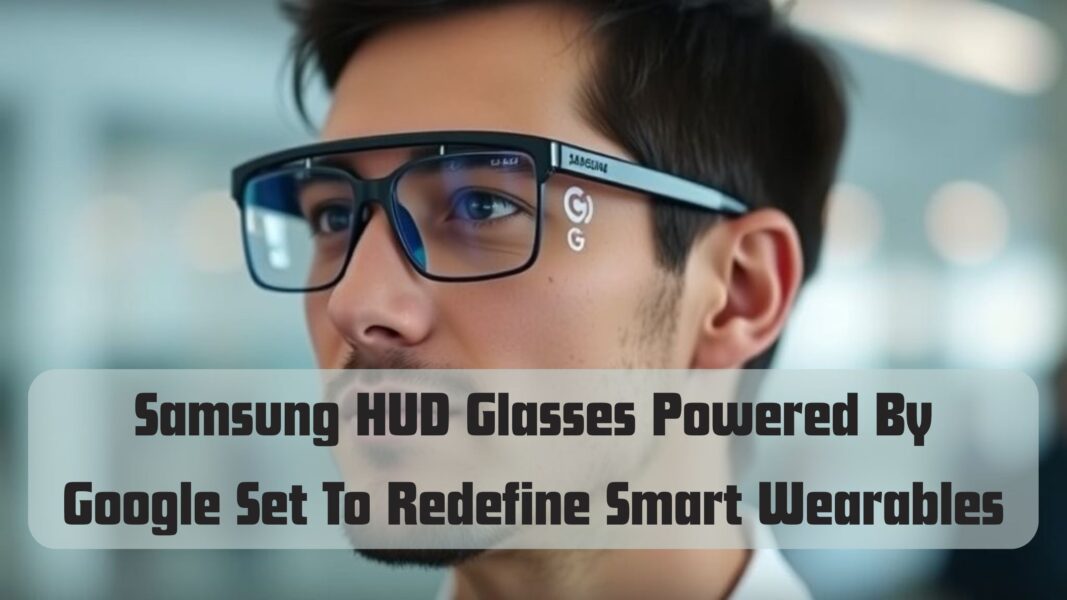
The upcoming Samsung HUD Glasses powered by Google are not just another smart accessory. They are the result of years of collaboration in augmented reality (AR), artificial intelligence (AI), and Android-based XR ecosystems. Designed to merge practicality with futuristic tech, these glasses promise to deliver on-the-go digital overlays, hands-free navigation, and real-world information through an in-lens display — all while staying as light and wearable as everyday eyewear.
This development marks a critical step forward in the evolution of smart wearables, building on earlier prototypes showcased at TED 2025 and Google I/O 2025. Although neither Samsung nor Google has officially confirmed the launch, leaks and industry reports paint a compelling picture of a product poised to reshape how we interact with the digital world.
The Rise of Samsung and Google’s HUD Glasses
In 2025, Google demonstrated a sleek prototype of smart glasses featuring a monocular HUD — a compact display that projects data directly into the wearer’s field of view. This prototype, developed with Samsung, highlighted the potential for consumer-grade AR glasses that could offer real-time notifications, language translation, and AI assistance without relying on bulky headsets.
The reference design drew attention for its minimalist build, resembling a regular pair of glasses rather than a sci-fi gadget. Unlike earlier attempts in the smart eyewear space, such as Google Glass (2013), this new model seemed practical and consumer-ready.
Samsung’s hardware expertise played a major role in this transformation. Known for its displays, chipsets, and manufacturing capabilities, Samsung provides the physical foundation for the glasses. Meanwhile, Google contributes the software intelligence, leveraging its Gemini AI model, Android XR platform, and Google Assistant ecosystem. Together, they aim to produce a wearable that combines style, comfort, and functionality in one seamless experience.
Also Read: Smart Glasses Surge Sparks Tech Giants’ FOMO
How Samsung HUD Glasses Work
At the heart of the new Samsung HUD Glasses lies a monocular heads-up display—a transparent digital overlay projected onto one lens. The technology allows users to access information such as messages, directions, weather updates, or real-time translations without taking out their phone.
The HUD reportedly integrates AI-powered context awareness, adapting what it shows based on location, activity, or voice commands. For example:
- When walking, it can display navigation arrows.
- When receiving calls, it can show the caller ID with gesture-based control to accept or decline.
- When traveling abroad, it can offer instant translation overlays.
Samsung’s microdisplay and optical lens innovations make this possible. The display unit, developed in-house, is ultra-light and energy-efficient. Google’s software ensures smooth synchronization with smartphones, wearables, and cloud services.
This device will also reportedly support Google Gemini Assistant, allowing for natural voice interactions, proactive suggestions, and real-time visual analysis — a key differentiator from Meta’s Ray-Ban Display.
Competing Against Meta’s Ray-Ban Display
Meta’s Ray-Ban Display glasses have established themselves as stylish smart eyewear capable of live streaming, photo capture, and limited visual overlays. However, their lack of a true HUD limits their functionality compared to full AR glasses.
The Samsung-Google collaboration aims to fill that gap. While Meta’s glasses prioritize social connectivity and camera integration, Samsung and Google are focusing on productivity, navigation, and AI integration.
Some industry analysts believe the HUD glasses could serve as a bridge between traditional smart glasses and full-fledged AR headsets, making them more approachable for everyday users. Their sleek design also hints at a product that balances performance with fashion, potentially appealing to professionals, travelers, and tech enthusiasts alike.
The Gemini Smart Glasses Ecosystem
Earlier in 2025, Google confirmed its work with Gentle Monster and Warby Parker to design Gemini smart glasses. These models focus on integrating AI assistance without necessarily including a display. Google also revealed plans to collaborate with Kering Eyewear — parent company of luxury brands like Gucci and Balenciaga — to bring stylish designs to the smart eyewear market.
However, not all models will include a HUD. According to Google, the display will be an “optional component”, meaning that the Gemini lineup could range from audio-only glasses to full-display AR devices. The Samsung HUD Glasses, therefore, appear to be the flagship model of this ecosystem — offering the most advanced display technology and the tightest integration with Android and Gemini AI.
Also Read: Mark Zuckerberg Predicts Smart Glasses to Replace Smartphones Soon
The Samsung Galaxy XR Connection
Samsung’s partnership with Google on HUD glasses is not an isolated project. It’s part of a larger collaboration that includes the Android XR headset, rumored to launch under the Galaxy XR branding.
This headset, designed to compete with Apple Vision Pro and Meta Quest 3S, leverages Google’s Android XR operating system and Samsung’s high-resolution OLED microdisplays. Together, these products could form a complete mixed-reality ecosystem, where the Galaxy XR headset handles immersive content while the HUD glasses provide lightweight, everyday AR functionality.
Industry insiders suggest that Samsung and Google are aligning their product timelines to build a coherent cross-device experience — similar to how Apple integrates Vision Pro, iPhone, and Apple Watch into a single ecosystem.
Design Philosophy — Blending Fashion with Function
One of the most significant challenges in smart eyewear has always been aesthetics. Users want high-tech functionality without compromising on comfort or style. Samsung appears to understand this balance well.
Early design leaks suggest that the HUD Glasses will feature a lightweight titanium frame, interchangeable lenses, and adjustable nose pads for comfort. The display unit is embedded subtly within the lens, maintaining a natural look that blends easily into casual or professional settings.
The glasses are expected to offer both prescription and non-prescription variants, catering to a broader user base. Samsung’s attention to ergonomics could give it an edge over competitors that struggle with bulky or heavy designs.
Core Features and Specifications (Expected)
While official specifications are yet to be confirmed, multiple industry reports and insider leaks hint at several core features of the Samsung HUD Glasses powered by Google:
- Micro OLED Display: Monocular HUD with high brightness and low latency
- Voice Assistant Integration: Powered by Google Gemini AI
- Gesture and Touch Controls: Frame-based controls and minimal physical buttons
- Audio System: Directional speakers for private sound output
- Camera Module: Optional for capturing images or AR recognition
- Battery Life: Targeted 8–10 hours on typical use
- Connectivity: Bluetooth 6, Wi-Fi 7, and Android phone pairing
- Compatibility: Android XR platform and Google Wear OS integration
Also Read: Google Search’s AI Assistant Transformation in 2025: What to Expect
Samsung’s Dual Strategy — With and Without Display
Interestingly, Samsung is reportedly developing two versions of its upcoming smart glasses:
- A premium HUD model with display (powered by Google) — focused on AR overlays and AI assistance.
- A simplified, non-display version — targeting users who prefer lightweight, audio-only experiences similar to the Ray-Ban Meta glasses.
This two-tier strategy allows Samsung to appeal to both tech enthusiasts and mainstream consumers, while differentiating itself from competitors that focus solely on one product type.
Market Impact and Industry Implications
The global AR eyewear market is projected to surpass $20 billion by 2030, driven by innovations in display technology, AI integration, and miniaturization. The collaboration between Samsung and Google positions them as serious contenders against Meta, Apple, and Chinese manufacturers like Nreal (now Xreal).
Experts believe this partnership could reshape how people use wearable tech, shifting the focus from entertainment to productivity, accessibility, and real-time contextual computing.
Furthermore, Samsung’s global manufacturing network and Google’s software dominance could lead to mass-market scalability, a factor that has hindered previous smart glasses from reaching mainstream adoption.
Challenges Ahead
Despite the excitement, several challenges remain:
- Battery Efficiency: Miniaturized electronics struggle to balance performance with battery life.
- Privacy Concerns: The integration of cameras and microphones in eyewear often raises surveillance and data privacy debates.
- Pricing: Advanced optics and miniaturized processors could push the price above $1,000, limiting accessibility.
- Public Acceptance: Consumers may still be hesitant to wear visible tech in public, as seen during the Google Glass era.
Samsung and Google will need to carefully manage these factors to ensure commercial success.
The Road Ahead — Launch and Expectations
According to The Financial News, Samsung and Google could officially unveil the HUD Glasses in late 2026, following the Galaxy XR headset release. The initial rollout may target select global markets such as the U.S., South Korea, and Europe.
If successful, the product could mark the beginning of a new wearable era, where smart glasses evolve from novelty gadgets to everyday essentials — much like how smartphones transitioned from luxury items to necessities.
The companies are expected to highlight cross-device compatibility, AI-driven features, and real-world usability as their primary selling points.
Also Read: Society of Authors Protests Meta Over Alleged AI Training with Pirated Books
Conclusion
The rumored Samsung HUD Glasses powered by Google represent more than just another gadget — they symbolize the convergence of AI, AR, and wearable technology into a seamless, everyday experience.
By combining Samsung’s world-class hardware with Google’s intelligent software, the two companies aim to create smart glasses that are not only functional but genuinely practical for daily use. If the launch unfolds as expected, these glasses could redefine the future of smart wearables, bridging the gap between the digital and physical worlds.
As competition heats up with Meta, Apple, and other tech giants, the Samsung-Google alliance could very well set the next global standard for augmented reality eyewear.
FAQs
1. What are Samsung HUD Glasses powered by Google?
They are upcoming smart glasses featuring a heads-up display and Google’s Gemini AI, designed for AR and hands-free productivity.
2. When will Samsung HUD Glasses launch?
Reports suggest a launch is planned for 2026, following the release of Samsung’s Galaxy XR headset.
3. How do the glasses work?
They project digital information onto a transparent lens using a monocular HUD, controlled via voice and gestures.
4. What makes these glasses different from Meta’s Ray-Ban Display?
Unlike Meta’s model, Samsung’s glasses include an active display and full AI integration powered by Google.
5. Will they support prescription lenses?
Yes, Samsung is expected to offer both prescription and non-prescription options.
6. Which AI assistant powers the glasses?
Google’s Gemini AI powers the HUD Glasses, offering real-time assistance and context-aware features.
7. What is the price range expected for these glasses?
While unconfirmed, industry experts expect pricing between $800 and $1,200.
8. Will the HUD Glasses connect with Android phones?
Yes, the glasses will seamlessly integrate with Android devices and the Galaxy ecosystem.
9. Are there non-display versions planned?
Yes, Samsung is developing a simpler version without a display for more affordable pricing.
10. How do Samsung HUD Glasses impact the future of wearables?
They mark the next phase in wearable evolution, merging AI, AR, and daily convenience into one lightweight device.