
In a major leap forward for mobile connectivity and public safety, T-Mobile has officially rolled out T-911, a groundbreaking feature that allows users to send emergency texts via satellite — completely free of charge.
The announcement marks a turning point in how wireless networks approach emergency communication, ensuring that no matter where you are — deep in the mountains, across open water, or on a deserted highway — you’ll always have a way to reach help.
This feature is available to everyone, regardless of carrier, provided you have a compatible smartphone and a clear line of sight to the sky. It’s part of T-Mobile’s broader T-Satellite program, which launched earlier this year to extend coverage far beyond the reach of traditional cell towers.
—
What Is T-911 and Why It Matters
T-Mobile’s T-911 service is an extension of its T-Satellite system — a $10-per-month add-on that provides satellite-based connectivity for calling, texting, and limited app data.
But while T-Satellite is a paid service, T-911 is completely free. It allows any compatible phone user to send text messages to emergency numbers — even without cell signal, Wi-Fi, or a traditional network connection.
T-Mobile’s official statement reads:
> “T-911 is designed to give every person in the United States access to life-saving emergency communication, even in the most remote or disaster-affected areas. You don’t need to be a T-Mobile customer — you just need a compatible device.”
This feature fulfills a promise T-Mobile made back in June 2025, during its “Trade-offs left the chat” livestream event, where the company pledged to bring satellite-powered 911 access to everyone — for free.
—
How T-911 Works
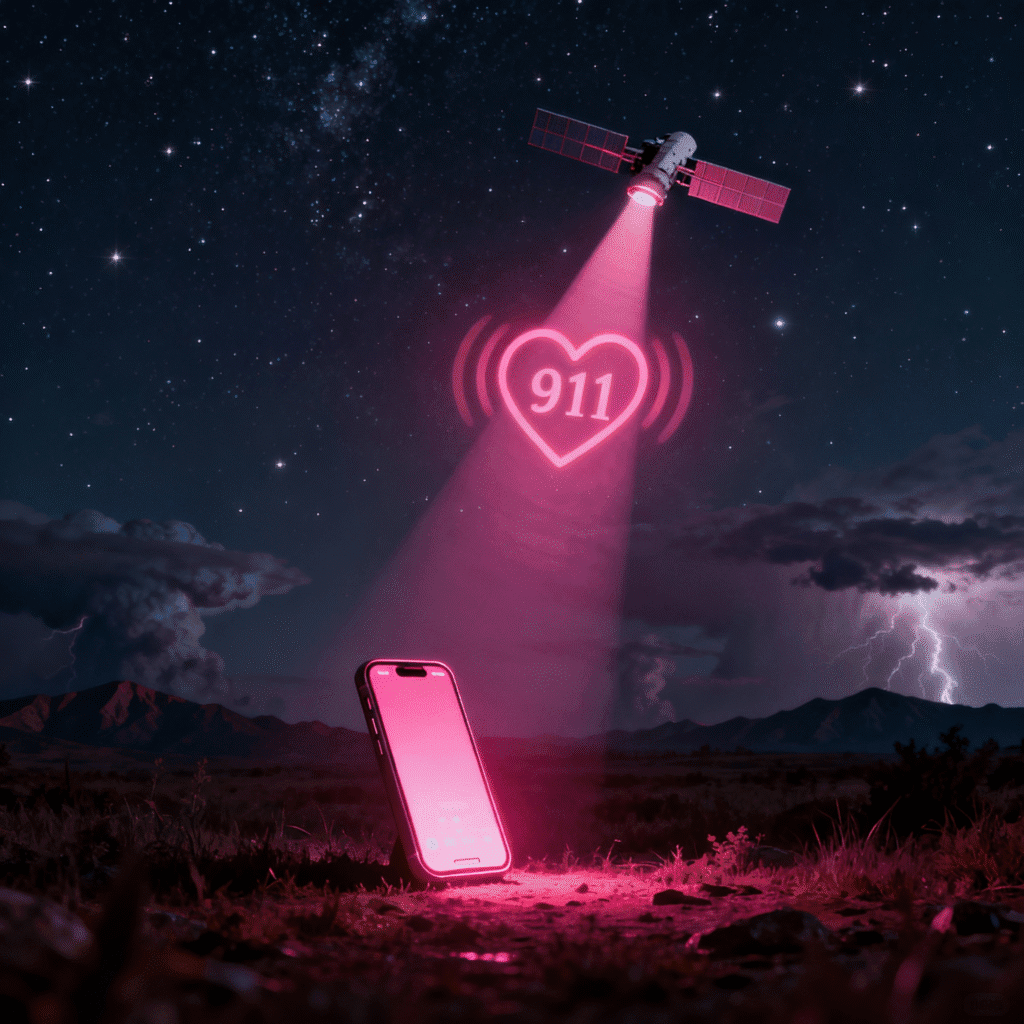
When a user is in an area with no cellular coverage — not even roaming access to other carriers — their phone will automatically attempt to connect to T-Mobile’s satellite gateway.
Through this connection, the device can send text messages directly to 911, 988 (Mental Health Crisis Line), or 838255 (Veteran Crisis Line).
In addition, users can text 611 for T-Mobile customer support, or receive Wireless Emergency Alerts (WEA) such as AMBER alerts and severe weather warnings.
Here’s the best part: You don’t need to do anything special to make it work once enabled. The phone detects when it’s out of range and connects to the satellite automatically.
When connected:
Android devices will show a small satellite icon beside the signal bars.
iPhone 13 and compatible models will display “LTE” or “T-Mobile TXT911” in the status bar.
If you see “T-Mobile TXT911” on your screen, that means your device is linked to the emergency satellite network — and help is just a text away.
—
Who Can Use It — Compatible Devices
T-911 requires a smartphone with satellite messaging capability. However, some phones that already have built-in SOS services (like newer iPhones or Pixel models) won’t need T-911, since those features already offer similar emergency communication.
Compatible phones include:
Most Motorola devices
Samsung Galaxy series (from Galaxy S22 onwards)
T-Mobile’s own Revvl smartphones
Google Pixel 9a
Apple iPhone 13
These devices support T-Mobile’s satellite protocol but don’t already have manufacturer-exclusive SOS systems.
Newer phones like the Pixel 10 or iPhone 15 Pro already have their own emergency satellite systems, so they won’t require T-911.
—
How to Enable T-911 (For T-Mobile Customers)
If you’re already a T-Mobile postpaid customer, enabling T-911 is straightforward and completely free.
Here’s how:
1. Open the T-Life app on your smartphone.
2. Tap “Manage” in the bottom right corner.
3. Select the line (phone number) you want to enable T-911 on.
4. Scroll down to “Manage add-ons and data.”
5. Under “Line-level services,” look for “T-Mobile Text to 911 via satellite.”
6. Check the box beside it.
7. Tap “Submit” and confirm your changes.
That’s it — you’re connected.
If your line already has T-Satellite enabled, you don’t need to do anything — T-911 is automatically included.
—
How to Enable T-911 (For Other Carriers)
Even if you’re not a T-Mobile customer, you can still sign up for free T-911 access using an eSIM.
Simply:
1. Go to T-Mobile’s signup page.
2. Enter your phone number and verify it with a one-time PIN.
3. Provide your IMEI number (to confirm your device’s compatibility).
4. Complete the short form with your date of birth, address, and account PIN.
5. Follow the instructions to install the eSIM profile provided by T-Mobile.
Once installed, your device will automatically connect to T-Mobile’s satellite network whenever you lose all other forms of coverage.
During internal testing, some users reported minor sign-up glitches, but the overall process is expected to be smooth and guided by on-screen prompts.
—
Beyond Emergencies: Mental Health and Crisis Support
T-Mobile didn’t stop at 911. Recognizing that emergencies come in many forms, the company has made 988 and 838255 (Veteran Crisis Line) accessible through T-911 as well.
This means anyone — whether struggling with mental health challenges or a veteran in distress — can reach trained professionals from anywhere, without needing cell service.
This expansion of crisis connectivity is part of T-Mobile’s broader social responsibility strategy, aimed at ensuring safety and emotional support are available universally.
—
Why This Matters for Rural and Disaster Areas
Millions of Americans live in or travel through rural and remote regions where cell coverage is unreliable. From hikers in the Rockies to truckers in the desert, connectivity gaps can turn emergencies deadly.
T-Mobile’s T-911 aims to eliminate those gaps once and for all.
The system uses satellites in low Earth orbit (LEO) to establish a text link with emergency services, even during natural disasters, power outages, or network failures.
When hurricanes, wildfires, or floods knock out traditional infrastructure, T-911 ensures first responders remain reachable — a critical lifeline for affected communities.
—
A Step Toward the Future of Satellite Communication
T-Mobile’s T-911 rollout signals more than just a new feature — it’s a vision of the future, where every phone, on every network, has global emergency access by default.
It also aligns with the space-based connectivity race involving companies like Starlink, AST SpaceMobile, and Apple.
T-Mobile’s partnership with SpaceX (announced in 2023) plays a central role here. Their collaboration aims to use SpaceX’s Starlink V2 satellites to deliver both emergency and non-emergency satellite services directly to mobile devices — without special hardware.
The T-911 service represents the first major consumer benefit of that partnership to reach the public.
—
T-Mobile’s Official Statement
In an official press release, T-Mobile wrote:
> “Our mission is simple — to make sure no one is ever left without a lifeline. Whether you’re a T-Mobile customer or not, T-911 ensures that help is always within reach, even when traditional networks fail.”
The company also hinted that this initiative is just the beginning. T-Mobile plans to expand its satellite data coverage for standard messaging and lightweight app usage later this year — potentially enabling satellite-powered WhatsApp or iMessage communication by 2026.
—
Key Takeaways
Feature Details
Service Name T-911
Provider T-Mobile
Launch Date November 2025
Cost Free for everyone
Coverage Nationwide via satellite (no network required)
Emergency Numbers Supported 911, 988, 838255, 611
Device Requirement Compatible smartphone with satellite capability
Availability All U.S. carriers
—
The Bigger Picture: Connectivity as a Human Right
T-Mobile’s free T-911 program reinforces a powerful message — that communication during emergencies should never depend on affordability or coverage maps.
In a time where climate change, power grid failures, and rural isolation continue to challenge connectivity, initiatives like this redefine what it means to be connected.
From mountaintops to coastlines, T-911 ensures no voice goes unheard when it matters most