

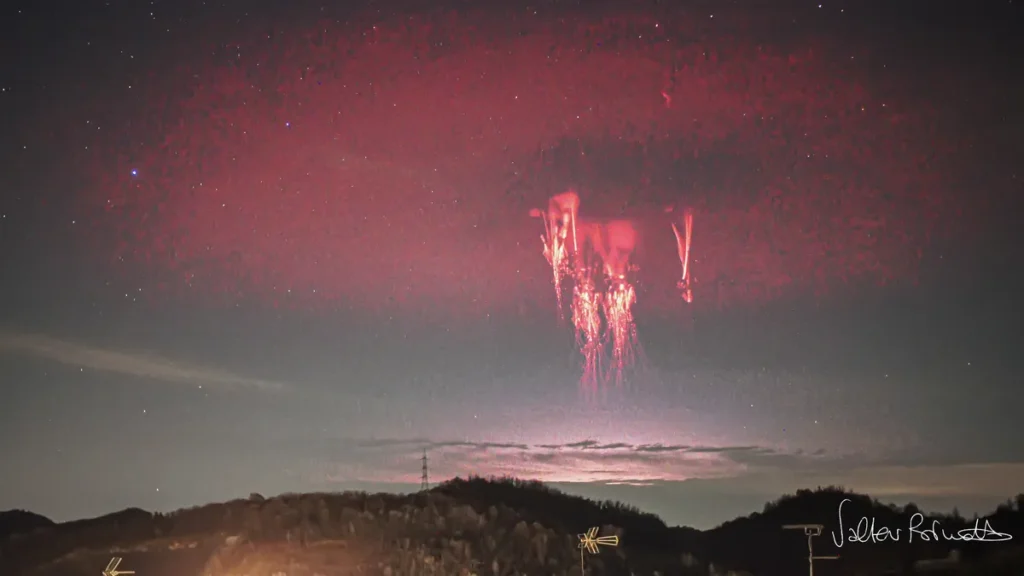
On a quiet November night in northern Italy, the sky revealed a secret that usually unfolds far beyond human perception. For less than a heartbeat, two of Earth’s rarest atmospheric phenomena—an elve and a red sprite—ignited simultaneously above the Alps, forming a luminous event so fleeting and improbable that most scientists only encounter it through satellite data or simulations.
Yet this moment was captured in stunning clarity by Italian photographer Valter Binotto, from his home in Possagno, a small town resting at the foothills of the Alps. The resulting image is not merely a beautiful photograph; it is a scientific anomaly, a technological triumph, and a reminder that Earth’s atmosphere remains one of the least understood layers of our planet.
The photograph marks one of the few documented instances—and possibly the only one to date—where an elve and a sprite appear together in a single frame, offering both scientists and technologists an unprecedented observational opportunity.
Lightning Beyond Lightning: Understanding Transient Luminous Events
When most people imagine lightning, they picture jagged bolts striking the ground or illuminating storm clouds from within. But above these familiar discharges lies a hidden world of electrical activity that occurs far higher in the atmosphere, near the boundary between Earth and space.
These phenomena are known as Transient Luminous Events, or TLEs. They occur in the mesosphere and lower ionosphere, well above the altitude of conventional thunderstorms. Triggered by intense lightning strikes below, TLEs manifest as brief flashes of light in extremely thin air, lasting anywhere from microseconds to milliseconds.
Despite their beauty, TLEs remained largely undocumented until the late 20th century, when low-light cameras and satellite sensors finally confirmed what pilots had occasionally reported for decades.
Elves: The Fastest Lightning Phenomenon on Earth
Among all TLEs, elves are perhaps the most elusive. The name “elve” is an acronym derived from “Emission of Light and Very Low Frequency perturbations due to Electromagnetic Pulse Sources,” a technical description that hints at their extreme speed and origin.
An elve appears as a massive, expanding ring of reddish light, often reaching up to 300 miles (480 kilometers) in diameter. Unlike sprites, which can linger for milliseconds, an elve exists for less than one-thousandth of a second.
They form when a powerful lightning strike generates an electromagnetic pulse that travels upward at near-light speed. When this pulse reaches the ionosphere, it excites nitrogen molecules, causing them to emit a faint red glow before vanishing almost instantly.
Because elves expand outward rather than upward and disappear almost immediately, capturing them requires not only precise timing but also high-speed imaging technology capable of detecting events invisible to the naked eye.
Sprites: The Crimson Jellyfish of the Upper Atmosphere
Sprites, while more commonly observed than elves, remain rare and unpredictable. They typically appear as towering red structures resembling jellyfish, tendrils, or branching trees, extending upward from the tops of thunderstorms.
Sprites form in response to strong positive cloud-to-ground lightning strikes. Unlike elves, which are driven by electromagnetic pulses, sprites result from quasi-electrostatic fields that build up after lightning discharges below.
Their characteristic red color also comes from excited nitrogen molecules, but their shape and duration make them easier—though still extremely difficult—to photograph.
Sprites often last only a few milliseconds and occur at altitudes between 50 and 90 kilometers, well above commercial flight paths but below satellites.
Why Seeing Both Together Is Nearly Impossible
Capturing either an elve or a sprite requires exceptional preparation, technical expertise, and a large measure of luck. Capturing both in the same frame is exponentially more difficult.
The two phenomena are driven by different physical mechanisms, occur at different altitudes, and evolve on different timescales. The conditions required for both to appear simultaneously must align with extraordinary precision: an intense lightning strike, the correct electromagnetic characteristics, minimal atmospheric interference, and the photographer’s camera pointed at exactly the right portion of the sky.
This is why Binotto’s image is being described as a once-in-a-lifetime capture—not only for photographers, but for atmospheric scientists as well.
The Role of Advanced Imaging Technology
This achievement was not accidental. Binotto used a Sony A7S camera paired with a fast 50mm f/1.4 lens, a setup optimized for low-light sensitivity and high frame-rate recording.
Rather than relying on a single still exposure, the image was extracted from high-definition video recorded at 25 frames per second. This approach dramatically increases the probability of capturing ultra-fast phenomena like elves, which are otherwise impossible to photograph using traditional long-exposure astrophotography techniques.
The convergence of consumer-grade imaging technology, improved sensor sensitivity, and real-time video analysis is transforming how rare atmospheric events are documented.
Citizen Science Meets Professional Research
Images like this are more than aesthetic achievements. They contribute to a growing body of citizen science that complements satellite observations and ground-based research.
Projects such as Spritacular encourage photographers around the world to document sprites, elves, and other TLEs. These observations help scientists better understand how thunderstorms interact with the ionosphere, how energy moves through Earth’s atmosphere, and how space weather influences terrestrial systems.
In an era where climate models, satellite networks, and AI-driven simulations dominate atmospheric science, ground-level optical observations remain invaluable.
Why TLEs Matter in the Age of Space Technology
Understanding transient luminous events is no longer a niche scientific curiosity. As humanity becomes increasingly dependent on satellites, GPS systems, and high-altitude communication infrastructure, the behavior of the upper atmosphere has direct technological implications.
Electromagnetic disturbances linked to powerful lightning events can influence radio wave propagation, satellite sensors, and even spacecraft electronics. Studying TLEs helps researchers model these interactions more accurately.
Moreover, TLEs provide a natural laboratory for plasma physics, offering insights relevant to fusion research, space propulsion, and advanced energy systems.
A Photographer Obsessed With the Impossible
This was not Binotto’s first encounter with an elve. The November capture marked the third time he had documented the phenomenon from his home location. But the addition of a sprite elevated the moment into unprecedented territory.
His dedication reflects a broader trend among astrophotographers who are increasingly pushing beyond stars, galaxies, and auroras to explore Earth’s own cosmic interface.
With patience, precision, and perseverance, amateur observers are now contributing to discoveries once reserved for institutional research programs.
The Emotional Impact of Rare Atmospheric Events
Beyond science and technology, images like this resonate on a deeply human level. They remind us that even in an age of constant digital stimulation, nature can still surprise us in ways that feel almost mythological.
Elves and sprites were once dismissed as folklore or pilot hallucinations. Today, they stand as symbols of how much remains hidden in plain sight, waiting for the right combination of curiosity and technology to reveal it.
Inspiring the Next Generation of Skywatchers
As low-light camera technology becomes more accessible, more enthusiasts are turning their lenses skyward. Guides to astrophotography equipment, real-time storm tracking tools, and online communities are lowering the barrier to entry.
While most will never capture an elve-sprite conjunction, the pursuit itself deepens our relationship with the natural world and fosters scientific literacy.
In this sense, Binotto’s photograph is not just a record of a rare event—it is an invitation to look up, observe, and question.
Conclusion: A Glimpse Into Earth’s Electric Soul
The simultaneous appearance of an elve and a red sprite above the Alps represents one of the most extraordinary atmospheric observations ever captured from the ground.
It stands at the intersection of science, technology, and art, demonstrating how modern imaging tools empower individuals to document phenomena occurring at the very edge of space.
As technology continues to sharpen our vision, events once thought invisible are stepping into the light—if only for a fraction of a second.
FAQs
1. What is an elve?
An elve is a fast-expanding ring of red light caused by electromagnetic pulses from lightning.
2. What is a red sprite?
A sprite is a brief, red lightning structure appearing above thunderstorms.
3. How rare are elves and sprites together?
Extremely rare; simultaneous captures are almost unheard of.
4. Where do these phenomena occur?
In the upper atmosphere, near the edge of space.
5. Can the human eye see them?
Usually no; they are too fast and faint.
6. Why are they red?
Excited nitrogen molecules emit red light.
7. Do they affect satellites?
They can influence electromagnetic conditions in the upper atmosphere.
8. What equipment captured this image?
A high-sensitivity camera and fast lens recording video.
9. Are these dangerous?
No, they pose no direct risk to people on the ground.
10. Can amateurs photograph them?
Yes, with proper equipment, timing, and persistence.