

For more than two decades, robot vacuums have promised hands-free cleaning, yet they have remained trapped by a fundamental limitation: flat surfaces. No matter how intelligent their navigation or powerful their suction, most robot vacuums still behave like cautious discs, helpless in front of stairs, thick thresholds, or uneven terrain.
At CES 2026 in Las Vegas, Roborock shattered that limitation.
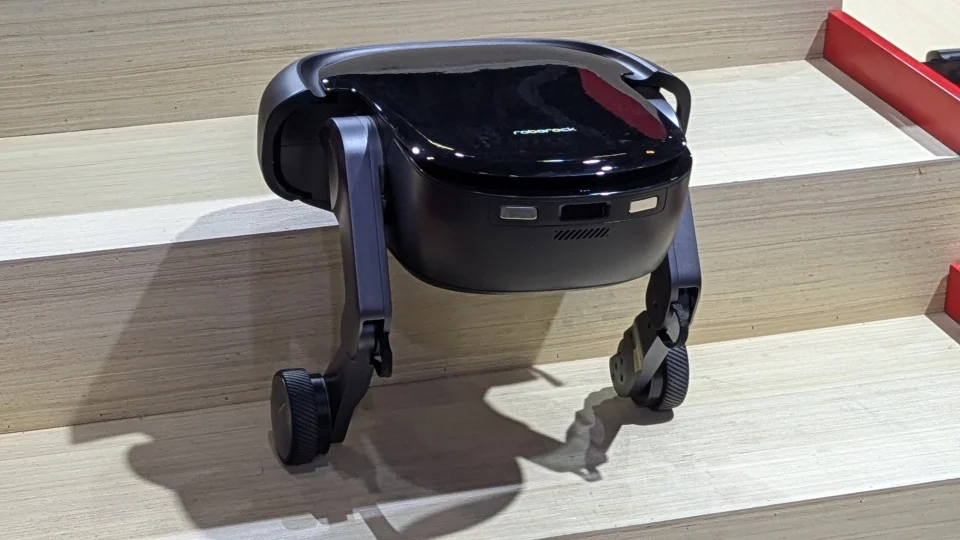
The company unveiled the Saros Rover, a fully functional robot vacuum that doesn’t just roll—it walks. Equipped with leg-like wheel mechanisms inspired by human biomechanics, the Saros Rover climbs stairs while actively cleaning, lifts itself over obstacles, pivots in tight spaces, and even hops small gaps.
This wasn’t a concept video or a glass-box prototype. The Saros Rover was operating live on the CES show floor, cleaning steps in real time, earning it one of the show’s most prestigious smart home awards.
From Wheels to Legs: A Radical Rethink of Robot Mobility
Robot vacuums have evolved dramatically in software over the past decade. LiDAR mapping, AI object recognition, and multi-floor memory have become standard. Hardware mobility, however, remained stagnant.
Roborock’s Saros Rover represents a philosophical shift. Instead of trying to improve wheels, the company replaced them.
Each of the Rover’s four wheel-legs can independently lift, rotate, and bend. This hybrid design allows the robot to retain the efficiency of wheels while gaining the adaptability of legs. The result is a machine that moves less like a puck and more like a small autonomous creature.
This shift immediately expands where a robot vacuum can go—and what it can clean.
Climbing Stairs While Cleaning: A First for Consumer Robotics
The most headline-grabbing feature of the Saros Rover is its ability to climb stairs. Not cautiously, not with assistance—but confidently and autonomously.
As the Rover approaches a staircase, its sensors analyze the height, depth, and angle of each step. The legged wheels then lift the chassis upward, one step at a time, while maintaining suction contact with the surface. Unlike traditional robots that must stop cleaning to reposition, the Saros Rover continues vacuuming as it climbs.
This capability fundamentally alters the definition of “multi-floor cleaning.” Until now, that phrase meant manually carrying a robot upstairs. With the Saros Rover, a single robot can clean an entire home continuously, including staircases that were previously impossible to automate.
Why Stairs Have Always Been the Final Boss of Cleaning Robots
Stairs represent a nightmare scenario for autonomous machines. They combine abrupt elevation changes, narrow surfaces, and the risk of catastrophic falls. As a result, most robot vacuums are trained to avoid stairs entirely.
Roborock didn’t simply solve stair climbing—it reframed the problem.
By distributing weight dynamically and adjusting center-of-gravity in real time, the Saros Rover treats stairs as navigable terrain rather than hazards. Its leg mechanisms ensure constant balance, even on uneven or irregular steps.
This approach mirrors techniques used in advanced research robots—but rarely seen in consumer products.
Obstacle Mastery: Thresholds, Gaps, and Tight Corners
Stair climbing is only one benefit of the Rover’s legged design. The same system allows it to overcome many everyday obstacles that frustrate robot owners.
Door thresholds, raised transitions between rooms, uneven tiles, and cluttered spaces become far less problematic. The Rover can lift itself over obstacles instead of repeatedly bumping into them.
It can also execute tight pivots by adjusting individual legs, enabling smoother navigation in cramped apartments or furniture-dense homes.
Even the robot’s ability to jump—while not essential—demonstrates how much mechanical freedom Roborock has unlocked.
Not a Gimmick: A Fully Functional CES Demonstration
CES audiences have learned to be skeptical of futuristic demos. Many impressive ideas never survive beyond the prototype stage.
The Saros Rover was different.
Roborock showcased a working unit that climbed steps, cleaned surfaces, and navigated obstacles repeatedly throughout the show. There were no wires, no external supports, and no staged resets.
Industry experts in attendance quickly recognized that this wasn’t experimental theater—it was a glimpse into the next generation of home robotics.
Cleaning Performance Still Comes First
While the Rover’s mobility steals the spotlight, Roborock hasn’t neglected its core mission: cleaning.
The Saros Rover builds on Roborock’s existing expertise in suction power, brush design, and debris handling. It maintains consistent suction even while climbing, adjusting motor output dynamically to compensate for gravity and surface changes.
Edge cleaning, dust pickup, and carpet transitions appear comparable to Roborock’s flagship models, ensuring that innovation doesn’t come at the cost of performance.
AI Navigation Meets Mechanical Intelligence
The Rover’s intelligence extends far beyond movement. Advanced AI systems coordinate perception, planning, and action in real time.
Cameras, depth sensors, and LiDAR work together to build a constantly updating 3D map of the environment. When the Rover encounters an unfamiliar structure—such as a staircase or unusual obstacle—it doesn’t rely on preprogrammed paths. Instead, it evaluates multiple movement strategies and selects the safest and most efficient option.
This blend of software intelligence and mechanical adaptability marks a new phase in consumer robotics.
The Broader Roborock Lineup at CES 2026
While the Saros Rover stole headlines, Roborock also introduced several near-term products designed to improve everyday cleaning.
Some upcoming models feature adjustable chassis heights, allowing them to raise themselves when transitioning onto thick carpets. Others improve mopping systems, obstacle detection, and multi-surface adaptability.
Roborock also unveiled robot lawn mowers, including a LiDAR-guided model that navigates outdoor spaces without boundary wires—another sign of the company’s growing robotics ambitions.
Why Legged Robots Are Entering the Home
Legged robots were once confined to research labs and industrial testing grounds. Advances in motors, batteries, sensors, and AI have changed that.
By bringing legged mobility into the home, Roborock is betting that consumers are ready for machines that look and behave differently—so long as they deliver real value.
Stair climbing alone may justify the shift, especially for multi-level homes where robot vacuums have always felt incomplete.
Pricing and Availability: The Big Unknown
Roborock has not yet announced pricing or a release date for the Saros Rover. Given its complexity, it is unlikely to be inexpensive.
However, history suggests that groundbreaking robotics often debut at premium prices before trickling down into mainstream models. Even if the Rover itself remains a flagship product, its technologies may influence more affordable vacuums in the years ahead.
Competitive Pressure on the Entire Industry
The Saros Rover places immediate pressure on competitors. If consumers see stair-climbing as the next logical step in automation, wheel-only designs may soon feel outdated.
Other brands will likely explore hybrid mobility, modular legs, or alternative solutions—but Roborock currently holds a clear first-mover advantage.
A Glimpse Into the Future of Home Robots
The Saros Rover is more than a vacuum cleaner. It represents a shift toward robots that adapt to human spaces instead of forcing humans to adapt to robots.
As mobility improves, future home robots could handle laundry transport, object retrieval, and other tasks that require navigating complex environments.
The Rover doesn’t just clean stairs—it opens doors.
Conclusion: When Cleaning Robots Learn to Walk, Everything Changes
Roborock’s Saros Rover may be remembered as the moment robot vacuums stopped being floor-bound appliances and started becoming true home robots.
By combining legged mobility, advanced AI, and real-world usability, Roborock has challenged long-held assumptions about what consumer robotics can be.
Stairs were the final frontier. Now they’re just another surface to clean.
FAQs
1. What makes the Saros Rover different from other robot vacuums?
It uses leg-like wheels that allow it to climb stairs and obstacles.
2. Can it really clean while climbing stairs?
Yes, it maintains suction and cleaning during ascent.
3. Is the Saros Rover available for purchase?
No pricing or release date has been announced yet.
4. Is this just a prototype?
No, it was fully operational at CES 2026.
5. Does it still use LiDAR navigation?
Yes, combined with cameras and AI planning.
6. Will it replace traditional robot vacuums?
It may redefine expectations for premium models.
7. Is stair climbing safe for the robot?
The legged design dynamically balances weight and grip.
8. Can it handle carpets and hard floors?
Yes, it adapts to multiple surfaces.
9. Will other brands copy this design?
Likely, but Roborock currently leads.
10. What does this mean for home robotics?
It signals a move toward more capable, mobile household robots.