

For years, Keychron has been synonymous with premium mechanical keyboards. The brand earned its reputation by blending enthusiast-grade design with mainstream accessibility, winning over programmers, gamers, writers, and hardware purists alike. At CES 2026, however, Keychron made it clear that it no longer sees itself as just a keyboard company.
Walking into Keychron’s booth this year felt less like visiting a peripheral manufacturer and more like stepping into an experimental lab for next-generation human-computer interaction. While the company did unveil multiple new keyboard lines, the product that immediately commanded attention wasn’t a keyboard at all. It was a small, oddly shaped device that quietly challenged long-standing assumptions about how we interact with computers.
That device was the Keychron Nape Pro Wireless Trackball Mouse, and it set the tone for everything else the company revealed.
The Nape Pro: Rethinking the Mouse From the Ground Up
At first glance, the Nape Pro doesn’t look like a mouse in the traditional sense. It’s compact, minimal, and intentionally ambiguous in shape. Measuring just 35.2 by 34.7 millimeters, it’s closer in size to a macro pad than a pointing device. Yet within this small footprint lies a surprisingly ambitious idea: a single input device that can seamlessly transform based on how you place it on your desk.
The Nape Pro features a 25-millimeter thumb-controlled trackball, six programmable buttons, and a scroll wheel. It connects via Bluetooth, a 2.4 GHz wireless dongle, or USB-C, offering flexibility across desktops, laptops, and mobile setups. Under the hood, it uses a Realtek controller with a 1,000 Hz polling rate and a PixArt PAW3222 sensor, ensuring responsiveness that meets both productivity and light gaming needs.
But hardware specs alone don’t explain why the Nape Pro became one of the most discussed items at Keychron’s booth.
OctaShift: Orientation-Aware Input Is the Real Innovation
The defining feature of the Nape Pro is Keychron’s OctaShift system, an orientation-sensing technology that automatically remaps the device’s buttons depending on how it’s positioned.
Placed horizontally beside a keyboard, the Nape Pro behaves like a laptop trackpad replacement, with its buttons functioning as left and right clicks. Rotate it vertically, and it becomes a standalone trackball with an entirely different control scheme. The M1 and M2 buttons at each end dynamically change roles, allowing the same hardware to act as a precision pointing device, a macro pad, or even a compact command console.
This isn’t just clever engineering—it’s a philosophical statement. Keychron is suggesting that input devices shouldn’t be locked into a single role. Instead, they should adapt to the user’s workflow, posture, and environment.
ZMK Firmware: Customization Without Compromise
Powering the Nape Pro is ZMK, an open-source firmware platform beloved by keyboard enthusiasts for its flexibility and transparency. By using ZMK instead of proprietary firmware, Keychron gives users deep control over layers, shortcuts, macros, and behavior across devices.
This decision aligns perfectly with the Nape Pro’s modular identity. Users can create profiles that transform the device into a video editing tool, a coding companion, or a productivity macro hub—all without switching hardware.
For power users, this level of control turns the Nape Pro from a novelty into a serious productivity instrument.
Ergonomics and Desk Freedom
Trackballs have long been appreciated for their ergonomic benefits, especially in tight desk spaces or mobile setups. By minimizing hand movement, they reduce strain while improving precision.
The Nape Pro takes this further by allowing users to place it wherever it feels most natural—beside the keyboard, in front of it, or even rotated vertically. This flexibility caters to modern hybrid workspaces, where desks are shared, reconfigured, or constrained.
The Q Ultra Series: Wireless Performance Without Sacrifice
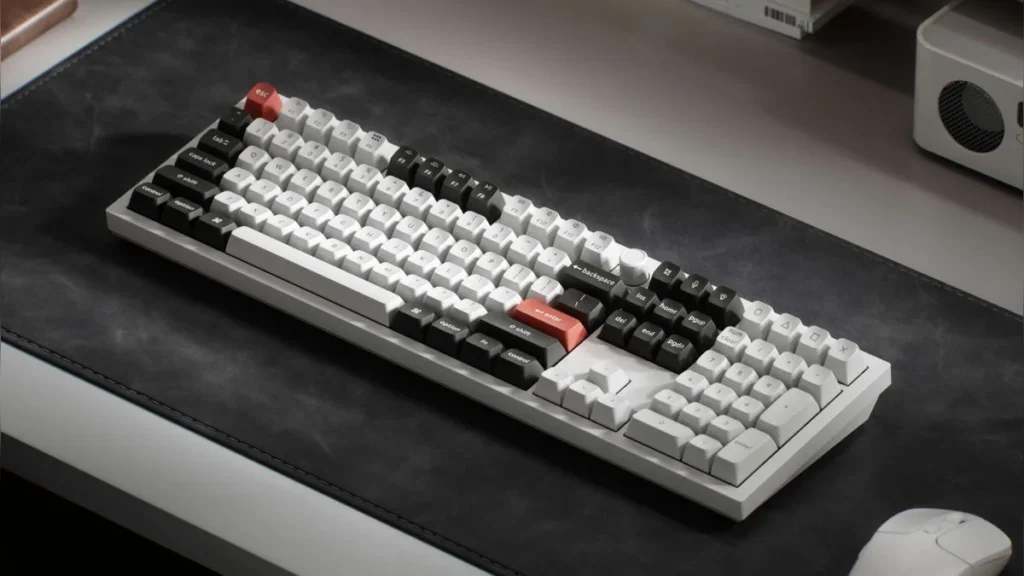
While the Nape Pro introduced a new category, Keychron didn’t neglect its core audience. The company unveiled the Q Ultra Series, a new generation of premium mechanical keyboards that push wireless performance to unprecedented levels.
These keyboards boast up to 660 hours of battery life while supporting an 8K polling rate in wireless mode—a combination that was once considered impossible. Traditionally, high polling rates meant massive power draw, but Keychron’s engineering suggests that wireless no longer has to mean compromise.
The Q Ultra Series features full aluminum cases, a double-gasket mounting system, layered acoustic foams, and new Silk POM switches designed for smoother keystrokes and reduced noise.
Design That Blends Craft and Engineering
Keychron has always paid close attention to build quality, but the Q Ultra Series elevates this focus. The keyboards use KSA double-shot PBT keycaps, decorative rotary knobs, and refined bottom accents that feel intentional rather than ornamental.
Each model—ranging from the full-size Q6 Ultra to the compact Q1 Ultra—maintains a consistent design language while catering to different layout preferences.
The V Ultra Series: Bringing Ultra Features to a Wider Audience
Recognizing that not everyone wants a full aluminum chassis, Keychron also introduced the V Ultra Series, an evolution of its popular V Max lineup.
Launching in late January, the V Ultra models inherit many of the Q Ultra’s technical advances, including ZMK firmware, 8K polling rate, and extended battery life. They also feature improved gasket mounts, redesigned knobs, and upgraded acoustic dampening.
By offering these features in a more affordable package, Keychron reinforces its reputation for balancing enthusiast appeal with mainstream accessibility.
Luxury Keyboards: When Input Devices Become Art
Perhaps the most unexpected reveal at the booth was Keychron’s limited-edition luxury keyboards. The Q1 HE 8K Marble Edition drew crowds not because of its specs—though magnetic Hall Effect switches and 8K polling rate are impressive—but because it’s made from real marble.
Yes, actual stone.
Keychron also previewed resin and concrete editions of the K2 HE, blending industrial materials with cutting-edge keyboard technology. These products blur the line between tool and art object, appealing to collectors and design enthusiasts as much as typists.
Why This Matters: Keychron’s Bigger Vision
Taken together, Keychron’s CES 2026 announcements reveal a company expanding its identity. The Nape Pro isn’t just a mouse. The Ultra keyboards aren’t just faster or longer-lasting.
They represent a broader vision where input devices become adaptive, customizable, and expressive. Whether through orientation-aware controls, open firmware, or unconventional materials, Keychron is pushing beyond incremental upgrades.
Conclusion: A Brand Redefining How We Interact With Computers
CES 2026 may be remembered for flashy displays and AI announcements, but Keychron’s booth told a quieter, more meaningful story. It was about rethinking the everyday tools we touch for hours each day.
With the Nape Pro, Keychron questioned what a mouse can be. With the Ultra series, it challenged the limits of wireless performance. And with its luxury keyboards, it reminded us that even utilitarian objects can be beautiful.
Keychron isn’t just refining peripherals anymore. It’s redesigning the relationship between humans and machines.
FAQs
1. What is the Keychron Nape Pro?
A wireless trackball device with adaptive orientation-based controls.
2. How does OctaShift work?
It detects device orientation and remaps button functions automatically.
3. Is the Nape Pro customizable?
Yes, it runs ZMK open-source firmware.
4. Does it replace a mouse entirely?
It can function as a mouse, macro pad, or hybrid controller.
5. What makes the Q Ultra keyboards special?
They offer 8K polling and extremely long battery life wirelessly.
6. Are the Ultra keyboards wireless?
Yes, they support 2.4 GHz, Bluetooth, and USB.
7. What switches do they use?
New Silk POM mechanical switches.
8. Are luxury keyboards practical?
They combine functionality with premium materials.
9. When will these products launch?
V Ultra arrives late January; luxury editions follow in February–April.
10. Why is this important for users?
It expands how peripherals adapt to workflows.