

For more than a week in January 2026, Iran has existed in what cybersecurity experts describe as a near-total digital blackout. Over 92 million people — an entire nation — have been abruptly disconnected from the global internet, with even basic phone and text services severely disrupted. What began as another temporary shutdown now appears to be evolving into something far more alarming: the possible construction of a permanently isolated national internet.
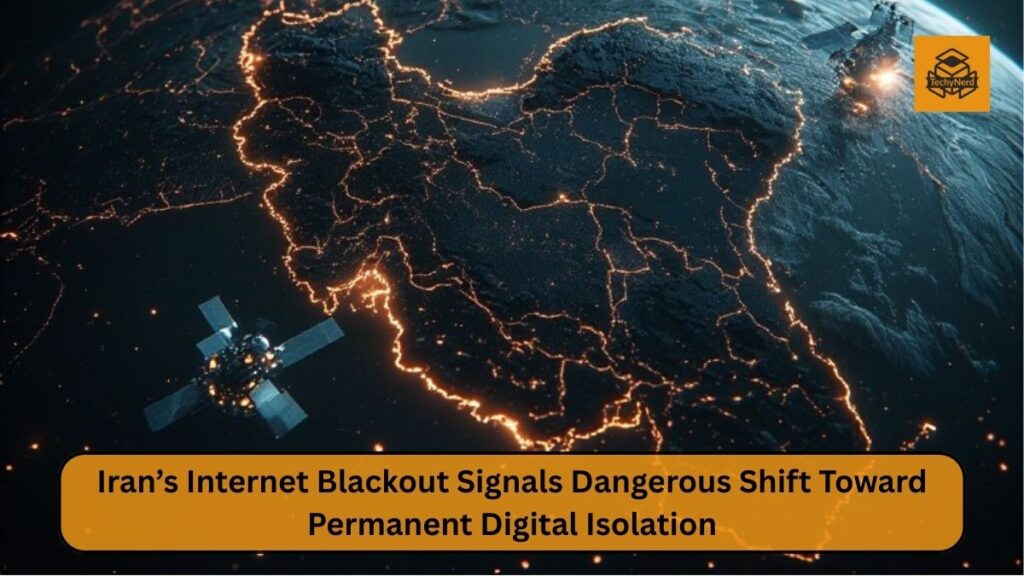
This shutdown is already among the longest and most severe ever recorded. But its duration is not the most troubling aspect. What has alarmed digital rights organizations, network analysts, and geopolitical observers is mounting evidence that Iranian authorities may be using the blackout as cover to fundamentally restructure how — and whether — citizens can access the global web in the future.
If these plans move forward, Iran may soon join a very small group of nations actively attempting to detach their populations from the open internet, replacing it with a tightly monitored, permission-based digital ecosystem.
The Mechanics of the Shutdown: A Nation Severed
The internet disruption began on 8 January, following a renewed wave of protests across Iran. Officially, Iranian authorities framed the shutdown as a response to what they described as externally coordinated “terrorist operations.” Unofficially, the move aligned closely with a pattern long observed by internet freedom groups: cutting connectivity to suppress dissent, obscure state violence, and limit international scrutiny.
Traffic data from global monitoring firm Kentik paints a stark picture. After days of complete darkness, a faint trickle of inbound data began returning on 17 January at approximately 3:42am local time. Yet even now, connectivity remains at roughly 0.2% of pre-shutdown levels — effectively negligible.
For most Iranians, the internet remains inaccessible. Messaging apps are offline, international calls are unreliable, and entire sectors of the economy have ground to a halt.
From Temporary Control to Permanent Disconnection
Iran has a long history of internet censorship. Western platforms such as Facebook, YouTube, and X have been blocked for years, while foreign news outlets — including the BBC — remain inaccessible without circumvention tools.
What makes the current moment different is the apparent shift in ambition.
According to reporting by IranWire and corroborated by multiple journalists speaking to BBC Persian, senior government officials have privately suggested that international internet access will not return until at least late March. Even then, access may never be restored in its previous form.
FilterWatch, a prominent internet monitoring initiative, believes the government is rapidly implementing new infrastructure that would permanently restrict access to the global internet. In this model, connectivity would no longer be assumed but granted selectively — subject to registration, vetting, and approval by security authorities.
Such a system would represent a profound transformation of Iran’s digital landscape.
A Tiered Internet: Surveillance by Design
Cybersecurity experts describe the emerging model as a “tiered internet.” Under such a system, most citizens would be confined to a domestic network — often called a “national intranet” — while only approved institutions, businesses, or individuals would gain access to international websites.
Technically, Iran has been preparing for this for years. Domestic data centers, state-approved platforms, and centralized traffic routing systems already exist. The current blackout may simply be the moment authorities flip the final switches.
Amir Rashidi, director of cybersecurity and digital rights at the Miaan Group, argues that the question is no longer whether Iran can do this — but whether it chooses to. The infrastructure, he says, is already in place.
What follows would be unprecedented levels of surveillance. Every connection, message, search query, and online interaction could be logged, analyzed, and filtered in real time.
Human Cost: Lives, Livelihoods, and Information Silence
The shutdown’s immediate consequences are devastating.
E-commerce platforms have collapsed overnight. Freelancers, online merchants, and remote workers have lost their income. Hospitals and emergency services face communication breakdowns. Families struggle to contact relatives both inside and outside the country.
More troubling is the blackout’s impact on human rights monitoring. According to the Human Rights Activists News Agency, thousands of protesters have reportedly been killed or detained since unrest escalated. However, independent verification is now nearly impossible.
Internet shutdowns, rights groups argue, function as digital smoke screens — allowing abuses to occur without witnesses.
Access Now has warned that restricting internet access does more than silence voices. It removes lifelines, emboldens authoritarian behavior, and erodes accountability mechanisms that rely on global visibility.
Power and Control: Who Decides Iran’s Internet Future?
One of the most significant shifts highlighted by analysts is where decision-making power now resides.
Historically, Iran’s internet policies were shaped by civilian ministries in coordination with regulatory bodies. Today, FilterWatch reports that key decisions are increasingly concentrated within security and intelligence organizations — with minimal transparency or public debate.
This shift mirrors trends seen in other authoritarian systems, where internet governance is treated as a matter of national security rather than civil infrastructure.
The result is an internet shaped less by economic or social needs and more by surveillance priorities.
Lessons from China and Russia
Iran is not inventing this playbook from scratch.
China remains the global benchmark for large-scale internet control. Its “Great Firewall” blocks most foreign platforms while promoting domestic alternatives. Crucially, China built this system gradually, embedding censorship into the internet’s growth from the start.
Russia, by contrast, is attempting to retrofit control onto an already open system. Its “Ru-net” initiative aims to enable a national kill switch — severing international connectivity during crises while keeping domestic services running.
Iran appears to be blending both models: Chinese-style permanent filtering combined with Russian-style emergency isolation capabilities.
Such hybrid systems are complex, expensive, and politically risky — but they offer regimes unprecedented control over information.
The Wild Card: Satellite Internet and Digital Resistance
Despite increasingly sophisticated controls, Iran faces a growing challenge: space-based internet.
Low Earth Orbit (LEO) services like Starlink have already disrupted censorship strategies during previous protests. Unlike terrestrial networks, satellite connections bypass national infrastructure entirely.
Iran has attempted to jam and block satellite terminals, with mixed success. According to confirmed reports, firmware updates by Starlink have enabled some users to remain connected despite interference. Elon Musk’s company has also waived subscription fees for Iranian users, further complicating enforcement.
Beyond satellites, emerging technologies such as Bluetooth-based mesh networks and device-to-device communication apps are enabling limited connectivity even during total shutdowns.
As Prof Alan Woodward of the University of Surrey notes, repression increasingly resembles a game of cat and mouse — where technological innovation continuously undermines absolute control.
Economic and Technical Limits to Isolation
Even with political will, permanent digital isolation carries serious risks for Iran.
Internet service providers face enormous technical strain operating dual networks. Businesses dependent on international trade, banking, and communication suffer long-term damage. Skilled professionals may accelerate emigration, draining technical talent.
Moreover, users adapt. VPN usage surged during previous shutdowns, and alternative platforms continue to emerge. Absolute isolation, experts argue, is nearly impossible without crippling economic consequences.
These pressures may force authorities to apply restrictions unevenly — granting access to select sectors while excluding the general population.
Is Digital Isolation Inevitable?
Despite the bleak outlook, some experts remain cautiously optimistic.
Advances in satellite connectivity, emergency messaging systems, and decentralized networking suggest that universal internet access remains achievable in the long run. Even smartphones now include satellite-based SOS capabilities, ensuring minimal connectivity during outages.
The struggle between repression and access is unlikely to end — but history suggests control rarely remains absolute.
As Prof Woodward observes, authoritarian regimes may slow connectivity, but technological momentum consistently pushes in the opposite direction.
Conclusion: A Defining Moment for Iran’s Digital Future
Iran’s current internet shutdown is no longer just a response to unrest. It is a stress test for a far more ambitious project — one that could redefine the relationship between citizens, technology, and the state.
Whether this moment marks the birth of a permanently isolated digital Iran or a temporary overreach remains uncertain. What is clear is that the stakes are enormous: economic stability, human rights, global integration, and the fundamental freedom to communicate.
The world is watching — even if Iran itself cannot see it.
FAQs
1. Why did Iran shut down the internet?
Officially for security reasons; critics say to suppress protests.
2. How many people are affected?
Approximately 92 million citizens.
3. Is this Iran’s longest shutdown?
Yes, it exceeds previous nationwide blackouts.
4. Will internet access return soon?
Reports suggest not until late March, if at all.
5. What is a tiered internet?
A system where access is granted selectively, not universally.
6. Can VPNs still work?
Most are currently blocked or unreliable.
7. How does Starlink impact censorship?
It bypasses national infrastructure entirely.
8. Is Iran copying China’s model?
Partially, with additional Russian-style controls.
9. What are the economic impacts?
Severe disruption to e-commerce and remote work.
10. Is permanent isolation sustainable?
Experts say it faces major technical and economic limits.