

Amazon has announced a sweeping round of layoffs affecting 16,000 employees, marking the company’s second major workforce reduction in just three months. While layoffs are no longer unusual in the tech sector, this move carries broader implications—signaling a fundamental transformation in how one of the world’s most influential companies is reorganizing itself for an AI-dominated future.
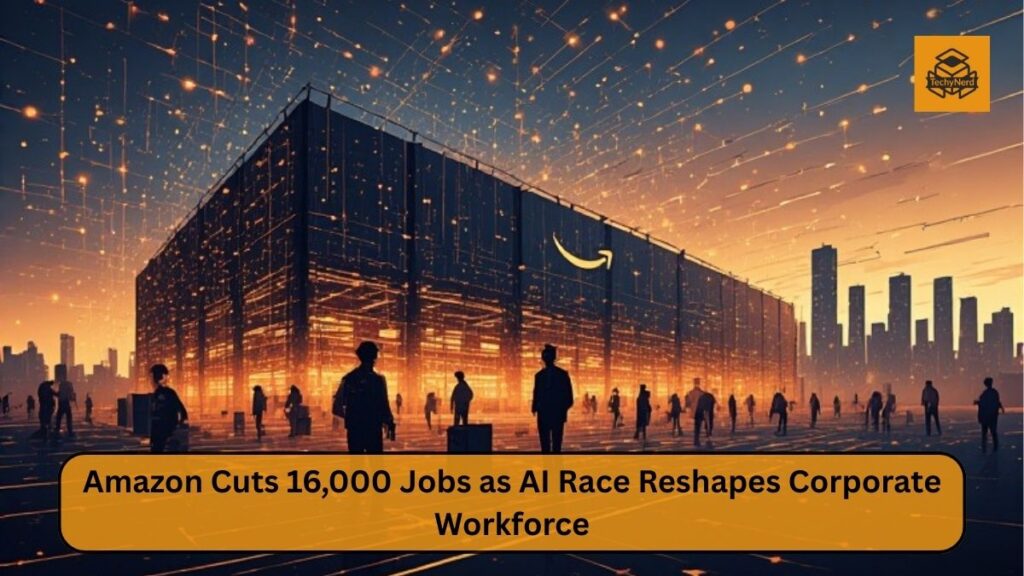
The cuts come amid intensifying competition among technology giants to lead the next era of artificial intelligence. For Amazon, this is not merely about trimming headcount; it is about reengineering the company’s internal structure to operate faster, leaner, and more like a startup—despite its immense global scale.
A Company Under Pressure to Move Faster
In a blog post announcing the layoffs, Amazon framed the decision as part of an ongoing effort to eliminate internal friction. According to Beth Galetti, Amazon’s Senior Vice President of People, the company is focused on reducing layers of management, increasing ownership, and removing bureaucratic bottlenecks that slow innovation.
Amazon’s leadership believes speed is now the defining advantage in the AI era. Decision-making delays, excessive approvals, and overlapping teams are seen as existential risks when competitors are rapidly deploying large language models, custom silicon, and cloud-based AI platforms.
This philosophy echoes CEO Andy Jassy’s repeated insistence that Amazon must operate like “the world’s largest startup”—a company willing to reinvent itself continuously rather than rely on past dominance.
The Scale of the Cuts—and Why They Matter
Amazon is the second-largest private employer in the United States, trailing only Walmart. According to filings with the U.S. Equal Employment Opportunity Commission, the company employed more than 350,000 corporate workers as of 2024.
When combined with the 14,000 corporate layoffs announced in October, the latest reductions bring total job cuts to roughly 30,000 employees, representing nearly 9% of Amazon’s global office workforce. This scale places Amazon among the most aggressive restructurers in Big Tech over the past year.
Unlike earlier rounds of pandemic-era layoffs that focused on cost containment, Amazon insists this wave is primarily about efficiency and organizational design, not short-term financial savings.
AI at the Center of Amazon’s Workforce Strategy
Artificial intelligence is not a side project at Amazon—it is now central to the company’s identity. From AWS Bedrock and custom AI chips to generative AI features embedded across retail, logistics, advertising, and customer service, Amazon sees AI as the engine of its next growth phase.
Jassy has been unusually candid about what this means for jobs. In a message to employees last year, he acknowledged that AI-driven productivity gains would inevitably reduce the need for certain roles while creating demand for others.
As generative AI agents automate tasks such as data analysis, reporting, customer interaction, and internal operations, many traditional white-collar roles are being redefined—or eliminated entirely.
Not Just Layoffs, But a Reallocation of Talent
Despite the headline-grabbing layoffs, Amazon has emphasized that it is not retreating from hiring altogether. Instead, the company is reallocating talent toward business units it views as critical to long-term competitiveness.
These include:
- Artificial intelligence and machine learning
- Cloud infrastructure and AI-optimized data centers
- Semiconductor design
- Advanced logistics and robotics
- Advertising technology
- Enterprise AI tools for AWS customers
Galetti stressed that Amazon will continue to hire “strategically,” even as it reduces headcount elsewhere—a pattern increasingly common across the tech industry.
Employee Transition Plans and Internal Mobility
Layoffs will begin immediately across multiple divisions. Most affected employees will be given 90 days to seek internal roles within Amazon, a policy designed to retain institutional knowledge and reduce abrupt exits.
Employees who do not secure new positions will receive severance packages and extended benefits, though details vary by region and role.
Interestingly, reports suggest the internal memo announcing the layoffs was sent prematurely, referencing a blog post that had not yet gone live—an ironic reminder that even tech giants struggle with internal coordination during rapid change.
Retail Strategy Shift: Grocery Retreat Signals Focus
Alongside the layoffs, Amazon confirmed it will close its Amazon Fresh and Amazon Go grocery formats, consolidating its physical retail ambitions around the Whole Foods brand.
This move reflects Amazon’s growing preference for focusing resources on businesses with strong margins, clear differentiation, and AI-driven scalability. Experimental retail concepts that fail to meet these criteria are increasingly viewed as distractions rather than innovation engines.
The Broader AI Arms Race in Big Tech
Amazon’s restructuring cannot be viewed in isolation. The company is locked in an intense AI competition with Microsoft, Google, Meta, OpenAI, and emerging challengers.
Each of these players is investing tens of billions of dollars annually in:
- Data centers
- AI accelerators
- Foundation models
- Developer ecosystems
These investments are enormously expensive, forcing companies to make hard trade-offs elsewhere—including workforce size.
Are AI Layoffs the New Normal?
Despite widespread anxiety, research suggests the AI job apocalypse may be overstated—for now. A recent Vanguard report found that roles highly exposed to AI automation are actually growing faster than before the pandemic.
However, the nature of work is undeniably shifting. Entry-level and process-driven roles are increasingly vulnerable, while demand is rising for:
- AI engineers
- Product managers
- Data scientists
- Systems architects
- Human-AI interaction designers
Amazon’s layoffs reflect this rebalancing rather than wholesale contraction.
What Amazon’s Decision Signals to the Industry
Amazon’s latest move sends a clear message to the tech sector: organizational speed now matters as much as innovation itself.
In an era where AI capabilities evolve monthly rather than yearly, companies burdened by internal complexity risk falling behind—even if they possess world-class technology.
For workers, the message is equally stark. Adaptability, continuous learning, and AI fluency are no longer optional—they are prerequisites for long-term career resilience.
Conclusion: A Workforce Rewritten by Artificial Intelligence
Amazon’s decision to lay off 16,000 employees is not just another chapter in the tech layoff cycle. It is a reflection of a deeper transformation underway across the global economy.
As AI reshapes how value is created, companies are being forced to rethink not only what they build, but how they organize the people who build it. Amazon’s bet is that fewer layers, faster decisions, and AI-driven productivity will keep it competitive in an increasingly unforgiving market.
Whether that strategy succeeds will depend not just on technology—but on how well companies manage the human cost of rapid change.
FAQs
1. Why is Amazon laying off 16,000 employees?
To reduce bureaucracy and improve speed as it competes in AI-driven markets.
2. Is this Amazon’s second layoff round recently?
Yes, it follows 14,000 corporate layoffs announced in October.
3. How many corporate employees does Amazon have?
Over 350,000 globally, based on 2024 filings.
4. Are these layoffs due to financial trouble?
Amazon says the cuts are about efficiency, not cost savings.
5. What role does AI play in these layoffs?
AI automation is reducing the need for some roles while creating new ones.
6. Will Amazon continue hiring?
Yes, selectively in areas critical to its future.
7. Are warehouse jobs affected?
The cuts primarily target corporate and office roles.
8. What happens to laid-off employees?
They get 90 days to find internal roles or receive severance.
9. Is AI causing mass unemployment?
Not yet, according to recent labor market studies.
10. What does this mean for tech workers?
AI skills and adaptability are becoming essential for career security.