

In an era dominated by cloud computing, AI workloads, video streaming, and real-time digital services, the physical foundations of the internet matter more than ever. While consumers experience connectivity through smartphones and laptops, the true backbone of the global digital economy lies beneath oceans and seas—subsea fiber-optic cables.
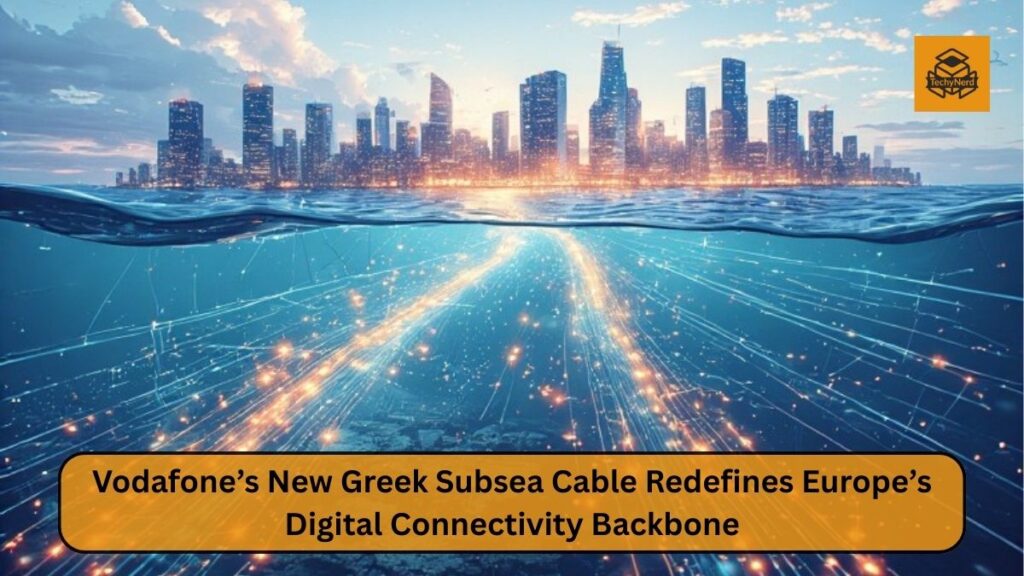
Vodafone’s announcement to construct a new high-capacity subsea cable system in Greece, named Thetis Express, represents a strategically significant move not only for the country’s digital economy but also for Europe’s broader role in global connectivity. This project signals how telecom operators are increasingly investing in infrastructure resilience, geographic diversification, and long-term data capacity to meet the demands of a hyper-connected world.
Why Greece Matters in the Global Connectivity Map
Historically, Greece has been positioned at the crossroads of Europe, Asia, and Africa. In the digital age, this geographic advantage is becoming increasingly valuable. Subsea cables passing through Greek waters offer shorter, faster, and more resilient routes for international data traffic connecting Western Europe to emerging markets in Southeast Asia, the Middle East, and Africa.
Vodafone’s investment reinforces Greece’s transformation from a regional telecom market into a strategic international connectivity hub. By linking Crete with mainland Greece and integrating with existing and future cable systems, the country becomes a vital node in Europe’s digital corridor.
Inside the Thetis Express Subsea Cable System
The Thetis Express is not a symbolic upgrade—it is a technically ambitious infrastructure project designed to meet modern and future data requirements.
Spanning approximately 340 kilometers, the system includes two marine cable segments measuring 129 and 163 kilometers, complemented by terrestrial fiber connections across Milos, Crete, and the Attica region. Once operational, it will connect carrier-neutral data centers in Heraklion and Athens, ensuring open access for multiple service providers.
With a transmission capacity of up to 180 terabits per second, the cable can support the equivalent of 25 million users streaming 4K video simultaneously. This level of capacity is critical for next-generation applications such as AI inference at scale, immersive media, remote healthcare diagnostics, and enterprise cloud workloads.
Resilience, Redundancy, and Reliability: The New Connectivity Standard
Modern internet infrastructure must be designed not just for speed, but for resilience. Cable cuts, power failures, and geopolitical disruptions have repeatedly exposed vulnerabilities in global networks.
The Thetis Express addresses these concerns by enabling rapid traffic rerouting, allowing wholesale and retail customers to switch data paths seamlessly in case of outages. This redundancy significantly reduces downtime for critical services such as online banking, government platforms, healthcare systems, and enterprise communications.
By integrating subsea and terrestrial routes, Vodafone enhances Greece’s network reliability at both local and international levels—an increasingly important factor as digital services become essential infrastructure.
Wholesale Connectivity and the Carrier Services Advantage
Vodafone’s Carrier Services unit plays a central role in global internet traffic flow, providing wholesale connectivity to telecom operators, hyperscalers, and internet service providers worldwide.
The Thetis Express strengthens this portfolio by offering:
- Greater international bandwidth availability
- Improved route diversity across Southern Europe
- Lower latency paths for cross-continental traffic
- Enhanced resilience for third-party networks
For ISPs and cloud providers, this translates into better service quality, improved uptime, and more competitive offerings for end users.
Economic Impact: Fueling Greece’s Digital Economy
Beyond technical performance, the project carries meaningful economic implications. High-capacity connectivity is a proven catalyst for:
- Foreign direct investment
- Data center expansion
- Tech startup ecosystems
- Remote work opportunities
- Digital public services
By improving access to ultra-fast and resilient internet, Vodafone’s infrastructure investment supports sectors such as fintech, e-health, online education, and digital tourism. The project also creates construction, engineering, and maintenance jobs while attracting long-term digital investment into Greece.
Integration with the 2Africa Cable Network
One of the most strategically important aspects of the Thetis Express is its planned linkage to the 2Africa subsea cable system, one of the largest cable projects ever undertaken.
The 2Africa network will ultimately connect 33 countries across Africa, Europe, and Asia, dramatically expanding global data routes. By connecting through Vodafone’s Crete landing station, Thetis Express becomes part of a massive international connectivity ecosystem, strengthening Europe-Africa-Asia digital flows.
This integration enhances route diversity while reducing dependency on congested or geopolitically sensitive paths.
Vodafone’s Long-Term Vision: Beyond Fiber
Vodafone has made it clear that subsea and terrestrial fiber investments are part of a broader connectivity strategy. The company is also exploring emerging satellite technologies, including space-based direct-to-device broadband, to complement traditional infrastructure.
This multi-layered approach—combining fiber, subsea cables, and satellite services—positions Vodafone to meet future connectivity challenges in an increasingly complex digital landscape.
Why Subsea Infrastructure Is More Important Than Ever
As AI models grow larger, cloud services expand globally, and real-time applications become mainstream, data traffic is exploding. Subsea cables carry over 95% of global internet traffic, making them critical geopolitical and economic assets.
Investments like Thetis Express reflect a broader industry trend: telecom operators are prioritizing control over infrastructure to ensure performance, security, and independence in a competitive and uncertain world.
Conclusion: A Strategic Cable with Global Implications
Vodafone’s Thetis Express is more than a connectivity upgrade—it is a strategic infrastructure investment that strengthens Greece’s role in global data flows, enhances Europe’s digital resilience, and supports the next phase of internet growth.
As digital services become the foundation of modern economies, projects like this will quietly but profoundly shape how data moves, businesses operate, and societies connect.
FAQs
1. What is the Thetis Express subsea cable?
It is a new high-capacity fiber-optic cable linking Crete with mainland Greece.
2. How long is the Thetis Express cable?
Approximately 340 kilometers, including marine and terrestrial segments.
3. What is the cable’s maximum capacity?
Up to 180 terabits per second.
4. Why is Greece important for subsea connectivity?
Its geographic position connects Europe with Africa and Asia efficiently.
5. Who will benefit from this cable?
Consumers, businesses, ISPs, cloud providers, and public services.
6. Will this improve internet reliability?
Yes, it enables faster traffic rerouting during outages.
7. How does this connect to 2Africa?
The cable will link to the 2Africa network via Crete.
8. Is this only for Vodafone customers?
No, it offers wholesale access to third-party providers.
9. When will it become operational?
After construction and testing phases are completed.
10. Does this support future technologies?
Yes, it’s designed for AI, cloud computing, and high-bandwidth applications.