

Tesla has long been synonymous with electric vehicles, disruptive automotive design, and Elon Musk’s vision of a sustainable future. But 2026 marks a clear inflection point in the company’s trajectory. For the first time in its history, Tesla has reported an annual revenue decline, alongside a dramatic drop in quarterly profits. At the same time, the company has announced the discontinuation of two of its most iconic vehicles—the Model S and Model X.
This is not merely a product reshuffle. It is a strategic realignment that signals Tesla’s evolution from an electric car manufacturer into a company increasingly centered on artificial intelligence, robotics, and autonomous systems. The transformation reflects changing market dynamics, intensifying global competition, and Musk’s long-standing ambition to position Tesla as a leader in general-purpose AI.
Financial Reality: Revenue Declines and Profit Compression
Tesla reported a 3% decline in total revenue in 2025, marking the first annual drop in the company’s history. More concerning for investors was the 61% fall in profits in the final quarter of the year, highlighting mounting pressure on margins.
Several factors contributed to this downturn. Global EV demand growth has slowed, pricing competition has intensified—particularly from Chinese manufacturers—and government subsidies supporting non-fossil fuel vehicles are being rolled back in key markets like the United States.
While Tesla remains a massive company by market capitalization, its financial results suggest the era of effortless growth in EVs is over. This economic reality appears to have accelerated Tesla’s pivot toward businesses it believes will define the next technological decade.
Ending an Era: The Model S and Model X Exit
The decision to discontinue the Model S and Model X carries symbolic and practical weight. These vehicles were foundational to Tesla’s rise, demonstrating that electric cars could be fast, luxurious, and technologically advanced.
However, in recent years, both models became low-volume offerings. According to industry analysts, they increasingly struggled to justify ongoing production amid Tesla’s focus on mass-market vehicles like the Model 3 and Model Y.
By shutting down their production, Tesla is freeing up manufacturing capacity in California—capacity that will now be repurposed for a radically different product line: humanoid robots.
Optimus Takes Center Stage: Tesla’s Bet on Humanoid Robots
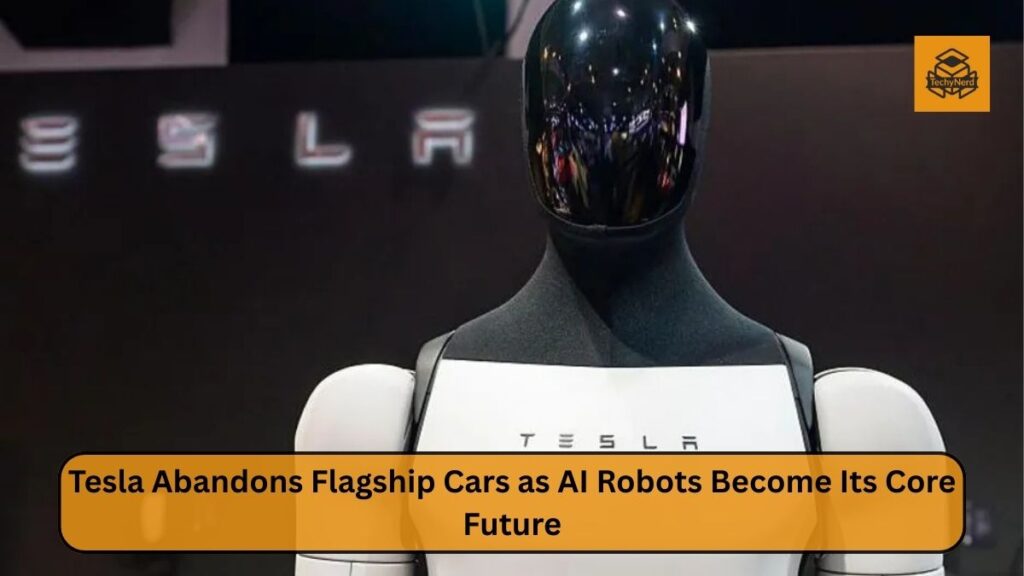
The vacated factory space will be used to manufacture Optimus, Tesla’s general-purpose humanoid robot. Once viewed as a speculative side project, Optimus is now moving into Tesla’s strategic core.
Musk has repeatedly described Optimus as potentially more valuable than Tesla’s car business. The robot is designed to perform repetitive, dangerous, or labor-intensive tasks across factories, warehouses, and eventually households.
Tesla’s advantage, according to Musk, lies in its AI stack—particularly its expertise in vision systems, neural networks, and real-world data gathered from millions of vehicles. These same systems, Tesla argues, can be adapted to robotic intelligence at scale.
Artificial Intelligence Over Automobiles
Tesla’s shift reflects a broader trend in the tech industry: AI is no longer a feature—it is the product.
The company disclosed a $2 billion investment in xAI, Musk’s artificial intelligence venture. While controversial among shareholders, the move tightens the relationship between Tesla’s hardware, data pipelines, and emerging AI models.
Musk has framed this investment as a response to shareholder demand, despite a prior vote showing more opposition than support. Regardless of governance debates, the move signals Tesla’s intent to remain deeply intertwined with frontier AI development.
Shareholder Tensions and Governance Questions
Tesla’s strategic redirection has not been universally welcomed. The decision to invest in xAI came despite shareholder skepticism, raising concerns about conflicts of interest and capital allocation discipline.
At the same time, shareholders previously approved a record-breaking compensation package for Musk, potentially worth nearly $1 trillion, contingent on Tesla dramatically increasing its valuation over the next decade.
This places immense pressure on Tesla to deliver exponential growth—not incremental automotive gains, but transformational breakthroughs. Robotics, AI, and autonomy represent Musk’s answer to that challenge.
Rising Competition and BYD’s Global Ascendancy
Tesla’s pivot also comes as competitive pressure intensifies. In January, BYD overtook Tesla as the world’s largest EV maker, underscoring the rapid rise of Chinese automakers.
BYD benefits from vertical integration, government support, and aggressive pricing strategies—advantages Tesla struggles to match globally. As EVs become more commoditized, Tesla’s differentiation increasingly relies on software, autonomy, and AI-driven services.
Robotaxis and the Autonomous Future
Beyond Optimus, Tesla continues to push aggressively into robotaxis, betting that full self-driving systems will unlock entirely new revenue streams.
The vision is ambitious: fleets of autonomous Teslas operating as on-demand transport networks, generating recurring income with minimal human involvement. While regulatory and technical hurdles remain substantial, Tesla’s investment patterns suggest it sees autonomy as inseparable from its AI-first future.
Politics, Public Perception, and Brand Risk
Elon Musk’s growing involvement in global politics has also had tangible consequences. His role in the administration of U.S. President Donald Trump and his outspoken political positions have alienated portions of Tesla’s traditionally progressive customer base.
Protests at Tesla dealerships and declining brand favorability in some regions highlight the reputational risks of Musk’s public persona. In an increasingly competitive EV market, brand loyalty is no longer guaranteed.
Capital Expenditure Surge: Betting Big on the Future
Tesla expects to increase capital spending by up to $20 billion, primarily directed toward AI infrastructure, robotics production, and compute capacity.
Musk has described the upcoming investment cycle as laying the foundation for an “epic future.” Whether that future materializes depends on Tesla’s ability to turn experimental technologies into scalable, profitable businesses.
Expert Perspective: A Logical but Risky Transition
Industry analysts largely agree that dropping the Model S and X makes sense from a portfolio perspective. These vehicles no longer aligned with Tesla’s volume-driven strategy.
However, replacing a proven—if maturing—business with speculative AI and robotics ventures significantly raises execution risk. Unlike EVs, humanoid robots and full autonomy lack established consumer markets at scale.
Tesla is betting that being early, vertically integrated, and data-rich will allow it to define these markets rather than chase them.
Conclusion: Reinventing Tesla for a Post-EV Decade
Tesla’s decision to cut flagship car models and double down on AI and robotics marks one of the most dramatic strategic pivots in modern tech history.
The company is no longer content to lead the electric vehicle revolution alone. Instead, it aims to shape the future of intelligent machines, autonomous mobility, and general-purpose robotics.
Whether this bold reinvention secures Tesla’s dominance—or stretches it too far—will define not just the company’s next decade, but potentially the direction of the broader technology industry.
FAQs
1. Why did Tesla discontinue the Model S and Model X?
They were low-volume models with declining strategic importance.
2. Where will Tesla build its humanoid robots?
At the California plant previously used for Model S and X production.
3. What is Optimus?
Tesla’s general-purpose humanoid robot designed for physical tasks.
4. Why did Tesla’s revenue fall?
Slowing EV demand, competition, and pricing pressure.
5. What role does xAI play in Tesla’s strategy?
It strengthens Tesla’s AI capabilities and long-term vision.
6. How much is Tesla investing in AI and robotics?
Up to $20 billion in capital expenditure.
7. Did shareholders approve the xAI investment?
More opposed or abstained than approved in a prior vote.
8. How does BYD affect Tesla?
BYD overtook Tesla as the world’s largest EV maker.
9. Is Tesla abandoning EVs entirely?
No, but EVs are no longer its sole strategic focus.
10. What is Tesla’s biggest risk now?
Turning unproven AI and robotics projects into profitable products.