

Samsung has quietly delivered one of the most meaningful display innovations of the decade, and it has nothing to do with foldable phones or ultra-bright OLED panels. Instead, the company’s newly announced 13-inch Samsung Color E-Paper represents a shift in how technology companies approach sustainability, energy efficiency, and real-world utility. While it may not be designed for consumers browsing novels on a couch, it signals something far more important: a future where digital displays consume almost no power and significantly reduce environmental impact.
At a time when global tech giants are under growing pressure to rethink materials, power usage, and product lifecycles, Samsung’s Color E-Paper emerges as a proof-of-concept that eco-conscious hardware does not need to compromise usability or visual quality. This device isn’t flashy in the traditional sense, but it quietly challenges long-standing assumptions about how digital signage, e-readers, and information displays should work.
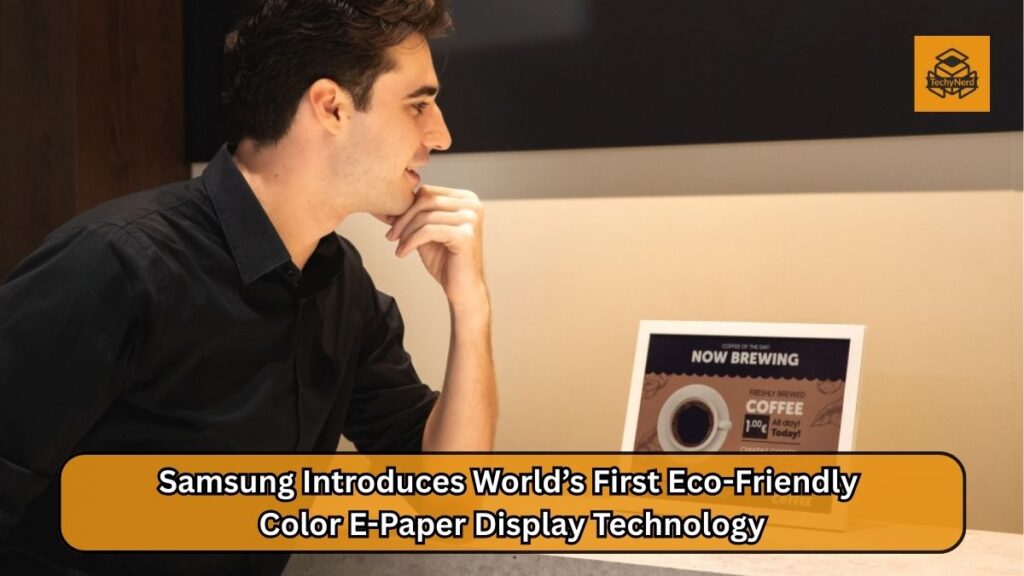
Understanding the Concept of Color E-Paper
Electronic paper, often called e-paper or e-ink, has existed for years, primarily in monochrome form. Traditional e-paper displays mimic the reflective qualities of ink on paper, making them extremely readable under bright light while consuming minimal energy. However, color e-paper has historically faced limitations such as muted hues, slower refresh rates, and reduced contrast.
Samsung’s Color E-Paper aims to move past these limitations by combining advanced color imaging algorithms with a refined display structure that enhances clarity and readability. The result is a screen that feels remarkably close to printed paper, but with the flexibility and control of digital content.
Unlike LCD or OLED panels, which constantly consume power to maintain an image, Samsung’s Color E-Paper requires zero power when displaying static content. Energy is only used when the display refreshes, making it ideal for use cases where information changes occasionally rather than continuously.
The World’s First Bio-Resin Display Housing
What truly sets this device apart is not just the screen itself, but the material surrounding it. Samsung has introduced the world’s first display housing partially made from bio-resin derived from phytoplankton. Phytoplankton are microscopic algae found in aquatic environments and are increasingly being explored as a renewable resource in material science.
While Samsung has not publicly detailed the exact chemical process used to convert phytoplankton into usable bio-resin, the broader implication is clear: petroleum-based plastics are no longer the only viable option for consumer electronics manufacturing.
The housing of the Color E-Paper consists of approximately 10% bio-resin and 45% recycled plastic, striking a balance between innovation, durability, and scalability. Though not entirely bio-based, this hybrid approach allows Samsung to reduce dependence on virgin plastics while maintaining structural integrity.
How This Compares to Other Industry Efforts
Samsung’s move becomes even more significant when placed in an industry-wide context. Amazon, for example, has steadily increased recycled plastic usage across its product lineup, including Kindle devices, reaching around 58% recycled plastic by late 2024. Apple has also experimented with bio-based materials, using 32% bio-based plastic in certain components as far back as 2018.
However, Samsung’s approach stands out because it applies bio-resin directly to a display housing, one of the most visible and structurally critical components of a device. This sets a precedent that other manufacturers may soon follow, particularly in categories like signage, tablets, and large-format readers.
Energy Efficiency That Redefines Digital Signage
Perhaps the most disruptive aspect of Samsung’s Color E-Paper is its power consumption profile. Traditional digital signage relies on LCD panels that must remain powered continuously, even when displaying static content such as menus or informational posters.
Samsung’s Color E-Paper eliminates this inefficiency entirely. Once an image is loaded, the screen draws no power at all. For businesses operating dozens or even hundreds of displays, this translates into substantial long-term energy savings.
Restaurants, retail stores, hotels, and corporate offices can now replace printed paper signage or power-hungry digital screens with a solution that combines the best of both worlds. The display offers digital flexibility without recurring energy costs.
Design, Size, and Physical Specifications
The 13-inch Color E-Paper display is approximately the size of an A4 sheet of paper, making it suitable for placement on tables, doors, counters, and walls. With a resolution of 1,600 × 1,200 pixels and a 4:3 aspect ratio, the display is optimized for text-heavy layouts and detailed visuals.
At 0.9 kilograms in weight and a 17.9 mm thickness, the device is thin enough to feel unobtrusive yet sturdy enough for commercial environments. Its paper-thin aesthetic reinforces the illusion that users are looking at printed material rather than a digital screen.
The built-in battery can be recharged via USB-C, allowing for completely wire-free operation. This makes installation far simpler than traditional signage systems that require permanent power connections.
How Content Is Managed and Updated
Unlike consumer tablets or e-readers, Samsung’s Color E-Paper does not run a conventional operating system. There are no downloadable apps, app stores, or user interfaces designed for personal use.
Instead, the device is managed remotely via Android or iOS devices, as well as enterprise-level content management systems. Businesses can update menus, pricing, schedules, or promotional materials without physically interacting with the display.
This remote control model makes the device particularly appealing for franchises and multi-location businesses, where consistent branding and synchronized updates are critical.
Why This Is Not a Kindle Replacement
Despite its color e-paper technology, Samsung’s new device is not intended to compete with consumer e-readers like Amazon’s Kindle lineup. It lacks app support, note-taking features, and user-centric software.
Devices such as the Kindle Scribe Color or large-format e-ink tablets from TCL are designed for reading, writing, and personal productivity. Samsung’s Color E-Paper is purpose-built for signage and information display, prioritizing efficiency and longevity over interactivity.
That said, the technology powering this display could eventually influence future consumer products, particularly if Samsung decides to enter the large-format e-reader market.
The Environmental Impact Beyond Materials
Samsung’s sustainability efforts extend beyond the display housing. The Color E-Paper ships in fully paper-based packaging, eliminating plastic entirely from the unboxing experience.
Additionally, the device’s ultra-low energy requirements significantly reduce its carbon footprint over time. When compared to continuously powered LCD displays, the long-term environmental benefits become substantial.
This approach aligns with growing global regulations and corporate sustainability goals, making the Color E-Paper an attractive solution for environmentally conscious businesses.
What This Means for the Future of Displays
Samsung’s Color E-Paper is not just a niche product; it is a signal. It suggests that future display innovation may prioritize efficiency, sustainability, and purpose-driven design over raw performance metrics like refresh rates and peak brightness.
As energy costs rise and environmental regulations tighten, technologies that consume near-zero power while remaining visually effective will gain increasing relevance.
FAQs
1. What is Samsung Color E-Paper?
It is a 13-inch digital display designed for signage, using ultra-low-power color e-paper technology.
2. Does the display consume power continuously?
No, it uses zero power for static content and only consumes energy during refresh.
3. What makes the display housing unique?
It is partially made from bio-resin derived from phytoplankton and recycled plastic.
4. Is this device meant for consumers?
No, it is designed for business and commercial signage use.
5. Can it be used as an e-reader?
No, it does not support apps or personal reading software.
6. How is content updated on the display?
Content can be updated remotely using Android or iOS devices.
7. What size is the display?
It is approximately the size of an A4 sheet of paper.
8. Is the device wireless?
Yes, it has a built-in battery and can operate without cables.
9. How eco-friendly is the packaging?
The device ships in fully paper-based packaging.
10. Will Samsung release consumer e-readers using this tech?
Samsung has not announced any such plans yet.