

Artificial intelligence is rapidly reshaping classrooms across the world. From AI-powered tutoring systems to automated grading tools and essay generators, schools are increasingly encouraged to integrate these technologies as preparation for a digital future. Yet in Fort Worth, Texas, one high school English teacher has chosen a dramatically different path—one that rejects generative AI almost entirely.
Chanea Bond, who teaches composition and American literature at Southwest High School in the Fort Worth Independent School District, has made a deliberate and controversial decision: no AI in her classroom. Instead of laptops, chatbots, and digital shortcuts, her students use notebooks, pens, dictionaries, and stacks of paper. In an era dominated by screens, Bond’s classroom looks more like it belongs to another decade.
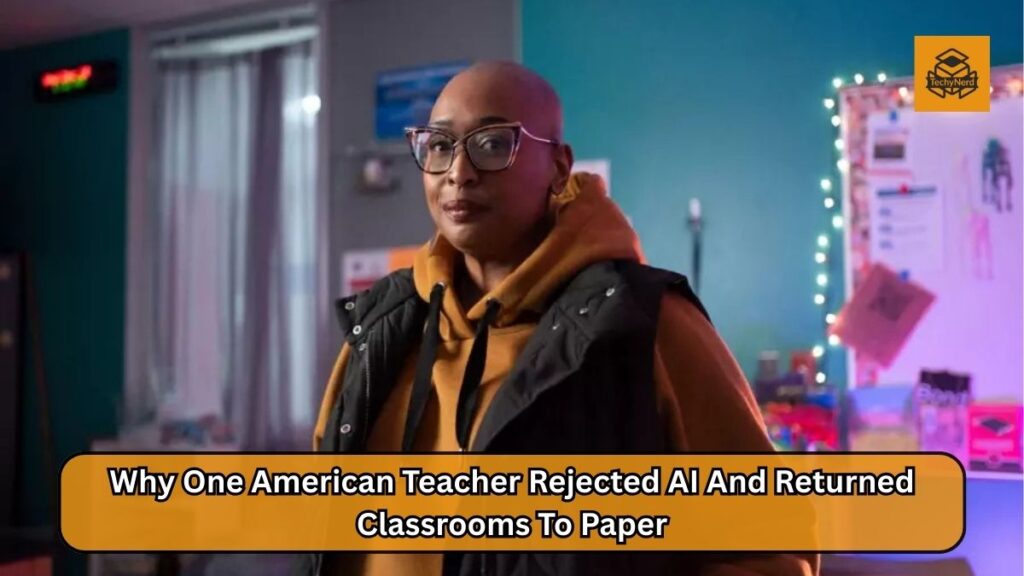
But this is not resistance rooted in nostalgia. It is a calculated pedagogical choice grounded in concerns about cognition, equity, authorship, and the long-term impact of outsourcing thinking to machines.
The School, The Students, And The Context
Southwest High School serves a predominantly low-income student population. Like many public schools in the United States, it provides every student with a school-issued laptop. Digital access, at least on paper, is no longer the primary barrier.
Bond argues that access alone does not equal understanding. Her concern is not whether students can use technology—but whether they are learning how to think, analyze, and express ideas independently.
In her classroom, technology is not absent because it is unavailable. It is absent because it is intentionally excluded.
The Turning Point: When AI Entered The Lesson Plan
Bond did not begin as an opponent of AI. In fact, she initially attempted to integrate it thoughtfully into her lessons. During one unit, she asked students to read and annotate Maya Angelou’s Still I Rise, then allowed them to use AI tools to generate thesis statements for literary analysis.
The results were immediate and troubling.
The AI-generated theses were grammatically clean but intellectually hollow. Students struggled to explain the arguments “they” had submitted. The emotional nuance of Angelou’s work was missing, replaced by vague, generic claims.
What Bond observed was not improved efficiency—but disengagement.
Students were no longer wrestling with meaning. They were outsourcing interpretation.
The Cognitive Cost Of Outsourced Thinking
From a cognitive science perspective, Bond’s concerns align with emerging research. Writing by hand engages different neural pathways than typing. It slows thought, forces selection, and encourages synthesis. AI, by contrast, accelerates output while bypassing internal struggle—the very struggle that builds intellectual muscle.
Bond realized that many students lacked the foundational skills needed to evaluate AI output critically. Without understanding how to construct a thesis or argument themselves, they could not tell whether AI responses were insightful or misleading.
In that context, AI became less a tool and more a crutch.
What An AI-Free Classroom Looks Like
Every class in Bond’s room begins the same way: quiet journaling in notebooks. No prompts optimized for algorithms. No spellcheck. Just students and their thoughts.
Assignments are handwritten. Essays are built in stages—thesis statements, outlines, bibliographies, drafts—each submitted physically. Dictionaries sit on desks, replacing search engines. Discussion is sparked using instructor reference books instead of online summaries.
Only at the very end of the process do students type their final drafts, and even then, only if no learning accommodations require otherwise.
This structure is intentional. By grading the process rather than just the final product, Bond ensures that thinking cannot be skipped.
Why Handwriting Still Matters In 2026
In the tech industry, efficiency is often treated as the ultimate goal. But education operates under different rules. Faster is not always better.
Handwriting introduces friction—and friction, in learning, is valuable. It creates pauses for reflection. It exposes gaps in understanding. It makes plagiarism harder and original voice clearer.
Bond uses journaling not just to improve writing, but to help students develop confidence in their own voices—especially those who feel their language does not sound “academic enough.”
Student Reactions: Resistance Turns Into Respect
At first, many students were confused. Some felt they were being pushed backward while the rest of the world moved forward.
But over time, resistance softened.
Students like junior Meyah Alvarez say the analog approach forced them to think more deeply. Writing by hand slowed their thoughts just enough to make ideas clearer. Literature, once intimidating, became more accessible.
Others appreciated that AI simply could not do the work for them. In Bond’s class, shortcuts were structurally impossible.
Several students even cited ethical and environmental concerns about AI as reasons they supported the ban—an unexpected but telling response from a generation often labeled “AI-native.”
When Students Do Use AI—and Get Caught
AI use has not disappeared entirely. Some students admit to using it elsewhere. Even in Bond’s class, a few tried.
One student, identified only by an initial, used AI to generate a bibliography after feeling overwhelmed and running out of time. Bond recognized it immediately—not through software, but through familiarity with the student’s voice.
Instead of punishment, she offered guidance. The assignment was redone from scratch.
The lesson stuck.
The student later reflected that using AI had cost him the opportunity to learn—and that the harder path was ultimately more rewarding.
A Divided Education System
Bond’s approach is not universal. Many educators are moving in the opposite direction.
Surveys show that around 60% of teachers now use AI at least occasionally. Some districts actively promote AI adoption. Miami-Dade County Public Schools provides students with access to Google’s Gemini chatbot. New Jersey has invested millions in AI education initiatives.
At the federal level, recent executive orders and Department of Education guidance encourage “responsible AI adoption” in K-12 schools.
The message from policymakers is clear: AI is here to stay.
The Middle Ground: Teaching AI Literacy
Some educators, like Pennsylvania teacher Brett Vogelsinger, argue for balance. Rather than banning AI, they model ethical use—showing students when AI enhances thinking and when it replaces it.
Even Vogelsinger admits, however, that the field is still experimental. There is no settled framework, no consensus curriculum, and no long-term data on outcomes.
Bond believes experimentation should not come at the cost of foundational skills.
The Bigger Question: What Is School For?
At its core, this debate is not about technology. It is about purpose.
Is school meant to produce efficient outputs—or thoughtful humans?
Bond argues that students who learn to think, write, and argue without AI will be better equipped to use AI responsibly later. Skills built without automation do not disappear when tools are introduced.
From a tech-industry perspective, this mirrors a principle seen in engineering: abstraction works best when fundamentals are understood.
Why This Matters Beyond Education
As AI becomes embedded in workplaces, society risks creating a generation fluent in tools but shallow in reasoning.
Bond’s classroom serves as a counterbalance—a reminder that human cognition is not a bottleneck to eliminate, but a resource to cultivate.
Her decision may seem radical today. In hindsight, it may prove prescient.
Frequently Asked Questions (FAQs)
1. Why did the teacher ban AI completely?
To protect critical thinking and writing development.
2. Does banning AI put students behind?
Bond argues it strengthens foundational skills.
3. Are computers used at all?
Only for final typing stages.
4. Is AI banned school-wide?
No, only in her classroom.
5. Do students support the ban?
Most grow to appreciate it.
6. What skills improve most?
Writing clarity, argumentation, confidence.
7. Is handwriting proven to help learning?
Yes, multiple cognitive studies support it.
8. Are other schools doing this?
Few go fully analog.
9. Will Bond change her approach later?
She remains open, but unconvinced.
10. What’s the core takeaway?
Thinking still matters more than tools.