

Artificial intelligence is no longer confined to analyzing data or generating content. It is now actively shaping the physical world, particularly in the field of biology. The emergence of AI systems capable of designing and executing laboratory experiments marks the beginning of a new scientific paradigm often referred to as programmable biology.
This transformation is being accelerated by organizations like OpenAI and Ginkgo Bioworks, which have demonstrated how AI models such as GPT-5 can autonomously design and oversee tens of thousands of biological experiments through robotic cloud laboratories. These facilities allow machines to perform complex experiment without direct human intervention, dramatically increasing speed and efficiency.
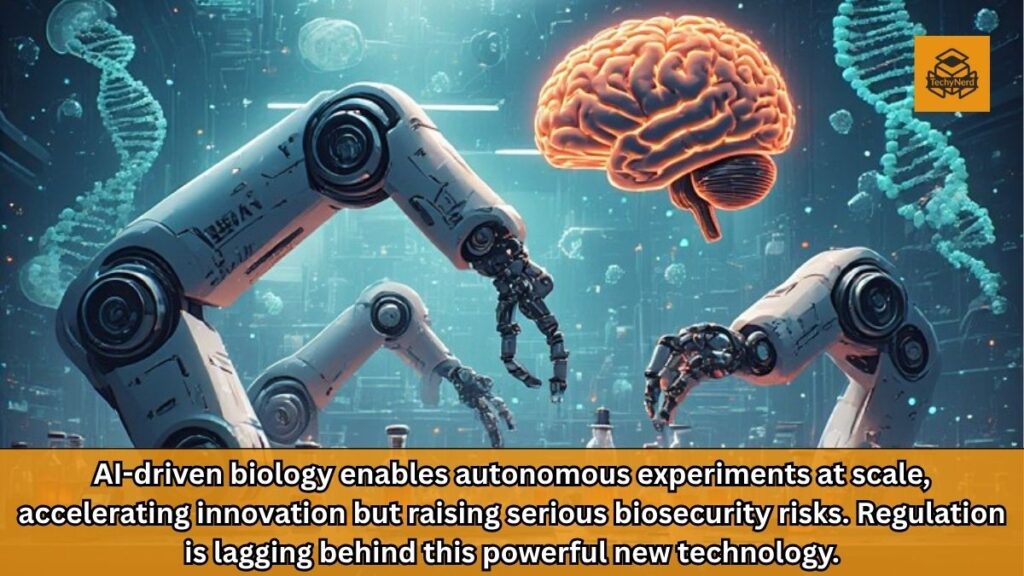
While the benefits of such advancements are profound, the implications for global biosecurity and governance are equally significant. Humanity is entering an era where biological systems can be engineered at scale, and the rules governing this capability are still in their infancy.
From Observation to Engineering: The Evolution of Biological Science
Biology has undergone several major transformations over the past century. Initially, it was a discipline focused on observation and classification. Scientists sought to understand life by studying organisms and documenting their characteristics.
The advent of genomics marked a shift toward understanding. By sequencing DNA, researchers could uncover the genetic instructions that govern biological processes. This knowledge laid the groundwork for targeted interventions, enabling breakthroughs such as CRISPR, which allows precise editing of genetic material.
Today, AI is driving a third transformation. Biology is becoming an engineering discipline, where systems are designed, built, tested, and optimized in iterative cycles. This approach mirrors practices in fields such as software development and mechanical engineering, where rapid prototyping and continuous improvement are standard.
The Rise of Autonomous Experimentation
One of the most striking developments in this नई paradigm is the ability of AI to autonomously conduct experiments. In a typical setup, an AI model generates hypotheses and experimental designs based on predefined goals. These designs are then executed by robotic systems in a cloud laboratory.
The results are fed back into the AI, which analyzes the data and refines its approach. This closed-loop system allows for continuous learning and optimization, enabling the exploration of thousands of संभावनाएँ in parallel.
The scale of this capability is unprecedented. What once required months or years of manual experimentation can now be achieved in days. This acceleration has the potential to revolutionize fields such as drug discovery, vaccine development, and industrial biotechnology.
AI-Accelerated Protein Engineering
Proteins are fundamental to life, acting as the कार्यशील components of cells. Designing new proteins has traditionally been a complex and time-consuming process, requiring extensive trial and error.
AI is changing this dynamic through the use of protein language models. These systems are trained on vast datasets of natural protein sequences, enabling them to predict how changes in structure will affect function. They can also generate entirely new protein designs tailored to specific उद्देश्यों.
When combined with automated laboratories, these models create a powerful feedback loop. Thousands of protein variants can be tested rapidly, with the most promising candidates refined in subsequent iterations.
This capability has significant implications for medicine. It could lead to faster development of नई दवाएँ, more effective vaccines, and innovative उपचार for complex diseases.
The Dual-Use Dilemma in AI-Driven Biology
While the benefits of AI in biology are substantial, they are accompanied by serious risks. One of the most pressing concerns is the dual-use nature of the technology. Tools designed for beneficial purposes can also be used to cause harm.
For example, the same AI systems that optimize protein design for medical applications could be used to enhance the properties of harmful pathogens. This includes increasing transmissibility, altering host specificity, or enabling immune evasion.
The integration of AI with automated laboratories further amplifies this risk. It lowers the barriers to conducting complex biological experiments, potentially enabling individuals with limited expertise to perform tasks that were previously restricted to विशेषज्ञ researchers.
Lowering Barriers: A New Kind of Accessibility Risk
Accessibility has long been a goal of technological innovation. However, in the context of biology, increased accessibility can have unintended consequences.
Studies have shown that AI tools can assist users in completing complex biological tasks with greater accuracy and efficiency. In some cases, individuals with limited training have been able to outperform experienced professionals in specific क्षेत्रों when aided by AI.
This raises important questions about नियंत्रण and accountability. If AI systems can guide users through sophisticated प्रयोग, the traditional safeguards based on expertise and institutional oversight may no longer be sufficient.
At the same time, other research suggests that AI assistance does not fully eliminate the challenges of complex biological workflows. Practical execution still requires specialized knowledge and संसाधन. However, as automation technologies continue to advance, this barrier is likely to diminish.
Robotic Cloud Laboratories: The New Infrastructure of Science
Robotic cloud laboratories represent a महत्वपूर्ण विकास in the infrastructure of scientific research. These facilities allow experiments to be conducted remotely, with AI systems controlling robotic उपकरण.
This मॉडल offers several advantages, including scalability, लागत reduction, and reproducibility. It also enables researchers to conduct experiments without physical access to a laboratory.
However, it also introduces new risks. The ability to remotely execute experiments means that potentially dangerous activities could be conducted from anywhere in the world. This वैश्विक accessibility complicates efforts to regulate and monitor biological research.
Regulatory Gaps and Governance Challenges
One of the most critical issues highlighted by the rise of AI-driven biology is the gap between technological capability and regulatory frameworks.
Existing regulations for biological research were designed for a world in which humans conducted experiments manually. They do not account for autonomous systems capable of डिजाइन and execution at scale.
Similarly, AI governance frameworks often focus on issues such as bias, privacy, and transparency, without addressing the unique risks associated with biological applications.
International agreements such as the Biological Weapons Convention were established decades ago and do not include provisions for AI. This leaves a significant gap in global governance.
Emerging Approaches to Biosecurity
In response to these challenges, researchers and policymakers are exploring new approaches to biosecurity. One प्रस्ताव is the implementation of risk-based access controls, where the availability of AI tools is determined by their potential for misuse.
Organizations such as the Nuclear Threat Initiative have suggested frameworks that match user access to risk levels, rather than imposing blanket restrictions.
Another महत्वपूर्ण area is the screening of synthetic DNA. While some companies voluntarily screen orders to prevent misuse, there is currently no universal requirement to do so. Strengthening these measures could help mitigate risks associated with AI-designed sequences.
Improving transparency and evaluation of AI models is also essential. Current safety assessments may not fully capture real-world risks, particularly as models become more capable.
Industry Self-Regulation and Its Limits
Some AI companies have begun implementing their own safety measures. For example, organizations like Anthropic have introduced tiered safety frameworks to manage risk.
While these efforts are महत्वपूर्ण, they are inherently limited. Self-regulation relies on voluntary compliance and may not be sufficient to address global challenges.
Moreover, the rapid pace of AI development means that risks can evolve faster than mitigation strategies. This creates a dynamic environment in which continuous adaptation is required.
Balancing Innovation and Risk
The challenge facing society is how to balance the benefits of AI-driven biology with the associated risks. Overregulation could stifle innovation and धीमा progress, जबकि underregulation could lead to गंभीर consequences.
Achieving this balance requires collaboration between governments, industry, and the वैज्ञानिक community. It also requires a proactive approach to governance, anticipating future developments rather than reacting to them.
Education and awareness are equally महत्वपूर्ण. As AI tools become more accessible, ensuring that users understand their implications is essential for responsible use.
Conclusion: A Critical Moment for Global Policy
The integration of AI into biological research represents a transformative moment in human history. It offers the potential to solve some of the world’s most pressing challenges, from बीमारी to environmental sustainability.
At the same time, it introduces risks that are unprecedented in scale and complexity. The ability to design and execute biological experiments autonomously raises fundamental questions about नियंत्रण, सुरक्षा, and ethics.
The decisions made today will shape the trajectory of this technology for decades to come. By addressing the governance gap and fostering responsible innovation, society can harness the power of AI-driven biology while minimizing its risks.
FAQs
1. What is programmable biology?
It is the use of AI to design and execute biological experiments.
2. How does AI run lab experiments?
AI designs experiments and robotic labs carry them out automatically.
3. What is a robotic cloud lab?
A remote lab where robots perform experiments controlled by AI systems.
4. What are protein language models?
AI systems trained to understand and design protein structures.
5. What is the dual-use problem?
Technology that can be used for both beneficial and harmful purposes.
6. Can AI design harmful biological agents?
There is concern that it could be misused for that purpose.
7. Are current regulations sufficient?
No, they lag behind technological advancements.
8. What is the Biological Weapons Convention?
An international treaty banning biological weapons.
9. How can risks be managed?
Through regulation, monitoring, and responsible AI development.
10. What is the future of AI in biology?
It will likely accelerate innovation while requiring stronger safeguards.