

In an era where artificial intelligence is rapidly reshaping industries, even something as seemingly simple as a restaurant logo can ignite a global debate. A small restaurant in Santa Cruz found itself at the center of controversy after adopting an AI-generated logo, triggering backlash from customers, designers, and the broader creative community.
What initially appeared to be a cost-saving decision quickly escalated into a wider conversation about the role of AI in creative professions, the perceived value of human artistry, and the ethical boundaries of automation. The incident has since become emblematic of a deeper shift underway in the tech and creative industries—one that challenges long-standing assumptions about originality, labor, and value.
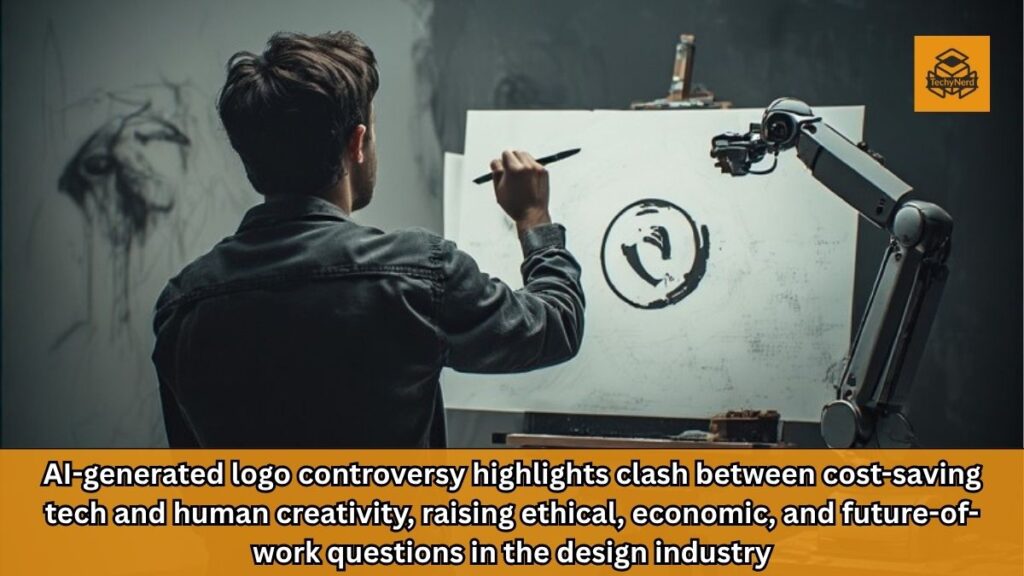
The Incident: A Branding Decision Gone Viral
The restaurant, seeking a fresh identity, turned to AI tools to generate a logo rather than hiring a professional designer. From a business perspective, the decision was pragmatic. AI tools promise speed, affordability, and convenience—key advantages for small businesses operating on tight margins.
However, the public response was swift and polarized. Customers began leaving negative reviews—not about the food or service—but specifically targeting the logo. Critics argued that the use of AI undermined human creativity, while others viewed the backlash itself as excessive and misplaced.
The owner eventually replaced the AI-generated logo with a traditional, human-designed alternative. Yet, by then, the conversation had already expanded far beyond a single restaurant.
The Economic Argument: Cost vs. Craft
At the heart of the debate lies a fundamental economic tension. Small businesses often operate under financial constraints, forcing them to make difficult decisions about where to allocate resources. Branding, while important, is frequently deprioritized in favor of operational necessities.
AI tools disrupt this equation by offering low-cost alternatives to traditionally expensive services. For many entrepreneurs, the appeal is obvious: why spend hundreds or thousands on a designer when an AI can produce multiple options in minutes?
However, this cost-benefit analysis overlooks a critical dimension—the value of human expertise. Professional designers bring not only technical skills but also strategic thinking, cultural awareness, and emotional intelligence. A logo is not merely a visual asset; it is a representation of brand identity, values, and positioning.
Reducing design to a purely transactional output risks commodifying creativity, potentially eroding the long-term value of branding.
The Creative Perspective: Is AI “Good Enough”?
One of the most contentious claims in the debate is that “AI can do just as good a job.” This assertion reflects a growing perception that AI-generated outputs are indistinguishable from human-created work.
From a technical standpoint, AI has indeed made remarkable progress. Modern generative models can produce visually appealing designs that meet basic aesthetic standards. For many use cases, this level of quality may be sufficient.
Yet, the question of “good enough” is inherently subjective. While AI can replicate styles and generate variations, it lacks the lived experience and contextual understanding that inform human creativity. Designers often draw on cultural references, historical knowledge, and nuanced insights that are difficult to encode into algorithms.
Moreover, creativity is not solely about the final output but also about the process. Collaboration between a client and a designer can lead to unexpected insights and innovative solutions—an iterative journey that AI tools currently struggle to replicate.
Ethical Considerations: Ownership, Originality, and Attribution
The controversy also highlights ethical concerns surrounding AI-generated content. Questions about ownership and originality remain unresolved in many jurisdictions. When an AI creates a logo, who owns the rights? The user? The developer? Or is the output inherently derivative?
Additionally, AI models are often trained on vast datasets that include copyrighted works. This raises concerns about whether AI-generated designs inadvertently incorporate elements of existing creations without proper attribution.
For designers, this issue is particularly sensitive. Many view AI as benefiting from their work without compensation, effectively creating a system where human creativity is both the input and the casualty.
The Social Media Amplification Effect
The role of social media in amplifying the controversy cannot be understated. What might have remained a localized issue quickly gained traction online, fueled by polarized opinions and viral discussions.
Negative reviews targeting the logo illustrate a broader phenomenon: the increasing tendency for consumers to engage with businesses based on values and principles, not just products or services. In this case, the use of AI became a proxy for larger concerns about fairness, authenticity, and respect for creative labor.
However, the backlash also raises questions about proportionality. Is it fair to penalize a small business for making a cost-driven decision? Or does such criticism reflect a deeper anxiety about technological change?
The Designer’s Dilemma: Adapt or Resist
For creative professionals, the rise of AI presents both a challenge and an opportunity. On one hand, automation threatens to commodify certain aspects of design, potentially reducing demand for entry-level work. On the other hand, it opens new avenues for innovation and efficiency.
Many designers are already integrating AI into their workflows, using it as a tool rather than a replacement. By leveraging AI for repetitive tasks, they can focus on higher-value activities such as strategy, storytelling, and client engagement.
This hybrid approach may represent the future of the industry—one where human creativity and machine efficiency coexist.
The Small Business Perspective: Survival vs. Ideals
From the viewpoint of small business owners, the debate can feel disconnected from practical realities. Operating a business involves constant trade-offs, and decisions are often driven by necessity rather than ideology.
For many entrepreneurs, AI tools democratize access to resources that were previously out of reach. They enable businesses to compete in a crowded marketplace without incurring prohibitive costs.
Criticizing these choices without acknowledging the underlying constraints risks alienating the very stakeholders that the creative community seeks to support.
The Broader Industry Implications
The AI logo controversy is not an isolated incident but a microcosm of a larger transformation. As AI continues to evolve, similar debates are likely to emerge across various creative domains, including writing, music, and video production.
The key challenge for the industry will be to establish frameworks that balance innovation with fairness. This may involve new business models, updated copyright laws, and ethical guidelines for AI usage.
Ultimately, the goal should not be to resist technological progress but to shape it in a way that preserves the value of human creativity.
Conclusion: A Turning Point for Creativity in the AI Era
The Santa Cruz logo controversy underscores a pivotal moment in the evolution of the creative industry. It reveals both the promise and the pitfalls of AI, highlighting the need for thoughtful integration rather than wholesale adoption or rejection.
As businesses, creators, and consumers navigate this new landscape, the conversation must move beyond binary positions. AI is neither a panacea nor a threat in isolation—it is a tool whose impact depends on how it is used.
The future of creativity will likely be defined not by competition between humans and machines but by collaboration between the two.
FAQs
1. Why did the AI-generated logo cause backlash?
Because many people felt it devalued human designers and creativity.
2. Are AI logos legally owned by the user?
Ownership laws vary and are still evolving globally.
3. Can AI replace graphic designers completely?
No, it lacks human creativity, strategy, and emotional intelligence.
4. Why do small businesses prefer AI tools?
They are cost-effective and fast compared to hiring professionals.
5. Is AI-generated design considered original?
This is debated due to training on existing datasets.
6. How are designers adapting to AI?
Many are integrating AI into workflows to enhance productivity.
7. Is it unethical to use AI for logos?
Not inherently, but ethical concerns exist around data use and originality.
8. Can AI create high-quality branding?
It can create visuals, but strategic branding still needs humans.
9. Why did customers leave negative reviews?
They reacted to the perceived ethical issue, not just design quality.
10. What does this mean for the future of design?
A hybrid model combining AI efficiency and human creativity is likely.