

Few companies in artificial intelligence embody contradiction as clearly as Anthropic. Founded by former OpenAI researchers with a mission centered on safety, alignment, and responsible development, the company has consistently positioned itself as the moral counterweight to an industry obsessed with speed, scale, and market dominance.
Yet as Anthropic’s valuation climbs into the hundreds of billions and its models grow ever more powerful, the company finds itself locked in an internal struggle that mirrors the broader crisis facing the AI industry: how to warn the world about existential risks while actively accelerating toward them.
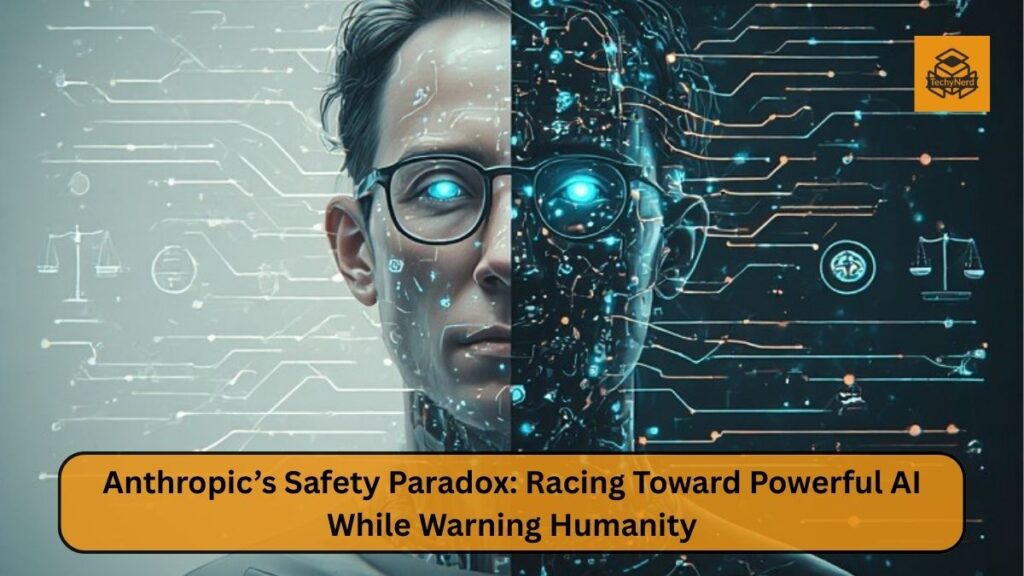
This tension is no longer theoretical. It is visible in Anthropic’s research papers, executive statements, product releases, and internal debates. It is voiced openly by its own safety researchers. And it raises a question that increasingly haunts the future of artificial intelligence: can companies truly slow down when competition makes acceleration feel existential?
“Things Are Moving Uncomfortably Fast”
The phrase captures more than a mood. It reflects a reality shared by many inside frontier AI labs. Anthropic safety researcher Sam Bowman’s candid admission underscores a growing sense that the pace of AI advancement may be outstripping humanity’s ability to understand, govern, or control it.
Anthropic, despite its emphasis on caution, is not immune to the pressures driving the AI arms race. With competitors like OpenAI, Google DeepMind, and Meta releasing increasingly capable models, the cost of hesitation is measured not just in lost revenue, but in irrelevance.
This creates a paradox: the very companies most alarmed by AI’s dangers are often those pushing the technology forward most aggressively.
The Superego of Silicon Valley
Anthropic has carefully cultivated an image as the AI industry’s conscience. While rivals roll out consumer features, monetization strategies, and viral demos, Anthropic publishes essays on civilizational risk, democracy, and long-term alignment.
CEO Dario Amodei has leaned into this distinction, framing Anthropic as the firm willing to confront uncomfortable truths rather than bury them beneath glossy marketing campaigns. In public forums, he contrasts Anthropic’s sober tone with what he sees as the industry’s growing commercialization of intelligence.
This positioning has earned the company credibility among policymakers, academics, and AI safety advocates. It has also raised expectations that Anthropic will behave differently when hard trade-offs arise.
The Adolescence of Technology
Amodei’s essay, “The Adolescence of Technology,” is emblematic of Anthropic’s intellectual posture. The piece explores how societies struggle to adapt when technologies mature faster than social institutions can respond. It frames advanced AI not as a tool, but as a force capable of reshaping democracy, national security, and economic power.
The essay avoids easy optimism. Instead, it warns that powerful AI systems could destabilize democratic processes, concentrate influence in the hands of a few actors, and create unprecedented security risks.
What makes the essay striking is not its content — many researchers share similar concerns — but the identity of its author. Amodei is not an outside critic. He is the CEO of a company actively building the very systems he warns about.
A Company Worth Billions, Wrestling With Extinction-Level Risks
At an estimated valuation of $183 billion, Anthropic is no longer a scrappy research lab. It is a major economic force with investors, partners, and customers expecting growth.
This reality complicates any call for restraint. Slowing development does not happen in a vacuum; it affects hiring plans, revenue forecasts, and competitive positioning. In a market where capability advances translate directly into power, hesitation can feel like surrender.
Anthropic’s internal struggle is therefore not about whether AI risks exist — its leadership is unusually frank on that point — but about whether it is realistic to prioritize caution without losing the race entirely.
Democracy, Power, and the Political Moment
Amodei’s public comments on democratic values, particularly in response to recent political developments in the United States, mark a rare intervention by a major tech CEO into contentious political territory.
His warning that powerful AI could amplify existing democratic vulnerabilities resonates at a moment when trust in institutions is already fragile. AI-generated misinformation, automated persuasion, and algorithmic amplification threaten to further destabilize public discourse.
By speaking openly, Anthropic differentiates itself from peers who avoid political statements. Yet it also exposes itself to criticism: can a company credibly defend democracy while creating tools that could undermine it?
The Acceleration Trap
Anthropic’s dilemma reflects what many researchers describe as the “acceleration trap.” Once a technology reaches a certain level of capability, competitive pressure makes slowing down individually feel irrational, even if collective restraint would be beneficial.
Each company fears that if it pauses, others will surge ahead. This logic mirrors classic arms race dynamics, where mutual escalation occurs despite shared recognition of danger.
Anthropic’s own behavior illustrates this trap. Even as it publishes safety research and philosophical essays, it continues to release increasingly capable models, integrate them into products, and expand commercial partnerships.
Safety Research Inside a Product Company
To its credit, Anthropic invests heavily in alignment and safety research. It employs teams dedicated to interpretability, robustness, and ethical evaluation. Its constitutional AI framework represents a genuine attempt to embed normative constraints into model behavior.
However, critics argue that technical safety measures may not be sufficient to address systemic risks. Alignment techniques can reduce harmful outputs, but they do not solve broader issues like economic disruption, concentration of power, or misuse by state and non-state actors.
This raises an uncomfortable possibility: safety research may reduce certain risks while enabling faster deployment overall, paradoxically increasing exposure to others.
Public Warnings, Private Momentum
One of the most striking aspects of Anthropic’s posture is the gap between its rhetoric and its trajectory. Publicly, the company emphasizes uncertainty, caution, and the need for governance. Privately, it competes aggressively for talent, compute, and customers.
This is not hypocrisy so much as structural tension. No single company can unilaterally change the incentives shaping the AI industry. Even leaders who believe slowdown is necessary may find themselves unable to act on that belief without external coordination.
Anthropic’s internal conflict thus becomes a case study in why voluntary restraint may be insufficient.
What Slowing Down Would Actually Mean
Calls to “slow down AI” often lack specificity. For Anthropic, meaningful restraint could involve delaying releases, limiting model scale, or declining certain partnerships. Each of these choices carries real costs.
Investors may push back. Customers may turn elsewhere. Governments may interpret hesitation as weakness. In a world where AI capability increasingly translates into geopolitical leverage, slowing down can feel risky not just economically, but strategically.
This reality complicates the moral clarity of AI safety debates.
Regulation as a Way Out
Anthropic has consistently supported stronger regulation and transparency requirements for frontier AI systems. Regulation offers a potential escape from the acceleration trap by leveling the playing field.
If all major actors are subject to the same constraints, no single company bears the cost of restraint alone. However, regulation is slow, fragmented, and often reactive.
The gap between the speed of AI development and the pace of policymaking remains one of the industry’s most dangerous fault lines.
A Mirror for the Entire Industry
Anthropic’s internal struggle is not unique. It reflects tensions present at every frontier AI lab, whether acknowledged publicly or not.
What sets Anthropic apart is its willingness to articulate those tensions openly. In doing so, it exposes the uncomfortable truth that ethical concern alone does not neutralize competitive pressure.
The question is whether transparency can translate into meaningful change.
The Risk of Normalizing the Uncomfortable
There is a danger that repeated warnings, unaccompanied by structural change, become background noise. If every new model release is accompanied by another essay on risk, audiences may grow numb.
Anthropic risks normalizing discomfort — making existential concern a permanent backdrop rather than a catalyst for action.
Conclusion: Can the Superego Win?
Anthropic stands at a crossroads that will define not just its own future, but the credibility of the AI safety movement as a whole.
If the company can translate its ethical commitments into concrete restraint, governance advocacy, and industry coordination, it may prove that responsible acceleration is possible.
If not, it may inadvertently demonstrate the limits of conscience in a competitive technological race.
Either way, Anthropic’s internal war is a warning: the hardest problems in AI are not technical. They are human, institutional, and political — and they are arriving faster than anyone is comfortable admitting.
FAQs
1. What is Anthropic’s main mission?
To build safe, aligned, and responsible AI systems.
2. Why is Anthropic described as conflicted?
It warns about AI risks while accelerating AI development.
3. Who is Dario Amodei?
CEO of Anthropic and a prominent AI safety advocate.
4. What is “The Adolescence of Technology”?
An essay warning about societal risks from powerful AI.
5. Does Anthropic support AI regulation?
Yes, it actively advocates for stronger oversight.
6. Why can’t Anthropic simply slow down?
Competitive and geopolitical pressures make unilateral restraint costly.
7. Is Anthropic unique in this dilemma?
No, but it is unusually transparent about it.
8. What risks does Anthropic emphasize most?
Democracy, national security, and loss of control.
9. Can technical safety measures solve these risks?
They help, but don’t address systemic societal issues.
10. What does Anthropic’s struggle reveal?
That AI’s biggest challenges are institutional, not technical.