

As 2025 approaches its final weeks, China has unveiled what may become one of the most consequential technological experiments of the decade. Beyond faster chips, smarter algorithms, or more advanced robots, this initiative redefines something far more fundamental: how computing power itself is organized and delivered at a national scale.
China has officially launched a vast, ultra-high-speed artificial intelligence computing network that links distant data centers into what effectively behaves as a single, colossal supercomputer. Spanning roughly 34,175 miles (55,000 kilometers) of optical fiber across 40 cities, the system connects China’s most powerful computing hubs into a unified AI infrastructure.
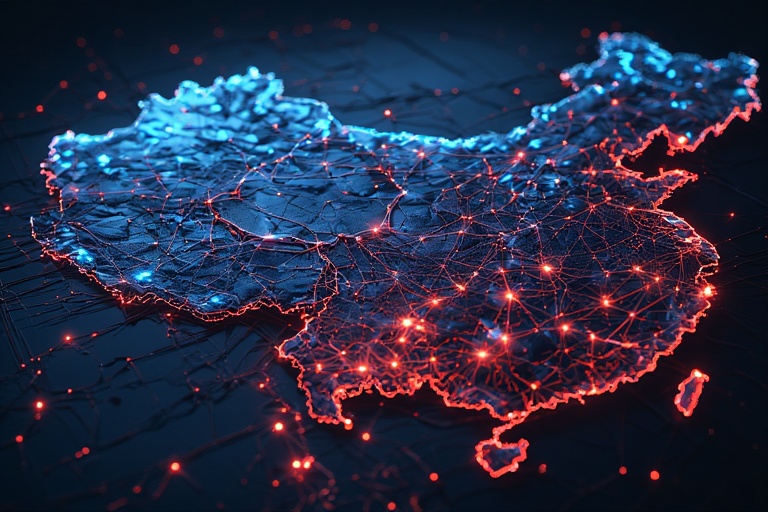
If successful over the long term, this network could reshape AI development, industrial automation, scientific research, and national digital strategy—not just for China, but for the global technology race.
From Isolated Data Centers to a Unified Computing Brain
Traditional supercomputers are physically centralized. Thousands of processors sit in one facility, sharing memory, storage, and ultra-low-latency interconnects. China’s new system challenges that model entirely.
Instead of concentrating computing power in a single location, the network distributes it across the country. Data centers separated by hundreds or even thousands of miles operate together as if they were housed under one roof. Tasks can be dynamically allocated, shifted, and synchronized in real time, creating the functional equivalent of one massive, geographically dispersed machine.
According to Chinese state media, the network achieves 98 percent of the efficiency of a single centralized computing center, an extraordinary figure given the physical distances involved. This level of performance has long been considered impractical due to latency, packet loss, and synchronization challenges.
The Future Network Test Facility Explained
Known as the Future Network Test Facility (FNTF), the system is the most advanced expression yet of China’s ambition to redesign the internet itself for the AI era.
The FNTF operates as a deterministic network, meaning data packets do not move randomly or opportunistically as they do on the public internet. Instead, each packet follows a precisely scheduled path, comparable to trains running on a fixed, tightly coordinated timetable.
This approach dramatically reduces unpredictability, enabling real-time coordination between distant machines—something essential for advanced AI workloads, medical systems, and industrial automation.
Why This Network Is Different From the Internet
The public internet prioritizes flexibility and scalability, not guaranteed performance. Packets take whatever route is available, arriving out of order or with variable delays. That’s fine for streaming video or browsing websites, but disastrous for distributed AI training that requires near-perfect synchronization.
China’s network sacrifices flexibility for precision. Latency, jitter, and packet loss are minimized through strict scheduling and dedicated optical links. This makes it possible to run massive AI models across multiple locations without the inefficiencies that normally plague distributed systems.
In effect, China is building not just faster networks—but purpose-built AI infrastructure at the national level.
The “East Data, West Computing” Vision
At the heart of this project lies a long-term national strategy known as “East Data, West Computing.”
China’s eastern regions are home to its largest cities, universities, and technology companies. These areas generate enormous demand for AI computation but face land, energy, and cooling constraints. Western regions, by contrast, have abundant space, renewable energy resources, and lower population density.
The strategy aims to shift energy-intensive computing workloads westward while allowing eastern users to access that power seamlessly. The new AI network makes this vision practical by eliminating the performance penalty typically associated with distance.
Performance That Redefines Possibility
Early tests of the network suggest capabilities that would be unthinkable on conventional infrastructure.
In one demonstration, researchers transmitted 72 terabytes of data from a radio telescope in under 1.6 hours. On a standard internet connection, the same transfer would have taken nearly two years.
The system reportedly supports:
- Continuous 24/7 operation
- 128 different network types simultaneously
- Over 4,000 concurrent service trials
This level of throughput and reliability positions the network as a foundational platform for next-generation AI research.
Implications for AI Model Training
Training modern AI models requires immense computing resources, often spread across thousands of GPUs. Synchronization overhead becomes a bottleneck as systems scale.
By treating distant computing centers as a unified system, China can:
- Pool scarce AI accelerators
- Reduce redundancy between data centers
- Train larger models faster
- Optimize energy consumption
This could accelerate China’s progress in large language models, computer vision, scientific simulations, and multimodal AI systems.
Beyond AI: Real-Time Applications at National Scale
While AI development is the headline use case, the implications extend far beyond machine learning.
The network is designed to support:
- Telemedicine, including real-time remote surgery and diagnostics
- Industrial internet systems for smart factories
- Energy grid optimization
- Low-altitude economy applications, such as drone logistics
- Next-generation telecommunications, including 6G research
These applications demand ultra-low latency and deterministic performance—exactly what the FNTF is designed to deliver.
A Calculated Gamble on Deterministic Networking
Despite its promise, the project carries significant risks.
Deterministic networks require:
- Extreme stability
- Constant synchronization
- Massive energy supplies
- Fault tolerance across vast distances
Any disruption—whether technical, environmental, or geopolitical—could ripple across the entire system. Maintaining near-perfect efficiency at this scale is unprecedented.
Critics argue that such tightly controlled systems may struggle to adapt to unpredictable real-world conditions over time.
China’s Confidence in the System
Despite these challenges, Chinese researchers appear confident. According to officials involved in evaluating the project, the network has already supported advanced research in 5G and 6G technologies.
Plans are underway to open access to:
- Manufacturing sectors
- Energy and power industries
- Transportation systems
- Emerging digital economies
Rather than a closed research experiment, the network is intended as a shared national resource.
What This Means for the Global AI Race
China’s move highlights a growing divergence in how major powers approach AI infrastructure.
While the United States and Europe largely rely on private companies to build cloud computing platforms, China is investing heavily in state-coordinated, infrastructure-first AI systems.
This approach could provide advantages in:
- Scale
- Cost efficiency
- Strategic coordination
- Long-term planning
At the same time, it raises questions about openness, flexibility, and global interoperability.
A New Definition of a Supercomputer
Traditionally, supercomputers are ranked by peak FLOPS in a single location. China’s network challenges that definition entirely.
If computing power can be pooled dynamically across thousands of miles with near-centralized efficiency, the concept of a “supercomputer” may evolve from a machine into a nationwide capability.
The Long-Term Question
The ultimate test will be endurance. Sustaining performance, reliability, and efficiency over years—not weeks—will determine whether this system becomes a model for the future or a cautionary tale.
If it succeeds, China may have pioneered a new blueprint for AI infrastructure—one that blurs the line between networks and computers themselves.
FAQs
1. What makes China’s AI network unique?
It links distant data centers into a single system with near-centralized efficiency.
2. How large is the network?
Approximately 34,175 miles of optical fiber across 40 cities.
3. What is a deterministic network?
A network where data packets follow fixed schedules for predictable performance.
4. Why is this important for AI?
AI training requires tight synchronization across massive computing resources.
5. Can other countries replicate this model?
Yes, but it requires massive investment, coordination, and energy infrastructure.
6. Is this faster than traditional cloud computing?
For real-time and AI workloads, it can significantly outperform standard networks.
7. What industries benefit beyond AI?
Healthcare, manufacturing, energy, telecommunications, and logistics.
8. Does this replace traditional supercomputers?
It expands the concept rather than replacing localized machines.
9. What are the biggest risks?
Stability, energy consumption, and long-term operational complexity.
10. Could this reshape the global AI race?
Yes, by giving China scalable, coordinated computing advantages.