

Across college campuses in the United States and beyond, artificial intelligence has quietly transformed from a study aid into a structural force reshaping education. What began as concern over students using AI to cheat has now evolved into a paradox: students are increasingly using AI tools not to cheat, but to protect themselves from being falsely accused of doing so.
Universities once worried that generative AI would undermine learning by automating essays and assignments. Today, students worry that writing too well, too clearly, or too fluently might trigger suspicion. The result is an escalating arms race involving AI detectors, AI “humanizers,” and self-surveillance tools that track keystrokes, browser activity, and writing history.
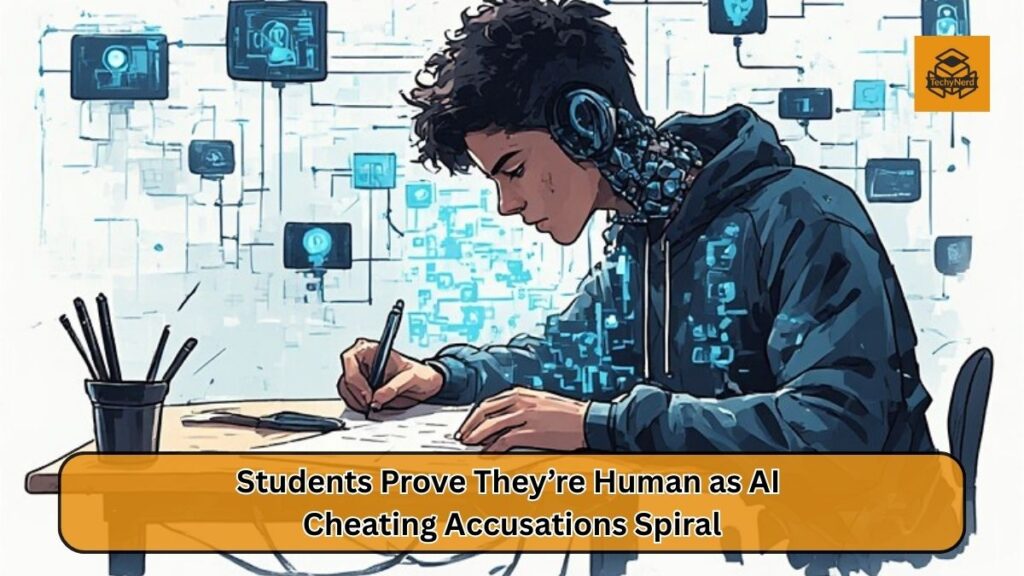
This is no longer a debate about academic honesty alone. It is a structural crisis involving trust, technology, labor, and the future of learning itself.
How AI Detectors Changed Student Behavior
AI detection software entered classrooms with the promise of restoring academic integrity. Tools such as Turnitin and GPTZero were marketed as ways to identify AI-generated writing by analyzing sentence patterns, predictability, and linguistic structure.
Yet as adoption grew, cracks began to appear. Independent research and lived student experience revealed that these systems are far from infallible. Non-native English speakers, strong writers, and students with structured reasoning styles are disproportionately flagged. False positives have become common enough that some students have taken legal action against universities.
The fear of being wrongly accused has reshaped how students write. Many now deliberately simplify their language, insert minor grammatical errors, or avoid stylistic clarity. In some cases, academic excellence itself has become a liability.
The Rise of AI “Humanizers”
As detectors spread, a new industry rapidly emerged: AI humanizers. These tools analyze writing and subtly alter phrasing, rhythm, and structure to make text appear more “human” and less algorithmically predictable.
Some students use humanizers after relying heavily on generative AI. Others insist they never used AI at all but run their work through these tools as a defensive measure. In both cases, the motivation is the same: avoiding accusation.
This industry has grown at remarkable speed. Dozens of platforms now offer subscriptions ranging from free to $50 per month, collectively attracting tens of millions of visits. Detection companies view these tools as a direct threat, while students see them as protection against unreliable systems.
The irony is hard to miss. Students accused of using AI are turning to more AI to prove their innocence.
Self-Surveillance Becomes the New Proof
As detection disputes increased, some companies introduced tools that allow students to document their writing process. Grammarly’s Authorship feature, for example, tracks keystrokes, revision history, pasted text, and AI suggestions.
Students can now submit “proof of humanity” alongside assignments, showing how long they worked, what sources they visited, and how their drafts evolved. Millions of such reports have been created, though many are never formally submitted.
While these tools offer reassurance, they introduce new concerns. Writing assignments now come with implicit surveillance, shifting the burden of proof from institutions to students. Learning increasingly happens under digital observation.
Faculty Caught in the Middle
Professors face mounting pressure from both sides. On one hand, they are expected to uphold academic standards. On the other, they are warned not to rely solely on AI detection scores.
Most detection companies explicitly advise educators to use their tools only as conversation starters, not evidence. Yet meaningful conversations require time, emotional labor, and trust — all of which are in short supply when instructors manage hundreds of students.
For adjuncts and teaching assistants, this added responsibility is often uncompensated. The result is tension, burnout, and inconsistent enforcement across departments.
Where Definitions Break Down
At the core of the conflict lies a fundamental question: what counts as unacceptable AI use?
Spell-checkers, grammar suggestions, and predictive text are now embedded into nearly every writing platform. Even search engines increasingly summarize and rephrase information using AI. The boundary between assistance and authorship has become blurred.
Students report confusion over shifting rules, with each professor interpreting AI usage differently. What is permitted in one class may be punished in another. This inconsistency fuels anxiety and undermines trust.
The Emotional Cost of False Accusations
Beyond grades, false accusations carry emotional weight. Students describe stress, shame, and fear of academic probation or financial aid loss. Some have withdrawn from programs entirely.
In many cases, personal narratives, lived experiences, or emotionally complex writing were flagged as AI-generated — an outcome that feels deeply dehumanizing to those affected.
The paradox is striking: institutions use AI to judge humanity, often without recognizing the human cost of error.
A System Approaching Its Limits
Experts increasingly agree that banning AI outright is neither realistic nor effective. As generative models improve and integrate into everyday tools, enforcement becomes harder and disputes more frequent.
Some educators advocate for a shift in assessment design, emphasizing in-class writing, oral exams, drafts, and reflective work. Others call for clearer policy, transparency, and national standards.
There is also growing pressure for regulation — not only of AI itself, but of the academic integrity industry that has rapidly commercialized student fear.
What Comes Next for Education
The current trajectory is unsustainable. A system where students must prove they are human, educators must police algorithms, and learning is shaped by fear cannot endure.
The future likely lies not in better detection, but in redefining learning outcomes, embracing ethical AI literacy, and restoring trust between students and institutions.
The question is no longer whether AI belongs in education. It is whether education can evolve fast enough to use it wisely.
FAQs
1. What are AI humanizers?
They are tools that modify text to make it appear more human and less likely to be flagged by AI detectors.
2. Are AI detectors accurate?
Accuracy varies, and false positives remain a widely documented issue.
3. Why are strong writers flagged more often?
Clear structure and logical reasoning can resemble AI-generated patterns.
4. Are students allowed to use AI tools?
Policies differ widely by institution and even by individual course.
5. What is self-surveillance software?
Tools that track writing history, keystrokes, and edits to prove authorship.
6. Can AI detectors be used as proof of cheating?
Most providers advise against using them as sole evidence.
7. Do humanizers always mean cheating?
Not necessarily; many students use them defensively.
8. How are professors responding?
With caution, concern, and increasing calls for policy reform.
9. Is this affecting mental health?
Yes, students report stress, anxiety, and withdrawal from programs.
10. What’s the long-term solution?
Clear standards, redesigned assessments, and ethical AI integration.