

For more than two decades, Dragon Quest VII has occupied a unique place in JRPG history. It is ambitious, narratively dense, and structurally distinctive with its time-shifting exploration and deeply personal story arcs. Now, with Dragon Quest VII Reimagined, Square Enix is taking a second, more ambitious attempt at reviving the 2001 classic for the modern generation. While the game makes sweeping updates across its visuals, systems, and storytelling architecture, one element remains central to its identity: its iconic cast of party members.
This new version not only preserves the emotional essence of the original characters but elevates them using contemporary narrative design principles. Through richer dialogue, modernized personality frameworks, and improved relational dynamics, the heroes of Dragon Quest VII Reimagined have been reshaped for players who demand greater emotional nuance from their RPG experiences.
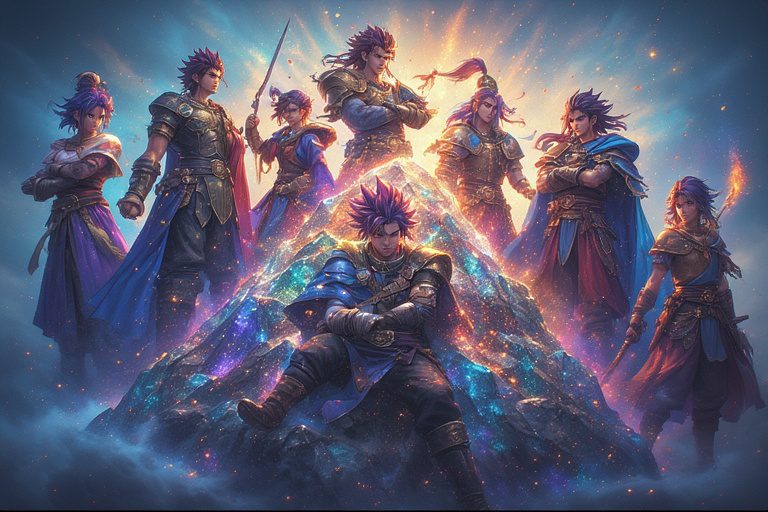
To understand how this transformation takes place, Game Informer spoke with lead scenario writer Sayaka Takagi and producer Takeshi Ichikawa, both of whom offered rare insight into how each character was rebuilt. Their reflections reveal how Square Enix is modernizing classic RPG storytelling for an era shaped by expressive protagonists, dynamic narrative choices, and player-shaped identity.
The Hero: A Modern Blank Slate Reimagined Through Player Agency
Every Dragon Quest begins with a protagonist known simply as the Hero. In Dragon Quest VII Reimagined, the Hero is still the son of a humble fisherman living in Pilchard Bay. However, the way the character is written reflects a more contemporary understanding of agency-driven design.
Modern RPGs expect the silent (or minimally voiced) protagonist to function not as a void but as a nuanced reflection of the player’s emotional choices. According to producer Takeshi Ichikawa, this led the team to redefine the Hero as “the most normal” Dragon Quest protagonist ever created. This sounds counterintuitive for a legendary hero, but it aligns perfectly with the design philosophy behind modern player-projection protagonists.
His ordinariness is a feature, not a flaw.
He is designed as a vessel through which players map their values, humor, and emotional reactions. His dialogue options gently shape his personality, ensuring that players feel like co-authors of his journey rather than observers.
Despite the expectations his parents place upon him—a quiet life as a fisherman—there’s a constant narrative undercurrent that he is destined for something far beyond his shoreline upbringing. His sense of quiet ambition and unspoken restlessness pull players into a familiar archetype: the reluctant hero whose destiny is shaped gradually, not suddenly.
Prince Kiefer: A Royal Character Rebuilt Through Modern Emotional Complexity
In the original 2001 game, Kiefer stood out as impulsive, loyal, and adventurous. In Reimagined, Kiefer evolves into a deeper and more psychologically rich character.
As the prince of Estard and childhood best friend of the Hero, Kiefer’s internal conflict is shaped by privilege, expectation, and insecurity. According to Ichikawa, despite being royalty, Kiefer is deeply envious of others. This is not jealousy rooted in resentment but in longing—he desperately wants to become someone meaningful.
He speaks casually, even clumsily, which deviates from traditional royal diction. This intentional choice strips away the stereotype of the polished noble and replaces it with a young man struggling with identity. His envy becomes a narrative mirror to the player’s own desires for growth.
Kiefer’s purpose is no longer defined by lineage but by a personal quest for relevance.
He dreams not of a throne but of agency, of breaking free from the predetermined life mapped for him by birth. This subtle modernization makes Kiefer one of the most relatable characters in the cast.
Maribel Mayde: A Reassessment of Personality Through Adult Perspective
Maribel has always been one of the most polarizing characters in Dragon Quest VII, known for her sarcasm, bold commentary, and tendency to express what others politely avoid. But in Reimagined, she becomes one of the story’s most emotionally layered party members.
Lead writer Sayaka Takagi says that revisiting Maribel as an adult profoundly changed her understanding of the character. As a child, she perceived Maribel as loud, sharp-tongued, and irritating. But during development, Takagi recognized Maribel’s deeper motivations—loyalty, concern, and unwavering emotional support.
Today’s players expect complex female characters who balance strength, vulnerability, humor, and emotional depth. Maribel captures all of these traits.
She is adorable yet fierce, critical yet caring. Her blunt honesty makes her dialogue feel refreshingly modern. She voices the frustrations, questions, and emotions that many players feel but rarely see spoken aloud in JRPG narratives.
Maribel also seamlessly fits into multiple vocations—Priestess, Mage, and more—giving her mechanical flexibility that mirrors her narrative adaptability.
Ruff: Innocence, Instinct, and the Toriyama Archetype Revived for 2025
Ruff, the cheerful young boy raised among wolves, embodies pure-hearted innocence. His bond with his wolf companion, which fights alongside him, instantly makes him one of the most memorable characters for players.
Ichikawa notes a familiar parallel: Ruff’s personality carries echoes of Akira Toriyama’s iconic character designs—particularly Goku in his youthful form. The sense of wonder, curiosity, and instinctive bravery captures the spirit of Toriyama’s archetypes without relying on clichés.
In Reimagined, Ruff’s dialogue and animation emphasize his childlike purity even more.
He possesses a primal intuition that compensates for his lack of worldly experience. He is naïve but never weak, innocent but never helpless, and dependent but never burdensome.
His wildness is softened by moments of heartfelt sincerity, giving players a character they instinctively want to protect—an emotion amplified by modern animation and voice work.
Aishe: Sophistication, Strength, and Sensuality Through Refined Character Design
Aishe represents a blend of elegance and combat prowess, shaped by her role as a high-ranking member of the Roamers. In Reimagined, the team enhances her aura of class, sensuality, and reliability.
Takagi explains that Aishe is intentionally written as an attractive yet dignified woman—confident, mature, and composed. Unlike many RPG archetypes, Aishe’s sensuality is not ornamental; it is tied to her cultural identity and her role in the Roamer hierarchy.
She plays the role of the responsible older-sister figure, guiding the younger members of the party and grounding the group through experience.
Her flexibility across vocations—Dancer, Troubadour, Jester—allows her combat performance to mirror her narrative multidimensionality.
In modern JRPG design, characters like Aishe appeal to players who appreciate complexity without caricature—a balance Square Enix carefully preserves.
⭐Sir Mervyn: The Classic Paladin Reborn for Contemporary Narrative Design
Sir Mervyn remains one of the most mysterious characters in Dragon Quest VII Reimagined. A legendary warrior from the past, sealed in stone until the Hero awakens him, Mervyn brings gravitas and a narrative bridge between eras.
Ichikawa and Takagi avoided revealing too much, maintaining the surprise for players familiar with the original. But what they do suggest is that Mervyn’s characterization is now heavily informed by modern RPG narrative standards.
He is no longer just a stoic paladin archetype.
He is written as a man displaced in time, struggling with the emotional and cultural distance between his past and present. This gives him a profound reflective quality that reinforces the themes of history, legacy, and rediscovery that define the game.
Reimagining a Classic for a New Gaming Era
Beyond individual characters, Dragon Quest VII Reimagined represents a milestone in how legacy RPGs are reconstructed for new generations. The team adopts a design philosophy rooted in:
- deeper emotional authenticity
- character-driven narrative pacing
- modernized dialogue writing
- contextual personality evolution
- cinematic storytelling integration
Voice acting—a first for some characters—also transforms how players connect with the party.
Every emotional beat gains weight, every moment of banter feels more intimate, and every internal conflict becomes more resonant.
This is not merely a remake.
It is a reinterpretation of how classic JRPG storytelling should evolve in an era dominated by narrative-rich titles like Final Fantasy VII Rebirth, Persona 5, and Octopath Traveler.
A Modern Release for a Global Audience
Dragon Quest VII Reimagined launches on February 5, 2026, across:
- PlayStation 5
- Xbox Series X|S
- Nintendo Switch
- Switch 2
- PC
The multiplatform release signals Square Enix’s intention to broaden the franchise beyond Japan and introduce new generations to its timeless characters.