

When Google DeepMind makes a strategic hiring decision, the global AI community pays attention—and this time, the implications stretch far beyond software breakthroughs. DeepMind’s recent onboarding of Aaron Saunders, the former chief technology officer of Boston Dynamics, signals a profound shift in the company’s ambitions. Saunders is not merely another recruit; he is a symbol of technological convergence—someone whose expertise sits precisely at the junction where AI intelligence meets physical embodiment.
Boston Dynamics has long been regarded as the pinnacle of robotic engineering innovation. Its machines have stunned the world with their agility, balance, and lifelike flexibility, demonstrating forms of movement that were once considered impossible. Now, that same engineering heritage is being brought into DeepMind’s fold at a moment when AI models like Gemini are becoming increasingly capable of understanding vision, language, physical dynamics, sensor inputs, and decision-making in real time.
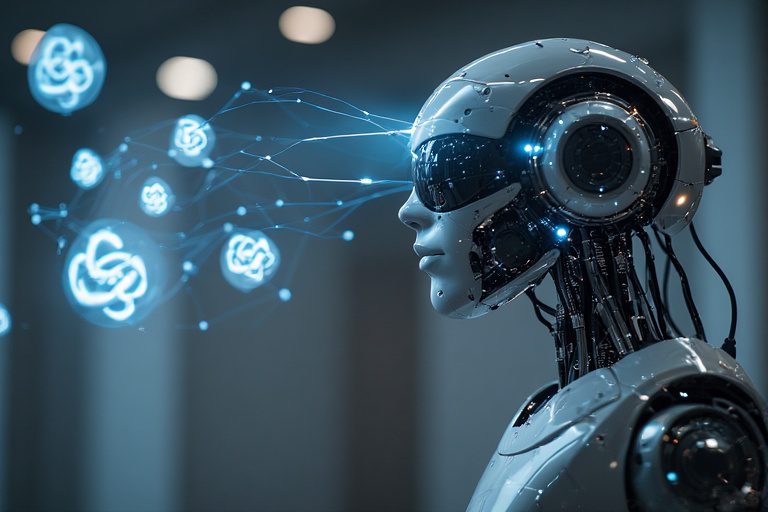
Taken together, these developments reveal DeepMind’s long-term ambition: to turn Gemini from a purely digital intelligence into the foundational operating system for the robots of tomorrow.
The Vision: Gemini as a Universal Operating System for Robots
DeepMind CEO Demis Hassabis has hinted at this direction for years, but the company’s intention is now explicit. He describes Gemini as almost an “Android for robots”—a software layer that would unify the diverse and chaotic world of robotics.
In smartphones, Android created a common ecosystem across thousands of hardware configurations. Hassabis imagines something similar, but for machines that walk, roll, fly, lift, assemble, and perform physical labor.
Gemini, in his vision, becomes:
- the perceptual brain,
- the motor-planning system,
- the decision-making engine,
- the multimodal interpreter,
- the universal control layer that can adapt to different robotic bodies.
This approach reframes robotics entirely. Instead of each company building its own isolated stack of hardware and software, Hassabis wants one intelligence system—Gemini—to work across humanoids, quadrupeds, industrial arms, and unconventional robotic forms.
This is precisely where Aaron Saunders’ experience becomes invaluable.
Why Aaron Saunders Matters for DeepMind’s Future
Few individuals in the world possess Saunders’ depth of understanding regarding robotic locomotion, mechanical systems, and engineering constraints. At Boston Dynamics, he shaped some of the most iconic robotic platforms ever created. His engineering fingerprints can be seen in:
- Atlas, the humanoid robot capable of parkour
- Spot, the four-legged robot used in industrial sites worldwide
- Advanced prototypes that explored fluid movement, balance, and multi-terrain adaptability
Saunders began as an engineer working on a six-legged amphibious robot, demonstrating early talent in unconventional mechanical design. By 2018, he became vice president of engineering, and in 2021, he stepped into the role of CTO—a position that placed him at the heart of Boston Dynamics’ most ambitious machine-building initiatives.
DeepMind’s decision to bring Saunders on as VP of hardware engineering is strategic. AI that controls the physical world cannot succeed without deep integration between algorithm and mechanism. Robotics isn’t only about intelligence; it is also about torque, materials, joints, actuators, weight distribution, energy efficiency, and structural layout.
Saunders is one of the few who has actually built such systems—which is why his presence at DeepMind dramatically accelerates the company’s push into robotics.
The Timing: Robotics is Reaching an Inflection Point
Hassabis believes robotics is on the verge of a breakthrough moment in the next few years, and the broader industry numbers support his optimism.
Several shifts are occurring simultaneously:
- AI models are becoming multimodal, meaning they can interpret vision, language, sensor data, motion inputs, and complex environments.
- Hardware components are getting cheaper and more modular, allowing startups to prototype robots quickly.
- Manufacturing demand for automation is rising, especially in areas like logistics, construction, and labor-intensive tasks.
- Consumer robotics is approaching mass viability, fueled by humanoids, warehouse robots, service robots, and personal assistance systems.
Companies across the US and Asia are racing to build the first truly scalable humanoid platform, with major players such as:
- Agility Robotics
- Figure AI
- 1X Technologies
- Tesla, with the Optimus humanoid
- Multiple Chinese manufacturers, including Unitree
Elon Musk has stated that Tesla intends to produce one million Optimus humanoids within the next decade, revealing the scale of ambition in the sector.
But China may be moving even faster.
The Rise of Chinese Robotics and Unitree’s Dominance
While Boston Dynamics once held the crown for innovation in legged robots, companies like Unitree Robotics have rapidly gained market dominance by offering cost-effective, efficient four-legged systems.
Unitree’s robots are:
- significantly cheaper
- widely adopted in manufacturing
- modular enough to integrate with third-party AI systems
- increasingly competitive in performance
Hassabis openly acknowledges being impressed with Unitree, but he emphasizes that DeepMind’s priority is not hardware competition. Instead, the company aims to outpace global rivals on the brain—the intelligence layer that ultimately differentiates robots.
In his words:
“I’m most interested in the AI brain part of it.”
This is where Gemini becomes the centerpiece of DeepMind’s robotics future.
Gemini’s Multimodal Intelligence is Built for Robotics
Gemini, DeepMind’s flagship model, excels in tasks that require integration of multiple forms of data—text, images, real-world video, instructions, sound, and complex reasoning. Robotics requires exactly this blend of capabilities.
A robot must be able to:
- observe the environment
- understand tasks through natural language instructions
- interpret dynamic scenes
- recognize objects and people
- plan actions with precision
- correct mistakes in real time
Gemini is already designed to do much of this in the digital world. Extending it into a physical operating system is the logical next step.
The Strategy: Unify the Robotics Industry Under a Single Intelligence Layer
Just as Google used Android to unify mobile computing, DeepMind is positioning Gemini as the unifying intelligence layer for robotics.
Companies building physical robots often struggle with the complexity of AI integration—training models, optimizing perception, creating adaptable control systems, and ensuring safe interactions with humans. Gemini, if successful, could drastically reduce those burdens.
Imagine a world where:
- a warehouse robot
- a delivery drone
- a humanoid worker
- a factory arm
- a household service robot
can all run variants of Gemini that understand their form and adapt seamlessly to their tasks.
This “universal brain” approach could revolutionize robotics the same way Android revolutionized mobile devices.
Alphabet’s Long Relationship With Robotics
It’s worth noting that Alphabet—the parent company of Google—has had a complicated history with robotics.
Alphabet once owned Boston Dynamics but sold it to SoftBank in 2017, which later sold a majority stake to Hyundai.
During Alphabet’s stewardship, Boston Dynamics struggled to commercialize its machines because the company prioritized research excellence instead of scalable productization.
DeepMind’s current push appears far more strategic and grounded in the capabilities of modern AI systems.
Why This Move Matters for the Global Robotics Landscape
By bringing Saunders on board and reinforcing Gemini as a robotics operating system, DeepMind is signaling its intention to dominate the next decade of automation.
The implications are enormous:
- Manufacturers could rely on predictable, AI-driven mechanics.
- Logistics companies could deploy autonomous machines at scale.
- Construction and mining could shift toward fully automated operations.
- Humanoid robots could finally become functional assistants, not prototypes.
- Consumer robotics might step beyond vacuums and lawnmowers into meaningful household support.
This is also happening at a time when governments and corporations are making major bets on robotics infrastructure, sensing that AI is finally capable of bridging perception and action. As Hassabis says, the next few years could deliver the long-awaited breakthrough moment.
A New Era of Robotics Begins
DeepMind’s mission has always been centered around solving intelligence, and this new direction—underpinned by the hiring of Aaron Saunders—marks a shift from purely digital intelligence to embodied intelligence.
Robots that think, perceive, and act with human-like fluidity have long been a staple of science fiction. Now, with Gemini as the brain and Saunders as the architect of physical form, DeepMind is positioning itself to turn that fiction into reality.
The robotics revolution is no longer theoretical. It has begun.