
The smartwatch market has long promised frictionless interaction, but until recently, most wearable experiences remained tethered to touchscreens, voice commands, or smartphones nearby. With its latest update, Google is decisively reshaping that paradigm. The newest Pixel Watch software release introduces AI-powered gestures and on-device Smart Replies, marking a pivotal moment where wearable technology begins to feel genuinely autonomous.
At the heart of this transformation lies Gemini, Google’s advanced AI system, now integrated directly into the Pixel Watch experience. Rather than serving as a passive notification mirror, the Pixel Watch is evolving into a proactive, context-aware assistant that understands motion, intent, and language — all from your wrist.
This update isn’t about flashy features alone. It’s about redefining how humans interact with technology in motion-heavy, real-world scenarios where touchscreens simply aren’t practical.
From Smartwatch to Intelligent Companion
Wearables have traditionally struggled with one core challenge: usability when hands are busy. Whether carrying groceries, commuting, exercising, or navigating winter weather with gloves on, interacting with a tiny touchscreen often feels more frustrating than helpful.
Google’s latest Pixel Watch update directly addresses this friction. By expanding gesture-based controls and enhancing AI-driven responses, the company is signaling a shift toward ambient computing — where technology adapts to users naturally instead of demanding attention.
The Pixel Watch is no longer just reactive. It’s becoming anticipatory and intuitive, capable of understanding subtle human motion and generating meaningful responses without external dependencies.
The Rise of One-Handed, AI-Powered Gestures
Gesture control isn’t new in wearables, but Google’s implementation stands apart because of its precision, intelligence, and real-world practicality.
Earlier features like Raise to Talk introduced a glimpse of hands-free control. Now, Google expands that foundation with two powerful gestures:
Double Pinch: Precision Without Touch
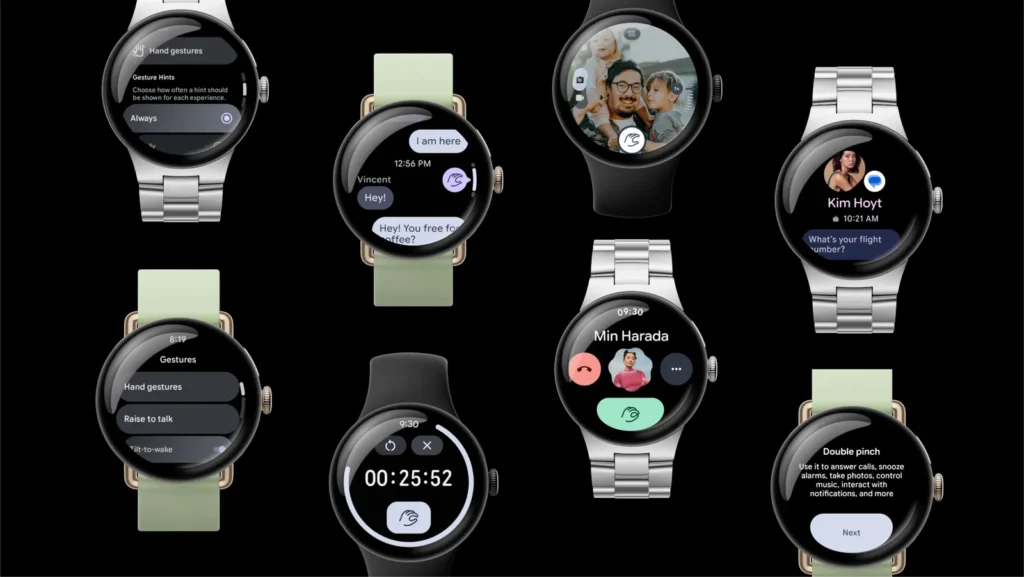
The double pinch gesture allows users to interact with their watch by bringing their thumb and index finger together twice in quick succession. This simple motion unlocks a surprisingly broad range of actions.
Users can scroll through notifications, dismiss alerts, snooze alarms, manage timers, pause music, or even select a Smart Reply — all without touching the screen. On-screen visual cues ensure users know exactly when the gesture is available, minimizing guesswork and improving confidence.
Wrist Turn: Motion as Command
The wrist turn gesture introduces another layer of intuitive control. By rotating the wrist in a deliberate motion, users can navigate content, accept calls, or dismiss interruptions. This makes interaction feel almost subconscious, reducing the cognitive load traditionally associated with smartwatch usage.
Together, these gestures redefine one-handed operation, making the Pixel Watch particularly useful in dynamic environments like workouts, outdoor travel, or multitasking at home.
Gemini AI Brings True Intelligence to Smart Replies
Perhaps the most technically significant update arrives with AI-powered Smart Replies, now generated directly on the watch itself.
For the first time in smartwatch history, Pixel Watch 3 and newer models can generate contextual Smart Replies without being connected to a phone. This leap is made possible by Google’s Gemma-based on-device language model, optimized for speed and efficiency.
Unlike earlier systems that relied heavily on cloud processing, this model operates locally, offering faster response times, improved privacy, and reliable performance even when connectivity is limited.
The result is messaging that feels natural, timely, and situationally aware — whether responding to a quick text, coordinating plans, or acknowledging notifications on the go.
Why On-Device AI Matters for Wearables
Running AI directly on a smartwatch isn’t just a technical achievement; it’s a strategic one. On-device intelligence reduces latency, improves reliability, and ensures personal data remains private.
Google reports that the new model is twice as fast and nearly three times more memory-efficient than previous generations. This efficiency allows advanced language processing to coexist with battery constraints — a long-standing challenge in wearable design.
For users, this means fewer delays, smoother interactions, and a device that remains useful even when disconnected from a smartphone or network.
Everyday Scenarios Where This Update Shines
The true test of wearable innovation lies in everyday utility, and this update excels in common, relatable moments.
While walking a dog, users can glance at their wrist, double pinch, and send a quick reply. During holiday shopping, alarms and timers can be managed without juggling bags. In winter conditions, wrist turns replace screen taps when gloves make touch impractical.
Even simple tasks like pausing music, answering calls, or acknowledging notifications become seamless, reinforcing the idea that technology should adapt to human behavior — not the other way around.
Positioning Pixel Watch in the Wearable AI Race
The wearable space is increasingly competitive, with Apple, Samsung, and emerging players racing to integrate AI meaningfully. Google’s approach stands out because it emphasizes contextual intelligence over novelty.
Rather than flooding the interface with features, Google focuses on subtle enhancements that quietly improve usability. Gemini doesn’t demand attention; it works in the background, making interactions smoother and more human.
This philosophy aligns with Google’s broader vision of ambient AI — present when needed, invisible when not.
A Glimpse Into the Future of Wearable Computing
These updates hint at a future where wearables become the primary interface for AI interaction. As gestures grow more refined and language models more capable, the need for constant screen interaction diminishes.
Pixel Watch is positioning itself as a bridge between physical movement and digital intelligence — a role that will become increasingly important as computing moves beyond phones and laptops.
In this context, the current update isn’t an endpoint. It’s a foundation for deeper integration between AI, motion sensing, and human intent.
Conclusion: A Quiet Revolution on Your Wrist
Google’s latest Pixel Watch update doesn’t scream innovation — it demonstrates it through experience. By combining Gemini AI, intuitive gestures, and on-device intelligence, the Pixel Watch takes a meaningful step toward fulfilling the long-standing promise of wearable technology.
This isn’t just about convenience. It’s about redefining how technology fits into daily life — unobtrusive, responsive, and genuinely helpful.
As AI continues to shrink in size and grow in capability, the wrist may become one of the most powerful interfaces we own.
FAQs
1. Which Pixel Watch models support the new AI gestures?
Pixel Watch 4 and newer models support the expanded gesture controls.
2. Do Smart Replies require a phone connection?
No, Smart Replies now work directly on the watch using on-device AI.
3. What AI model powers Smart Replies on Pixel Watch?
Google uses a Gemma-based language model optimized for wearables.
4. Are the gestures customizable?
Currently, gestures are system-defined, with visual hints guiding usage.
5. Does this update impact battery life?
Google optimized the AI model for efficiency to minimize battery impact.
6. Can gestures be used during workouts?
Yes, gestures are designed to work in motion-heavy environments.
7. Is Gemini always listening on the watch?
No, Gemini activates contextually based on user actions and settings.
8. Do gestures work with third-party apps?
Support varies, but core system interactions are fully enabled.
9. Is this update available globally?
The rollout is gradual and may vary by region.
10. What does this mean for the future of smartwatches?
It marks a shift toward hands-free, AI-first wearable computing.