

When most people imagine the internet, they picture glowing screens—smartphones in our hands, laptops on our desks, and massive data centers humming quietly somewhere far away. This visible internet powers email, social media, streaming, online shopping, and instant access to information from anywhere on Earth. But behind this familiar digital layer exists a far more pervasive and largely invisible system that has been reshaping modern life for decades.
This hidden system is known as the Internet of Things (IoT)—a vast, interconnected ecosystem of physical objects embedded with sensors, software, and network connectivity. Unlike traditional computing devices, IoT systems operate mostly in the background, collecting data, responding automatically to conditions, and making everyday environments smarter without demanding constant human attention.
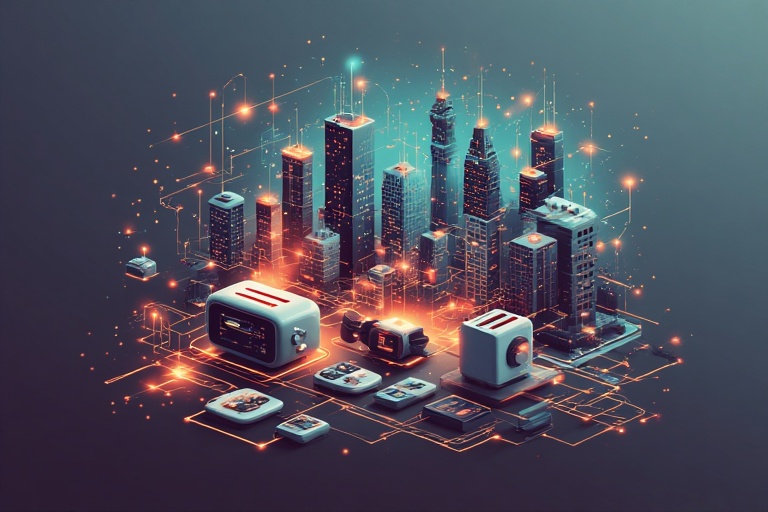
From the thermostat adjusting your home’s temperature before you arrive, to wearable devices monitoring heart rhythms in real time, IoT has quietly transformed how homes function, how cities operate, and how healthcare, energy, transportation, and industry evolve. What began as a curious experiment has now become one of the most influential technological revolutions of the 21st century.
A Humble Beginning: When a Toaster Joined the Internet
The conceptual origins of the Internet of Things trace back to the early 1990s, long before smartphones or cloud computing became mainstream. Engineer John Romkey conducted one of the earliest—and most memorable—experiments by connecting a simple household toaster to the internet. Using basic commands, users could turn the toaster on remotely, an idea that seemed amusing and impractical at the time.
Yet Romkey’s experiment planted a powerful seed. By later adding mechanical components that automatically dropped bread into the toaster, he demonstrated a crucial concept: machines could sense, respond, and act without direct human intervention. While the toaster itself was more novelty than necessity, it introduced a vision of a future where physical objects could communicate digitally and operate autonomously.
Few could have predicted that this playful innovation would one day scale into billions of connected devices shaping global infrastructure.
Defining the Internet of Things in Practical Terms
The Internet Engineering Task Force describes IoT as a network of physical objects embedded with electronics, software, sensors, and connectivity that enables them to exchange data with other systems over the internet. While technically accurate, this definition barely captures the practical impact of IoT in everyday life.
In simpler terms, IoT turns ordinary objects into data-aware systems. These objects can measure environmental conditions, detect changes, transmit information, and receive instructions. More importantly, they can automate responses—often without users noticing.
Today’s IoT ecosystem spans smart homes, healthcare devices, industrial machinery, agricultural sensors, energy grids, logistics networks, and entire smart cities. According to industry estimates, more than 21 billion IoT devices are currently in operation worldwide, a number projected to grow exponentially as connectivity becomes cheaper and more reliable.
The Smart Home: Where IoT Becomes Personal
For most consumers, the smart home is their first meaningful encounter with IoT technology. What once required manual effort—checking pipes for leaks, adjusting thermostats, monitoring security—can now be managed automatically through interconnected devices.
Consider modern water leak detection systems. These small sensors can be placed in crawl spaces, under sinks, or near appliances. When moisture is detected, alerts are sent instantly to a homeowner’s smartphone, preventing minor leaks from becoming catastrophic damage. The affordability of these systems has made them accessible to average households, and in many cases, insurance companies now encourage or subsidize their use.
Smart thermostats represent another widespread application. By learning household routines and responding to occupancy patterns, these systems optimize heating and cooling. When homeowners travel, temperatures can automatically adjust to energy-saving modes, then return to comfortable settings before arrival. The result is not just convenience, but measurable reductions in energy consumption and utility costs.
Health Monitoring: IoT as a Lifesaving Technology
Beyond convenience, IoT has become a powerful force in healthcare and personal wellness. Wearable devices—ranging from chest-mounted heart monitors to advanced smartwatches—continuously collect biometric data such as heart rate, physical exertion, sleep quality, and oxygen levels.
These devices transmit data securely to cloud platforms, where users and healthcare professionals can analyze long-term trends. For fitness enthusiasts, this means tracking progress with precision. For individuals managing chronic conditions, such as diabetes or heart disease, IoT devices can provide continuous monitoring that was once impossible outside clinical settings.
Glucose monitors worn by diabetic patients now offer real-time alerts when levels become dangerous, significantly reducing medical emergencies. In more advanced implementations, these systems can share data directly with healthcare providers, enabling proactive care instead of reactive treatment.
Electrical Safety and Home Infrastructure Intelligence
IoT’s role extends into areas most homeowners never think about—until something goes wrong. Electrical monitoring devices, such as smart voltage sensors, continuously analyze a home’s wiring for irregularities. These systems can detect hidden arcing, unstable voltage patterns, or faulty connections that may lead to electrical fires.
What makes these technologies particularly compelling is their integration with insurance and risk management. Some insurance providers now offer these devices at no cost, recognizing that early detection significantly reduces claims related to fire damage. This represents a shift where IoT not only protects individuals but reshapes entire industries by lowering systemic risk.
The Industrial Internet of Things: Powering the Global Economy
While consumer IoT garners attention, the Industrial Internet of Things (IIoT) is arguably more transformative. Factories, logistics networks, power plants, and transportation systems rely on IoT sensors to monitor performance, predict failures, and optimize operations.
In manufacturing, machines equipped with IoT sensors can detect wear and tear before breakdowns occur, enabling predictive maintenance that saves millions in downtime. In logistics, real-time tracking ensures efficient routing and inventory management. In agriculture, soil sensors guide irrigation systems, conserving water while improving crop yields.
These applications demonstrate how IoT has become foundational infrastructure—less visible than consumer gadgets, but far more economically impactful.
Smart Cities and the Future of Urban Life
Cities around the world are adopting IoT to manage traffic flow, reduce energy waste, improve public safety, and enhance quality of life. Smart traffic lights respond dynamically to congestion. Environmental sensors monitor air quality block by block. Public lighting systems adjust brightness based on activity levels.
As urban populations grow, IoT provides tools for sustainable development. Data-driven decision-making allows municipalities to allocate resources efficiently, reduce emissions, and respond rapidly to emergencies.
Security, Privacy, and the Risks of Ubiquitous Connectivity
Despite its benefits, IoT introduces significant challenges. Every connected device represents a potential security vulnerability. Poorly secured sensors can become entry points for cyberattacks, compromising not just individual privacy but entire networks.
Data privacy is another concern. IoT devices collect vast amounts of personal and behavioral data. Ensuring transparency, consent, and secure storage is critical to maintaining public trust. Regulators and manufacturers alike face growing pressure to implement robust standards that balance innovation with protection.
The Road Ahead: An Internet That Acts, Not Just Displays
The Internet of Things represents a fundamental shift in how technology interacts with the physical world. Instead of simply displaying information, IoT systems act—adjusting environments, preventing problems, and enabling smarter decisions without constant human oversight.
From a novelty toaster experiment to a global network of billions of devices, IoT has become an invisible backbone of modern civilization. Its future will be defined not by flashy screens, but by seamless integration into daily life—quietly working in the background to make homes safer, cities smarter, and industries more efficient.
FAQs
1. What is the Internet of Things in simple terms?
It is a network of everyday objects connected to the internet that can collect data and act automatically.
2. How did IoT begin?
One of the earliest examples was an internet-connected toaster created in the early 1990s.
3. How many IoT devices exist today?
There are over 21 billion IoT devices in use worldwide, with rapid growth expected.
4. Are smart home devices considered IoT?
Yes, smart thermostats, sensors, cameras, and appliances are common IoT examples.
5. How does IoT improve healthcare?
It enables continuous monitoring, early detection of issues, and remote patient care.
6. Is IoT secure?
Security varies; strong encryption, updates, and standards are critical to reducing risks.
7. Can IoT save energy?
Yes, IoT systems optimize heating, lighting, and resource use to reduce waste.
8. What is Industrial IoT?
It refers to IoT used in factories, logistics, energy systems, and large-scale operations.
9. Do insurance companies support IoT devices?
Many insurers now subsidize IoT safety devices to reduce claims and risks.
10. What does the future of IoT look like?
A world where technology acts intelligently in the background, seamlessly supporting daily life.