

The unveiling of Intel’s Panther Lake processors at CES 2026 was meant to signal a turning point. After years of architectural delays, manufacturing stumbles, and competitive pressure from Apple’s in-house silicon, Intel needed Panther Lake to do more than perform well—it needed to redefine expectations for laptop computing.
On paper, Panther Lake represents progress. Early benchmarks from PCWorld, using an Asus ZenBook Duo powered by the Core Ultra X9 388H, show real improvements in performance and battery life for Windows laptops. For Intel loyalists, that alone is reason for cautious optimism.
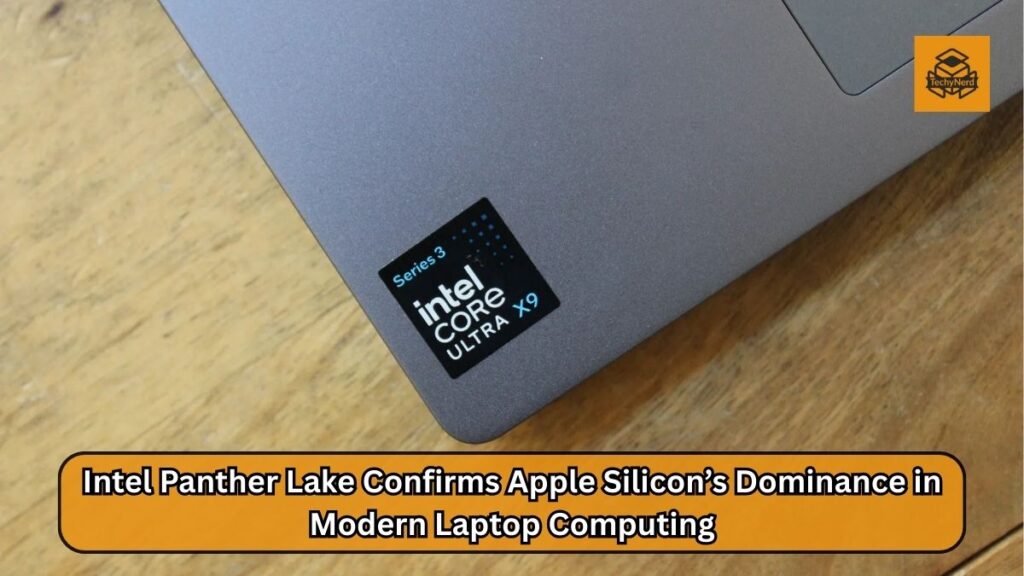
But when Panther Lake is placed next to Apple’s M-series processors, particularly the base M5, the comparison tells a different story. One that reinforces a conclusion the tech industry has been slowly accepting since 2020: Apple made the right decision to abandon Intel and build its own silicon.
Intel’s Long Road Back to Relevance
Intel’s recent history has been defined less by dominance and more by recovery. Manufacturing node delays, leadership changes, and fierce competition from AMD and Apple have reshaped the company’s position in the market. Panther Lake is part of Intel’s broader attempt to stabilize its roadmap while transitioning toward more efficient architectures.
The Core Ultra X9 388H is a capable mobile processor by traditional x86 standards. It delivers respectable multi-core performance, strong GPU compute scores, and battery life that rivals some ARM-based systems when paired with large batteries. For Windows users, especially those who value flexibility and legacy software support, Panther Lake is a meaningful step forward.
But the real question is not whether Panther Lake is good—it is whether it is good enough in a world reshaped by Apple Silicon.
Benchmark Reality: Performance Isn’t Just About Speed
When PCWorld ran benchmark tests comparing the Panther Lake 388H to Apple’s entry-level M-series chips, the results were revealing. In multi-core workloads, the Intel chip comes close to the base M5, but rarely surpasses it. In single-core performance, which impacts everyday responsiveness, Apple’s advantage becomes unmistakable.
Single-core performance matters more than many consumers realize. It influences how fast apps launch, how fluid an operating system feels, and how well a machine handles light workloads without ramping up power consumption. Apple’s M-series chips continue to dominate this area, even when compared to Intel’s newest designs.
The fact that even the older M3 can outperform Panther Lake in some single-core tests highlights how far ahead Apple’s silicon roadmap has moved.
GPU Compute: A Narrow Win With Context
Intel supporters may point to Geekbench Compute results, where the 388H edges past the M5 using OpenCL. On the surface, this looks like a win for Panther Lake. But context matters.
OpenCL is a cross-platform framework historically favored by Windows PCs. Apple, meanwhile, has invested heavily in Metal, its proprietary graphics and compute API optimized specifically for its hardware. When Geekbench Compute tests are run using Metal, the M5’s GPU performance leaps far ahead.
This divergence illustrates a broader truth: Apple’s advantage isn’t just about raw hardware—it’s about vertical integration. Hardware, software, APIs, and operating system are designed together, allowing Apple to extract performance gains that generic benchmarks often fail to capture.
Power Efficiency: Where Apple Quietly Wins
One of the most telling differences between Panther Lake and Apple’s M5 is power consumption. Intel rates the 388H at 25 watts, while Apple’s M5 operates at 15 watts. That 10-watt gap may seem modest, but in mobile computing, it is enormous.
Lower power draw translates directly into cooler operation, quieter fans, and more consistent performance when running on battery. PCWorld’s testing showed the ZenBook Duo achieving around 22 hours of battery life, but that result is heavily influenced by its massive 99Wh battery.
The M5 MacBook Pro, with a significantly smaller battery, delivers comparable real-world endurance while maintaining near-peak performance even when unplugged. Intel systems, by contrast, often throttle performance on battery, as seen in Panther Lake’s reported 20% drop during mobile use.
Efficiency, not peak wattage, is where Apple’s silicon strategy continues to shine.
The Architectural Divide: ARM vs x86
At the heart of this comparison lies a deeper architectural divide. Intel remains committed to x86, an instruction set burdened by decades of backward compatibility. Apple, by contrast, has fully embraced ARM-based design, allowing it to prioritize efficiency, scalability, and modern workloads.
Apple Silicon is not merely an ARM implementation—it is a custom system-on-a-chip that integrates CPU, GPU, neural engines, memory controllers, and security modules into a unified design. This approach minimizes latency, reduces power overhead, and simplifies software optimization.
Panther Lake, despite Intel’s best efforts, still operates within the constraints of modular PC design. Discrete components, legacy interfaces, and broad compatibility all come at a cost.
Software Ecosystems: Apple’s Hidden Advantage
Performance benchmarks only tell part of the story. Apple’s transition away from Intel was as much about software control as it was about speed.
macOS is now optimized exclusively for Apple Silicon. Developers target Metal instead of OpenCL, optimize for unified memory, and take advantage of neural engines for AI workloads. Over time, this creates a compounding advantage that Intel cannot easily replicate.
Windows laptops, even with Panther Lake, must support an enormous variety of hardware configurations. That flexibility is a strength—but it also limits optimization depth.
Apple’s ecosystem rewards consistency. Intel’s ecosystem rewards compatibility. In 2026, consistency is winning.
Battery Life Isn’t the Whole Story
Intel advocates often highlight battery life improvements as evidence that x86 laptops are catching up. And to be fair, Panther Lake shows genuine progress. But raw battery duration does not equal efficiency.
Apple’s advantage lies in delivering performance without compromise. Users do not need to choose between speed and longevity. The system behaves the same whether plugged in or mobile.
For professionals, creators, and developers, that reliability matters more than benchmark peaks.
Why Apple’s Intel Exit Was Inevitable
Looking back, Apple’s decision to abandon Intel now feels less bold and more inevitable. Intel’s roadmap uncertainty, combined with Apple’s desire for tighter hardware-software integration, made continued reliance on x86 untenable.
The M-series chips have validated that decision at every step. Each generation widens the gap not just in performance, but in philosophy.
Panther Lake confirms that Intel is improving—but it also confirms that Apple has already moved on.
What Panther Lake Means for Intel’s Future
This is not a story of failure. Panther Lake is an important milestone for Intel, particularly for Windows users who value strong performance, large batteries, and traditional PC flexibility.
But it also highlights Intel’s challenge: catching up to Apple requires more than faster clocks or better GPUs. It requires rethinking the entire mobile computing stack.
Whether Intel can do that within the constraints of x86 remains an open question.
Final Verdict: Progress, But Not Parity
Intel’s Panther Lake proves that the company is capable of meaningful progress. It delivers competitive performance, respectable efficiency, and improved battery life.
But when compared directly to Apple’s M5, the conclusion is unavoidable. Apple’s silicon strategy is not just ahead—it is fundamentally different.
And in modern laptop computing, different is winning.
FAQs
1. What is Intel Panther Lake?
Panther Lake is Intel’s latest mobile processor architecture for laptops announced at CES 2026.
2. How does Panther Lake compare to Apple’s M5?
It performs well but falls behind in single-core performance and efficiency.
3. Is Panther Lake better than Apple’s M4?
It can outperform the M4 in some workloads but not consistently.
4. Why does Apple Silicon consume less power?
Apple designs ARM-based chips with unified architecture and deep software optimization.
5. Does Panther Lake have better GPU performance?
Only in OpenCL benchmarks; Apple’s Metal performance is significantly stronger.
6. Is battery life better on Intel laptops now?
It has improved, but often relies on larger batteries.
7. Why did Apple leave Intel?
To gain control over performance, efficiency, and product roadmap.
8. Can Intel catch up to Apple Silicon?
It’s possible, but would require major architectural changes.
9. Is Apple Silicon better for professionals?
Yes, especially for creative and development workflows.
10. Should Mac users consider Intel laptops again?
For most users, Apple Silicon remains the superior choice.