

Emojis have quietly evolved from playful novelties into a global visual language. What began as a handful of yellow smiley faces has become a nuanced system of symbols capable of expressing emotion, culture, humor, and intent across linguistic barriers. Apple, one of the most influential technology companies in the world, has played a major role in shaping how emojis are perceived and used—particularly on the iPhone.
With the emergence of Unicode 18, the next generation of emoji standards, early signs suggest that iOS 27 could introduce a fresh set of emojis that further refine digital communication. While the list may appear modest at first glance, the implications are broader than they seem.
This article explores what these upcoming emojis represent, how Apple approaches emoji adoption, and why emojis still matter in an era increasingly driven by artificial intelligence and personalized digital experiences.
Understanding Unicode: The Foundation Behind Every Emoji
To understand why new emojis arrive slowly and deliberately, it is essential to understand the role of the Unicode Consortium. Unicode is a global standards organization responsible for ensuring that text—letters, symbols, and emojis—appears consistently across devices, platforms, and languages.
Every emoji you see on an iPhone begins its life as a Unicode proposal. These proposals are reviewed, debated, refined, and eventually published as part of a Unicode release. Once approved, technology companies such as Apple, Google, and Microsoft design their own visual interpretations based on standardized descriptions.
Unicode 18, recently published in draft form, represents the next chapter in this process.
The Unicode 18 Draft: What Emojis Are Being Proposed
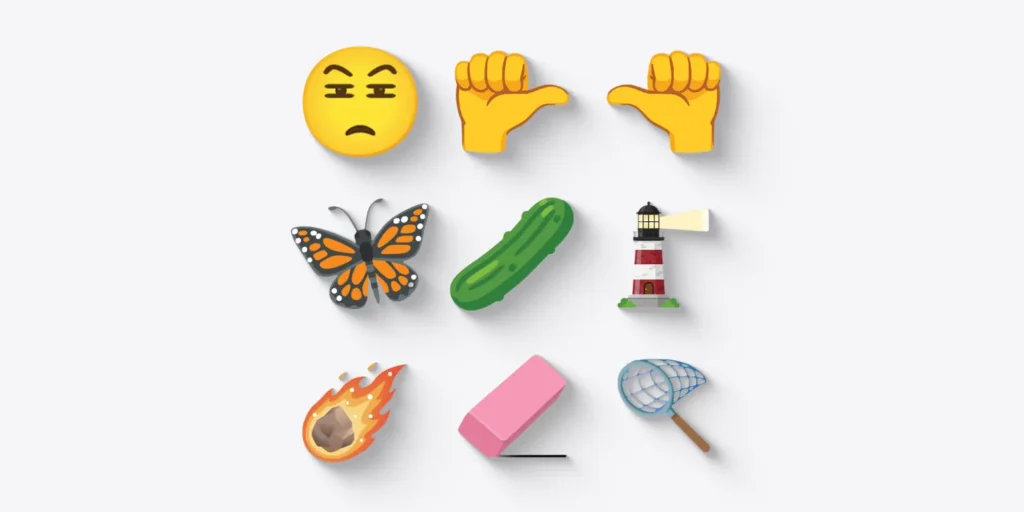
The Unicode 18 draft introduces a curated list of new emojis that balance emotional expression, practical symbolism, and nature-inspired imagery. These include:
A new smiley face with squinting eyes, designed to convey subtle emotional nuance
Directional hand gestures using leftward and rightward thumbs
A monarch butterfly symbolizing transformation and environmental awareness
A pickle emoji representing food culture and humor
A lighthouse symbolizing guidance and safety
A meteor representing space, speed, and cosmic phenomena
An eraser emoji emphasizing correction and learning
A net with a handle, commonly associated with fishing or collecting
While this list is not expansive, each emoji fills a conceptual gap in the existing emoji ecosystem.
Why Emoji Additions Are Slower Than Before
In the early 2010s, emoji updates were headline-worthy events. Each new release felt transformative. Today, the reaction is more subdued—and for good reason.
The emoji library has grown into the thousands, covering nearly every basic emotion and object. Incremental updates now focus less on volume and more on precision and inclusivity. Emojis are no longer about novelty; they are about relevance.
Apple’s recent focus has shifted toward customization, particularly with the introduction of Genmoji under Apple Intelligence. This feature allows users to generate personalized emojis using text prompts or combinations of existing emojis, reducing reliance on standardized additions.
In this context, Unicode 18 emojis act more like refinements than revolutions.
Apple’s Emoji Strategy: Quality, Timing, and Control
Apple does not immediately adopt every Unicode release. Instead, it integrates emojis strategically into major or mid-cycle iOS updates. This ensures stability, consistent design language, and alignment with broader platform goals.
At present, Apple has not yet rolled out Unicode 17 emojis, which were finalized in mid-2025. These are expected to appear in a future iOS 26 update, likely around spring—historically Apple’s preferred window for emoji releases.
Based on this cadence, Unicode 18 emojis are unlikely to arrive before iOS 27.4, expected sometime in March or April 2027.
This delayed rollout reflects Apple’s long-term planning rather than hesitation.
Emotional Nuance: The Power of the Squinting Smiley
Among all proposed emojis, the squinting smiley face may have the greatest impact. Emojis thrive on emotional precision, and subtle facial expressions are often the most heavily used.
This new smiley bridges a gap between amusement, skepticism, and playful discomfort—emotions frequently expressed in modern digital conversation but difficult to capture with existing emojis.
Apple’s design philosophy tends to emphasize clarity over exaggeration, meaning its version of this emoji will likely become a frequently used symbol once released.
Directional Gestures: A Small Change with Big Utility
The introduction of leftward and rightward thumb gestures may seem minor, but directional context matters more than ever—especially in instructional content, accessibility messaging, and UI-related communication.
These emojis could become particularly useful for:
Guiding attention in chat-based customer support
Enhancing instructional content on mobile devices
Supporting accessibility-friendly visual communication
Such additions reflect Unicode’s growing emphasis on functional symbolism.
Nature, Space, and Symbolism in Modern Emojis
The inclusion of a monarch butterfly, meteor, and lighthouse reflects an ongoing trend: emojis are increasingly symbolic rather than literal.
The monarch butterfly is widely associated with transformation, climate awareness, and resilience.
The meteor taps into growing public fascination with space exploration and astrophysics.
The lighthouse symbolizes guidance, safety, and hope—concepts deeply embedded in storytelling and mental health discourse.
Apple has historically leaned into symbolic clarity, which means these emojis may find unexpected popularity beyond their literal meanings.
The Pickle and the Eraser: Everyday Objects with Digital Meaning
Food emojis have always enjoyed high engagement, and the pickle emoji continues that tradition. In internet culture, pickles often symbolize humor, sarcasm, or niche preferences.
The eraser emoji, meanwhile, reflects the digital age’s obsession with correction, revision, and learning. It aligns well with education, creativity tools, and even productivity-focused conversations.
These emojis may appear simple, but their contextual flexibility makes them valuable.
Genmoji vs Standard Emojis: A Shift in Power
Apple’s Genmoji feature represents a turning point. For the first time, users are not limited to waiting for Unicode approval to express themselves visually.
By allowing AI-generated emojis, Apple has effectively:
Reduced pressure on Unicode to satisfy every niche request
Empowered users to create context-specific symbols
Shifted emojis from static assets to dynamic expressions
However, standardized emojis remain critical for cross-platform compatibility, ensuring that messages look consistent across devices and operating systems.
Unicode emojis are not obsolete—they are foundational.
Why Emojis Still Matter in a Post-AI World
Despite advances in AI-generated images and avatars, emojis remain unmatched in speed and universality. They convey tone instantly, prevent misinterpretation, and add emotional depth to short messages.
For Apple, emojis are more than decorative elements—they are part of the iOS identity. Every emoji update reinforces Apple’s commitment to human-centered design.
Unicode 18, though modest in scale, continues this legacy.
Looking Ahead: What iOS 27 Represents
iOS 27 is not just another software update. It represents Apple’s evolving philosophy—one that blends AI-driven personalization with carefully curated system features.
The Unicode 18 emojis, when they arrive, will likely feel less like a major announcement and more like a natural extension of the platform. That subtlety is intentional.
In a mature ecosystem, refinement is progress.
Frequently Asked Questions (FAQs)
1. What is Unicode 18?
Unicode 18 is the next proposed standard for emojis and characters, defining new symbols for global platforms.
2. When will Unicode 18 emojis come to iPhone?
They are expected to arrive with iOS 27.4, likely in spring 2027.
3. Has Apple adopted Unicode 17 yet?
No, Unicode 17 emojis are expected in a future iOS 26 update.
4. Why does Apple delay emoji releases?
Apple integrates emojis carefully to ensure design consistency and system stability.
5. What is the most notable emoji in Unicode 18?
The squinting smiley face stands out for its emotional nuance.
6. Will these emojis look the same on Android?
No, each platform designs its own visual version based on Unicode descriptions.
7. What is Genmoji in iOS?
Genmoji allows users to create custom emojis using AI and text prompts.
8. Are emojis becoming less important?
No, they remain essential for fast, emotional digital communication.
9. Why are fewer emojis added each year?
The emoji library is mature, so updates now focus on precision rather than quantity.
10. Can Unicode 18 emojis still change?
Yes, draft emojis may be modified before final approval.