

The gaming industry in 2025 is an organism in constant mutation. Hardware refresh cycles are tightening, monetization systems are expanding, and game design philosophies are increasingly shaped by data-driven retention metrics rather than pure creativity. Yet amid this advanced technological landscape, one of the year’s most remarkable releases does not come from a gritty AAA powerhouse or a sprawling open-world franchise. It comes from Kirby — Nintendo’s deceptively simple, pink puffball — through a sequel resurrected from a GameCube classic.
Kirby Air Riders, launching after more than two decades of anticipation, does not merely revive a beloved cult favorite. It boldly reintroduces a design philosophy that stands in direct opposition to the prevailing complexity of the modern gaming market. At a time when racing games like Mario Kart World and Sonic Racing: Crossworlds dominate charts with layered progression systems, advanced physics models, and intricate online modes, Air Riders chooses a different path: radical simplicity paired with almost limitless depth.
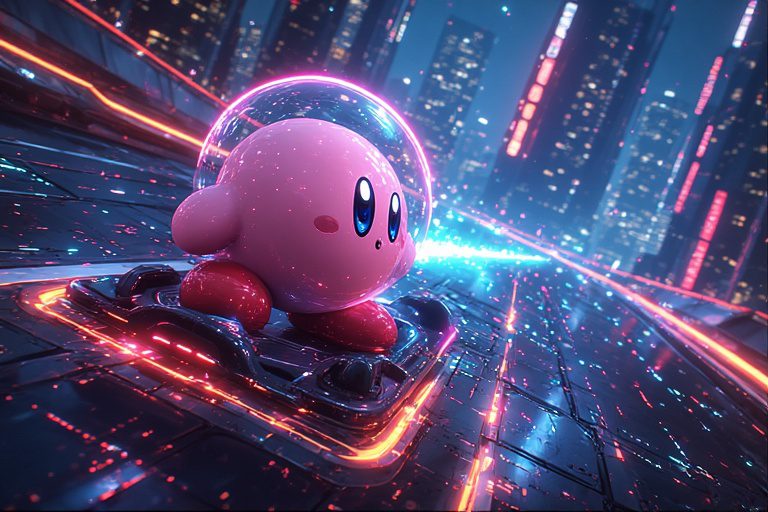
This long-form analysis explores why Kirby Air Riders is one of Nintendo’s most strategically significant releases of the decade — and how its minimalist controls, advanced online infrastructure, and hybrid game modes position it as a potential breakthrough in multiplayer design during the Switch 2 era.
The State of Racing Games in 2025 — An Overcrowded Genre Evolving at High Speed
The racing genre has gone through a transformation over the past 15 years. Once dominated by Nintendo’s family-friendly world of Mario Kart, the space has now fragmented into three core branches:
- Hyper-realistic simulation racers (Forza, Gran Turismo, etc.)
These games emphasize photorealism, precision physics, and esports integration. - Hybrid arcade-sim racers (Sonic Racing, CTR, Asphalt, etc.)
These mix high-speed arcade fun with modernized skill systems and online depth. - Character-driven kart racers (Mario Kart World, Lego 2K Drive, etc.)
Designed for mass-market appeal and social playability.
Nintendo’s own Mario Kart World, introduced earlier this year, set an aggressive new bar with its global online infrastructure, dynamic weather systems, and real-time interactive spectatorship. It was the natural evolution of the franchise — bigger, more complex, and more interconnected.
Kirby Air Riders, however, does the opposite.
Why Nintendo Needed a Game Like Air Riders
Nintendo’s biggest risk in the 2020s has been feature bloat. Even the company’s most iconic franchises have expanded their complexity, partly in response to market demands and partly due to rising hardware capabilities.
Yet Nintendo has always succeeded by ignoring conventional wisdom.
And Air Riders is a reminder of that.
Strategic Purpose of Air Riders
- It balances the Switch 2 ecosystem, which needs both sprawling AAA experiences and tight, replayable multiplayer titles.
- It helps Nintendo diversify beyond Mario Kart, which cannot carry the entire arcade racing portfolio indefinitely.
- It introduces younger or casual players to mechanically approachable but strategically deep gameplay.
- It provides Nintendo with a new competitive multiplayer franchise that can scale its esports ambitions.
Put simply, Air Riders fills a gap that only Nintendo could identify — and only Nintendo could confidently build.
The Design Philosophy — Minimalism with Explosive Depth
The fundamental brilliance of Air Riders lies in its control scheme:
- Automatic acceleration
- Left joystick to steer
- Any button to brake + drift
- Button tap to inhale enemies
- Joystick wiggle to spin attack
This is the core of the entire experience. No dual analog acceleration, no layered combos, no complicated power management.
Why This Matters in a Tech-Heavy Market
Today’s games tend to overwhelm players with:
- Skill trees
- Perks
- Prestige systems
- Daily quests
- XP grinding
- Matchmaking ladders
- Inventory loadouts
Nintendo goes the other way.
Where others stack systems, Nintendo subtracts them.
The result is a hyper-accessible, low-friction gameplay loop that still generates remarkable strategic depth. Every racer has distinct stats. Every machine behaves idiosyncratically. Every copy ability changes the flow of a match. And every mode amplifies these differences.
City Trial Mode — The Beating Heart of Air Riders
City Trial, one of the defining modes from the 2003 classic, returns with unprecedented ambition in the 2025 sequel.
A Technical Overview
- A massive open arena
- Real-time upgrades scattered across the map
- Vehicles you can swap on the fly
- Environmental hazards and randomized events
- Final battles that vary between boss fights, arena matches, high jumps, and classic races
- Support for 16-player online chaos
From a tech perspective, City Trial showcases some of Nintendo’s most advanced networking work since Splatoon 3 and Mario Kart World. The mode’s network load is high, yet latency remains surprisingly controlled due to predictive smoothing and physics interpolation.
Why City Trial Is a Masterpiece
City Trial transforms the racing formula into something more dynamic and emergent — essentially a lightweight battle royale fused with kart racing and party-game unpredictability.
It creates moments that are unforgettable because they are unplanned:
- A last-minute vehicle swap changing the entire outcome
- Players sabotaging each other for stat boosts
- Meteor showers forcing sudden detours
- Copy abilities turning small skirmishes into comedic chaos
This mode alone could sustain the entire game’s lifespan — and Nintendo clearly knows it.
Top Ride Mode — Reinventing a Controversial Classic
Top Ride, with its bird’s-eye view and ultra-tight tracks, may be divisive, but in this sequel it receives meaningful refinements:
- smoother camera transitions
- improved traction modeling
- multiple terrain-based challenges
Even with the improvements, it remains a niche mode — but one that enhances the game’s range. It appeals to players who want old-school, arcade-style chaos without the complexity of larger courses.
Road Trip — Nintendo’s Experimental Single-Player Vision
Road Trip Mode introduces a roguelike-inspired structure:
- a branching path of micro-challenges
- each challenge granting stat upgrades
- occasional boss fights
- narrative interludes
From a design standpoint, this is one of Nintendo’s boldest single-player experiments in years. It compresses dozens of micro-experiences into a playable “run” that lasts nearly two hours.
Tech Industry Impact
This mode hints at Nintendo’s growing interest in:
- roguelike-lite formats
- quick-session gameplay
- hybrid narrative/progression loops
- repeatable campaign structures
In other words, Nintendo is not just responding to market trends — it is adapting them in its own unconventional way.
Multiplayer Architecture — Nintendo’s Most Advanced System Yet
One of the most surprising elements is the multiplayer “paddock,” a lobby-like social environment where players can:
- emote
- view match results
- showcase cosmetic builds
- swap between machines
- interact before and after matches
This is a far cry from the static lobbies Nintendo historically relied on. It signals the company’s clear intent to finally embrace persistent online social spaces — a hallmark of modern live-service design.
Cosmetics and the Miles Economy
The introduction of “Miles”, a non-premium currency, allows players to earn:
- costumes
- decals
- wraps
- vehicle add-ons
Significantly, Nintendo avoids the pay-to-win pitfalls that plague rival titles. The model here is cosmetic-only progression, aligning with the company’s ethos of fairness and family-friendly simplicity.
Kirby as a Strategic Franchise for Nintendo
It might seem surprising that Nintendo is using Kirby — not Mario — to push some of its most innovative ideas.
But Kirby has long served as a testbed for experimental gameplay concepts:
- Kirby’s Epic Yarn for aesthetic risk-taking
- Kirby Star Allies for accessibility mechanics
- Kirby and the Forgotten Land for 3D design evolution
Why Kirby Is the Right Choice for a “Simple-Deep” Game
- The character’s brand is inherently flexible
- Kirby appeals to both adults and younger players
- The franchise isn’t weighed down by expectations like Mario Kart
- It allows Nintendo to introduce radical mechanics without backlash
Kirby is Nintendo’s “creative wildcard,” and Air Riders proves it more than ever.
The Cultural Impact — Why Air Riders Matters in 2025
The return of Air Ride after two decades has struck players emotionally. It symbolizes:
- nostalgia
- optimism
- joy in simplicity
- the return of pure arcade fun
In a gaming world filled with grinding, monetization, and complex loops, Air Riders feels cleansing — like a palate reset for the entire industry.
Why This Sequel Took Over 20 Years
Nintendo’s long gap between titles wasn’t due to oversight. The company was waiting for:
- the right hardware
- mature online infrastructure
- enough cultural nostalgia
- a player base ready for arcadey simplicity
2025 provides all of those ingredients.
Commercial Outlook — Air Riders Could Become Nintendo’s Next Evergreen Title
Given Mario Kart 8 Deluxe achieved absurd sales longevity, Nintendo is clearly trying to create another perennial multiplayer bestseller.
Air Riders has the potential to:
- anchor Nintendo’s 2025 holiday lineup
- become a staple of Switch 2’s online community
- generate long-term content updates
- attract casual and competitive players alike
Conclusion — A New Blueprint for the Future of Racing Games
Kirby Air Riders is not merely a sequel or a nostalgic revival. It represents a new design philosophy — one that values minimalist inputs, maximal depth, clean online systems, and rapid-fire fun.
In a market racing toward greater complexity, Nintendo chooses the opposite approach: elegance.
And in doing so, it may have just reshaped the future of multiplayer racing.