

Few brands sit at the intersection of nostalgia, engineering, and imagination quite like Lego. For decades, Lego has succeeded not by chasing trends, but by evolving slowly, deliberately, and with deep respect for how children—and adults—play. At CES 2026, the company unveiled what may be its most ambitious leap yet: Lego Smart Play, a new system that brings sensors, sound synthesis, and responsive interaction directly into traditional Lego bricks.
This is not Lego’s first experiment with technology. Past efforts introduced app-based play, augmented reality overlays, and Bluetooth-enabled characters. Many of those ideas were clever, but few felt timeless. Smart Play is different. It does not demand a phone. It does not replace imagination. Instead, it enhances physical play with subtle intelligence embedded directly into the bricks themselves.
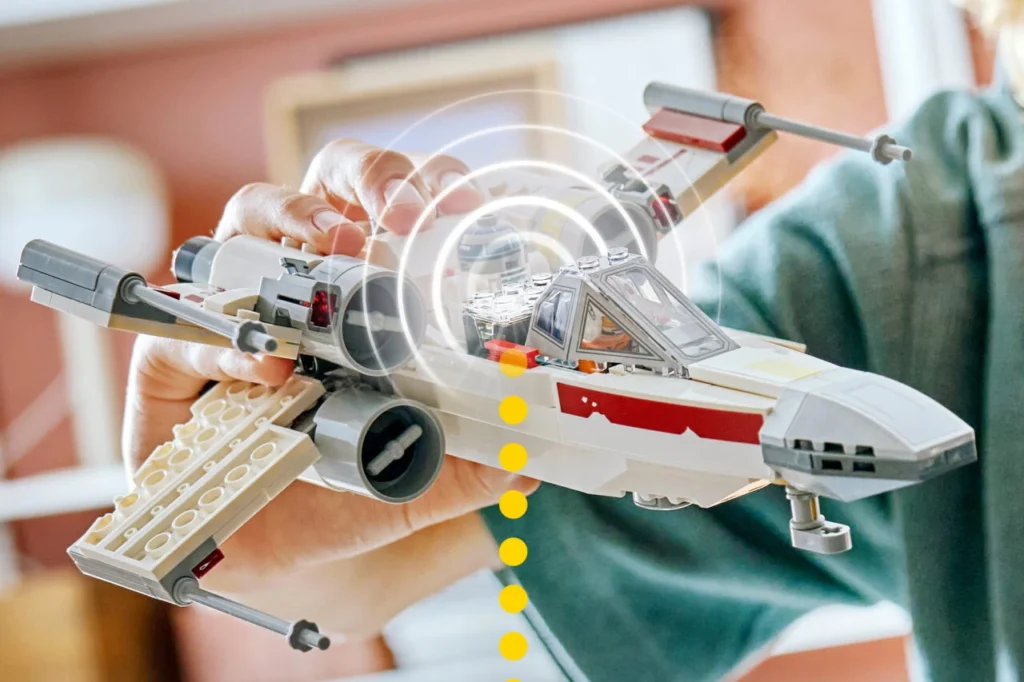
Nowhere is this philosophy clearer than in Lego’s Star Wars Smart Play lineup, a collection that leverages decades of fan devotion while introducing a genuinely new way to interact with one of the most beloved fictional universes ever created.
Lego’s Long Journey Toward Intelligent Play
Lego has always been more than plastic bricks. At its core, the Lego system is a modular language of creativity, where physical constraints spark imagination rather than limit it. Over the years, Lego experimented with merging that philosophy with digital experiences.
Projects like Lego Dimensions allowed characters to jump between universes. Lego Mario added basic interactivity and scoring mechanics. Hidden Side explored augmented reality storytelling. Each of these initiatives taught Lego something important—but they also revealed a recurring problem: reliance on screens diluted the tactile magic that makes Lego special.
Smart Play represents a philosophical correction.
Instead of pushing play into an app, Lego embedded intelligence directly into the bricks. The result feels less like a toy that uses technology and more like technology that respects toys.
What Is Lego Smart Play, Really?
Lego Smart Play is not a single product but a new platform. It consists of three core elements that work together seamlessly:
At the center is the Smart Brick, a standard-looking Lego brick that quietly houses an impressive array of technology. Around it are Smart Minifigures, which contain embedded identifiers and electronics. Completing the system are Smart Tags, which allow ships, vehicles, environments, and structures to participate in the interactive experience.
The genius of Smart Play lies in how invisible it feels. If you didn’t know the Smart Brick was special, you might mistake it for a slightly translucent Lego piece. But inside, it contains sensors that detect motion, light, sound, proximity, and orientation—along with a miniature speaker and wireless charging capability.
Unlike previous Lego tech experiments, Smart Play works entirely offline. There is no required app. No firmware updates demanded mid-play. No screens competing for attention. The intelligence lives inside the build.
The Smart Brick: Small, Silent, and Surprisingly Powerful
From a hardware perspective, the Smart Brick is remarkable. Lego engineers managed to compress an accelerometer, light detector, sound sensor, wireless charging coil, and onboard audio synthesis into a form factor that remains fully compatible with standard Lego builds.
What truly sets it apart, however, is how sound is generated. Rather than relying on prerecorded audio files, the Smart Brick uses a built-in synthesizer. Sounds are generated dynamically based on player actions. This means engine noise can change based on movement, lightsaber clashes respond to timing and force, and environmental sounds shift depending on proximity.
There is no generative AI involved. This is procedural audio design—an approach more commonly found in advanced video games than children’s toys.
The result is a system that feels reactive rather than scripted.
Why Star Wars Is the Perfect Testbed
If Lego was going to introduce a platform this ambitious, Star Wars was the obvious choice. Lego Star Wars is one of the most successful toy lines in history, beloved by multiple generations and deeply tied to imaginative play.
Star Wars is also a universe defined by sound. The hum of a lightsaber, the whine of a TIE fighter, the roar of an X-wing engine—these audio cues are emotionally powerful. Embedding them into physical play without requiring a screen is a bold and inspired move.
The Smart Play system does not simply reproduce these sounds. It contextualizes them.
Hands-On at CES 2026: First Impressions Matter
At CES 2026, hands-on demos revealed just how far Lego has taken this idea. Building the sets initially feels familiar. Bags of bricks, clear instructions, methodical construction. For most of the build process, nothing feels different from Lego Star Wars sets released over the past two decades.
The difference emerges at the final stage, when the Smart Brick and its related components are integrated into the model. Suddenly, the build feels less like a static object and more like a responsive system.
Pick up an X-wing and tilt it mid-flight, and R2-D2 reacts audibly. Land the ship gently, and the engines cool down with a fading hum. Engage in a lightsaber duel, and the clash responds to motion, timing, and proximity.
This is not gimmickry. It is layered interaction.
Luke’s Red Five X-Wing: A Familiar Icon, Reimagined
The flagship Smart Play set is Luke Skywalker’s Red Five X-wing, a 584-piece build that balances nostalgia with innovation. The ship itself remains instantly recognizable, but it is surrounded by a broader play environment that includes ground vehicles, a command center, and character interactions.
Two Smart Minifigures—Luke and Princess Leia—anchor the experience, while multiple Smart Tags allow the ship, support vehicles, and even R2-D2 to participate in the system. The result is a cohesive play space rather than a single display model.
At around $100, the set is priced above traditional Lego Star Wars kits of similar size. Lego argues that value is defined by experience, not piece count. After hands-on time, that argument carries weight.
Darth Vader’s TIE Fighter: Minimalist but Effective
The most accessible entry point into Smart Play is Darth Vader’s TIE Fighter. With 473 pieces and a lower price point, it offers a more focused experience. There is one Smart Minifigure—Vader himself—and a single Smart Tag tied to the ship.
Despite its simplicity, the set delivers some of the most satisfying interactions. Flying the TIE Fighter triggers distinct engine sounds. Engaging in mock dogfights with the X-wing set unlocks reactive audio cues that make the battle feel dynamic rather than repetitive.
This set demonstrates that Smart Play scales effectively, even with fewer components.
Throne Room Duel & A-Wing: Where Smart Play Shines
The most ambitious set in the initial lineup is The Throne Room Duel & A-Wing. At $160, it is also the most expensive. However, it justifies its price by fully embracing the Smart Play ecosystem.
Three Smart Minifigures—Luke, Darth Vader, and Emperor Palpatine—interact with multiple Smart Tags embedded throughout the environment. Platforms detect movement, the throne responds to presence, and the duel evolves based on how players move and position characters.
This set feels less like a toy and more like a physical game system. It evokes classic Lego dueling sets from the mid-2000s while layering in modern responsiveness.
For long-time Lego fans, it bridges generations beautifully.
Design Philosophy: Enhancing, Not Replacing Imagination
One of the most impressive aspects of Smart Play is restraint. Lego could have flooded the experience with constant sound and flashing lights. Instead, interactions are contextual and optional.
Crucially, every Smart Play set remains fully playable without the Smart Brick. The electronics enhance play, but they do not define it. This ensures longevity. When batteries eventually degrade, the bricks remain bricks.
This design choice reflects a deep understanding of why Lego has endured while other tech toys faded.
Pricing, Value, and the Lego Debate
Lego sets have become more expensive over the years, and Smart Play continues that trend. Critics will undoubtedly question whether electronics justify higher prices.
From a product strategy standpoint, Lego is positioning Smart Play as a premium experience—not a replacement for traditional sets. Standard Lego Star Wars kits are not going away. Smart Play is an alternative for those seeking deeper interaction.
Given the engineering involved, the pricing feels aligned with the value proposition.
The Road Ahead: A Smarter Lego Universe
Lego has already teased future Smart Play expansions, including the Millennium Falcon, Mos Eisley Cantina, and Landspeeder. If these sets interconnect as seamlessly as early demos suggest, Smart Play could evolve into a modular, expanding universe.
This opens intriguing possibilities: cross-set interactions, emergent storytelling, and play experiences that grow over time without relying on software updates.
Final Verdict: A Rare Case of Tech Done Right
Skepticism was warranted. Lego has tried—and sometimes failed—to merge physical play with technology before. But Smart Play feels different because it respects Lego’s core philosophy.
It does not demand attention. It rewards curiosity. It enhances imagination rather than replacing it.
For lifelong Lego and Star Wars fans, this is one of the most promising evolutions the brand has delivered in years.
FAQs
1. What is Lego Smart Play?
A new Lego system that adds sensors, sound, and interaction to physical bricks.
2. Does Smart Play require a phone or app?
No, it works entirely on its own.
3. Are the sounds prerecorded?
No, sounds are generated dynamically using onboard synthesis.
4. Can the sets be played without electronics?
Yes, all Smart Play sets function as normal Lego builds.
5. When do the sets release?
They launch on March 1, 2026.
6. Are Smart Play sets suitable for adults?
Absolutely, especially longtime Lego Star Wars fans.
7. Will more sets be released?
Yes, Lego has teased additional Smart Play Star Wars sets.
8. Is this Lego’s biggest tech leap?
It may be the most seamless integration yet.
9. Are Smart Play bricks rechargeable?
Yes, they use wireless charging.
10. Is Smart Play replacing classic Lego?
No, it’s an optional premium experience.