

For decades, home theater audio has been bound by rules. Speakers had to be placed at exact angles, measured distances, and precise heights to achieve “true” surround sound. Living rooms were rearranged, furniture compromised, and wires snaked across floors—all in service of audio accuracy.
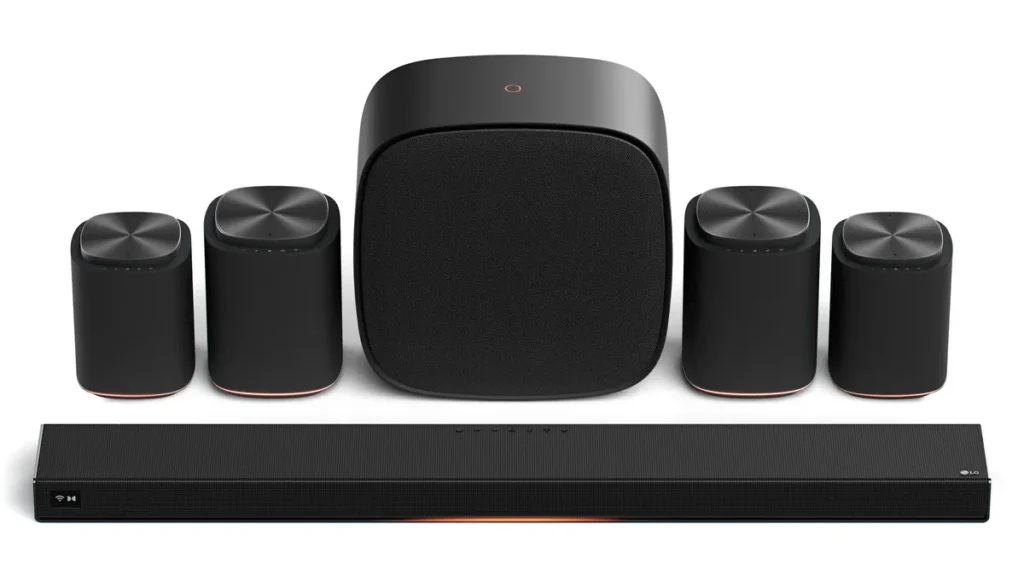
LG’s newly unveiled Dolby Atmos FlexConnect system challenges that entire philosophy.
With the introduction of the LG Sound Suite—its first FlexConnect-enabled speaker lineup—LG is signaling a future where immersive audio adapts to the room, not the other way around. Instead of forcing users to design their living spaces around speaker placement, FlexConnect allows speakers to be placed almost anywhere while software intelligence handles calibration automatically.
This is not just an incremental improvement. It represents a fundamental rethinking of how surround sound systems should work in real homes.
What LG Announced Ahead of CES 2026
Ahead of CES 2026, LG revealed its first Dolby Atmos FlexConnect ecosystem, branded as the LG Sound Suite. For the first time, the company is combining FlexConnect technology with a soundbar-centric design, expanding the appeal beyond premium TV owners.
The lineup includes four distinct components: the H7 soundbar, M7 and M5 surround speakers, and the W7 subwoofer. Together, they form a modular audio system capable of scaling from minimal setups to full cinematic experiences.
While FlexConnect initially debuted with TCL hardware, LG’s implementation marks the first time the technology is being paired with a soundbar that can act as the system’s central controller—even when used with TVs that lack native FlexConnect support.
Understanding Dolby FlexConnect: Software-Defined Surround Sound
Dolby FlexConnect is not a new audio format. It is a new way of delivering Dolby Atmos.
Traditional Atmos systems require precise speaker layouts to create accurate height, depth, and spatial effects. FlexConnect replaces these physical constraints with real-time acoustic mapping. Using microphones, processing algorithms, and spatial modeling, the system analyzes where each speaker is located in the room and adjusts audio output accordingly.
This allows users to place speakers asymmetrically, at different heights, or even at unconventional positions. The system compensates by dynamically steering sound to maintain a cohesive 3D soundstage.
In practical terms, FlexConnect shifts surround sound from a hardware-defined experience to a software-defined one.
Why the H7 Soundbar Is the Most Important Piece
The most significant innovation in LG’s announcement is the H7 soundbar’s role as a “lead device.” Unlike previous FlexConnect implementations that required compatible TVs, the H7 can independently manage speaker coordination.
This means users can integrate FlexConnect speakers with virtually any TV by simply adding the soundbar. The soundbar becomes the system’s brain, handling calibration, synchronization, and spatial processing.
This dramatically lowers the barrier to entry. Users no longer need to upgrade their TV to access FlexConnect—an important move in a market where TVs are replaced far less frequently than audio accessories.
From Minimalist Setup to 13.1.7 Home Theater
LG claims the Sound Suite supports up to 27 different speaker configurations. These range from simple two-speaker arrangements to an expansive 13.1.7 channel Atmos setup capable of rivaling dedicated home theaters.
What makes this impressive is not the channel count itself, but the flexibility. Users can start small and expand over time without reconfiguring their entire setup. Each added speaker is automatically integrated into the system’s spatial model.
This modular approach aligns with modern consumer behavior, where buyers prefer incremental upgrades rather than all-at-once investments.
Why This Matters for Real Living Rooms
Most homes are not designed for perfect acoustics. Furniture placement, open floor plans, wall materials, and ceiling heights all interfere with ideal speaker layouts.
FlexConnect acknowledges this reality instead of fighting it. By allowing speakers to be placed where they are convenient rather than where diagrams dictate, LG is targeting everyday users rather than home theater purists alone.
This approach could significantly expand the audience for immersive audio, particularly among apartment dwellers and urban households where space constraints are unavoidable.
LG’s Strategic Play Against Traditional AV Systems
LG’s move is as much strategic as it is technical.
Traditional AV receivers and wired speaker systems are powerful but intimidating. They require technical knowledge, careful installation, and ongoing adjustment. Soundbars, by contrast, have grown popular because of their simplicity.
By merging soundbar convenience with Atmos-grade immersion, LG is positioning FlexConnect as a middle path—more advanced than a basic soundbar, but far more accessible than a full AV receiver setup.
This places pressure on both traditional AV brands and competing soundbar manufacturers to rethink their approaches.
Comparison With TCL and the Competitive Landscape
Dolby FlexConnect first appeared in TCL’s Z100 system, priced at around $300. While affordable, TCL’s implementation was limited in ecosystem depth.
LG’s Sound Suite expands the concept into a full product family, backed by LG’s display dominance and premium TV lineup. With FlexConnect compatibility arriving in LG’s 2026 TVs—and retrofitted to select 2025 models—the company is building an integrated audio-visual ecosystem rather than a standalone product.
This integration could give LG a significant edge, especially among consumers already invested in LG displays.
The Role of Software in the Future of Audio
The Sound Suite underscores a broader industry shift: audio performance is increasingly driven by software intelligence rather than physical placement alone.
As processing power increases and room-mapping algorithms improve, the importance of perfect speaker geometry diminishes. What matters instead is how well the system understands and adapts to its environment.
LG’s FlexConnect system is a clear example of this trend, where software becomes the defining feature of hardware.
Pricing, Availability, and the Waiting Game
LG has not yet announced pricing or release dates for the Sound Suite. This creates uncertainty but also anticipation. If LG positions the system competitively, it could disrupt the premium soundbar market.
Pricing will ultimately determine whether FlexConnect remains a niche feature or becomes mainstream. Given TCL’s pricing benchmark and LG’s premium branding, the final cost will signal how aggressively LG intends to push this technology.
Implications for the Home Entertainment Industry
If FlexConnect succeeds, it could redefine consumer expectations for home audio. Fixed layouts, long cables, and complex calibration processes may increasingly feel outdated.
Manufacturers may be forced to prioritize adaptability and intelligence over rigid performance metrics. The future of home audio may be less about where speakers are placed—and more about how well systems adapt to human spaces.
Conclusion: A New Era of Audio Freedom
LG’s Dolby Atmos FlexConnect Sound Suite is not just a new product—it’s a statement about where home entertainment is heading.
By freeing users from traditional speaker placement rules, LG is aligning immersive audio with modern living realities. If execution matches ambition, FlexConnect could become one of the most important audio innovations of the decade.
FAQs
1. What is Dolby FlexConnect?
It’s a surround sound technology that adapts audio output based on speaker placement.
2. Do speakers need to be placed symmetrically?
No, FlexConnect allows flexible and asymmetrical placement.
3. Can FlexConnect work with older TVs?
Yes, if paired with LG’s H7 soundbar acting as a lead device.
4. How many speakers does the system support?
Up to a 13.1.7 channel configuration.
5. Is this a wireless system?
Yes, speakers connect wirelessly and are software-calibrated.
6. Does FlexConnect replace traditional AV receivers?
It offers an alternative, not a direct replacement.
7. When will LG Sound Suite launch?
Pricing and availability have not yet been announced.
8. Is FlexConnect exclusive to LG TVs?
Native support is in LG TVs, but soundbar-based support expands compatibility.
9. How is this different from regular Dolby Atmos soundbars?
It uses intelligent spatial mapping instead of fixed speaker layouts.
10. Is this suitable for small apartments?
Yes, it’s designed specifically for real-world living spaces.