

Meta’s ambitions in the mixed reality space have always been bold—some may even argue they’ve been overly ambitious at times. From the early days of Oculus to the expansive metaverse roadmap, the company has consistently positioned itself as a long-term visionary of immersive computing. Now, a new chapter in that journey involves a significant shift in release timelines. According to an internal memo obtained by Business Insider, Meta’s highly anticipated mixed reality glasses, code-named “Phoenix,” have been delayed from their initial 2026 timeframe to early 2027.
The internal communication, authored by Meta Reality Labs executives Gabriel Aul and Ryan Cairns, paints a picture of a company refusing to compromise on product quality, user experience refinement, and hardware reliability. In their words, the delay provides Meta with “a lot more breathing room to get the details right”—a phrase that reflects both caution and strategic recalibration.
The mixed reality sector, particularly the area occupied by advanced spatial computing devices, has undergone drastic transformation over the past few years. With competitors like Apple entering aggressively through the Vision Pro, and Samsung resurfacing through its Galaxy XR projects, pressure has intensified. Meanwhile, consumer expectations have ballooned: lightweight form factors, seamless integration of virtual and physical worlds, all-day wearability, and true convenience are no longer aspirational—they are demands.
Phoenix represents Meta’s most serious attempt at breaking the boundaries of traditional VR headsets and stepping into everyday wearable AR/MR hardware. This isn’t just another addition to Meta’s lineup of devices—it’s part of a long-haul vision to evolve computing beyond screens and handheld interfaces. Let us unpack everything we know: the technology, the delay, the design strategy, the compute puck, and how Phoenix fits into the company’s broader roadmap.
A Strategic Delay: Why 2027 Matters for Meta’s XR Roadmap
Product delays in the tech industry are not uncommon, especially in emerging sectors like augmented and mixed reality. However, Meta’s shift from late 2026 to early 2027 is more than a scheduling adjustment—it’s a recognition of the complexity behind delivering a lightweight, reliable, and technically superior mixed reality experience.
Reality Labs executives emphasize that several major UX transitions, internal system-level redesigns, and hardware dependencies have created a congested development timeline. Their memo underscores an unmistakable priority: Meta refuses to launch Phoenix until it is polished and stable.
This decision aligns with broader industry trends. When Apple entered with the Vision Pro, it demonstrated that consumers will tolerate premium prices if a product delivers genuine innovation. Meta appears to be following a different path—prioritizing accessibility through lighter design, lower cost, and battery efficiency.
A delay allows the company to:
- perfect its holographic rendering pipelines
- optimize the weight-to-performance ratio
- improve the compute puck wireless system
- refine Horizon OS for wearables
- strengthen hand tracking, spatial mapping, and environmental anchors
- reduce heat buildup
- extend battery life
In other words, 2027 may be the earliest moment when all these moving parts can coexist in a single, consumer-ready device.
From “Puffin” to “Phoenix”: How the Product Evolved
Earlier leaks referred to Meta’s next-generation glasses as “Puffin,” a name that hinted at whimsy more than power. But as details emerged, it became clear this was not just another iterative concept—it was the first serious attempt to merge the lightweight design of Ray-Ban Meta glasses with the immersive capabilities of the Quest series.
The shift to the “Phoenix” codename signals rebirth, reinvention, and ambition.
Reports indicate that Phoenix will:
- adopt a goggle-like structure
- resemble a bulky pair of glasses rather than a VR helmet
- weigh around 110 grams (an extraordinary reduction compared to Vision Pro’s 650 grams)
- rely on an external compute puck
- run on Horizon OS
- act as a more affordable alternative to VR-dominant headsets like Quest 3
This combination reveals Meta’s mission: to bring mixed reality to the masses without the pitfalls of overly heavy headsets.
A Look at the Hardware: The Goggle-Like MR Glasses of the Future
The weight projection—110 grams—is one of the most talked-about aspects of Phoenix. If Meta achieves this, Phoenix will immediately stand out as the lightest MR device of its class. The Vision Pro, though technologically impressive, sparked criticism for its heaviness, even with a battery pack offloaded to an external unit.
Phoenix is expected to offer:
- compact optical systems
- high-resolution passthrough
- color-corrected mixed reality layers
- ultra-wide field-of-view optics
- eye and hand tracking capabilities
- depth-sensing outward cameras
- advanced environmental mapping
Yet, the real magic lies not in the glasses themselves, but in what powers them behind the scenes.
The Compute Puck: Meta’s Biggest Hardware Innovation Yet
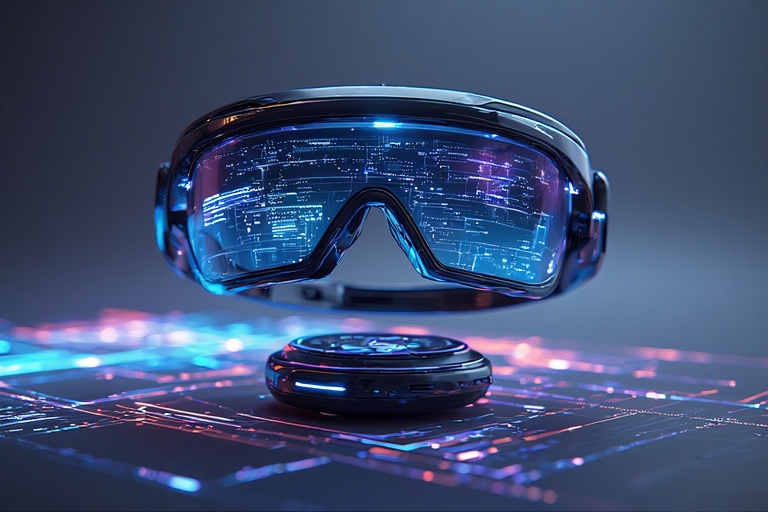
One of the most transformative elements of Phoenix is its compute puck, a small external device responsible for carrying the bulk of processing, AI workloads, rendering pipelines, and heat-intensive operations. This puck wires or wirelessly connects to the glasses, enabling them to remain incredibly light.
In essence, Meta is separating heavy computing duties from wearable optics.
The compute puck may include:
- a small form factor CPU/GPU system
- dedicated AI accelerators
- wireless connectivity modules
- a battery for sustained usage
- cooling structures for heat dissipation
This shines a spotlight on Meta’s long-term wearable strategy:
the future of computing is modular.
Instead of overburdening the face-mounted device with all hardware components, Meta envisions a distributed system similar to how smartphones work alongside earbuds or smartwatches.
Horizon OS: The Operating System Behind the Vision
Meta confirmed earlier that its XR ecosystem would unify under Horizon OS, a purpose-built system optimized for spatial applications, mixed reality content, and 3D interfaces.
Phoenix will take full advantage of this OS ecosystem.
Horizon OS features include:
- spatial UX layers
- persistent digital anchors in your environment
- voice and gesture-based navigation
- compatibility with Meta’s app ecosystem
- integration with Quest-series features
- third-party developer support for MR apps
- optimization for shared spaces and multiplayer experiences
Horizon OS aims to serve as Meta’s direct answer to Apple’s visionOS, and Phoenix is positioned to be its showcase wearable.
A Market in Transition: Where Phoenix Fits in the XR Landscape
The industry is undergoing a significant shift. While VR remains a thriving niche, mixed reality and AR hardware represent the next frontier. There is greater demand for lighter devices that can blend real and digital environments while enabling productivity, entertainment, navigation, and intelligent overlays.
Meta’s Quest 3 remains the market leader in consumer MR, but its headset format hinders all-day usability. Phoenix aims to overcome this limitation by introducing a wearable that fits between smart glasses and full headsets.
Phoenix becomes the bridge:
Ray-Ban Meta Smart Glasses → Phoenix Mixed Reality Glasses → Quest Headsets
This three-tier lineup signals Meta’s desire to dominate multiple experience categories within the spatial computing ecosystem.
Internal Budget Shifts: Metaverse Cuts and AI Prioritization
Bloomberg recently reported that Meta plans to cut up to 30% of its metaverse spending, reallocating funds toward wearables and AI-driven hardware, including AI glasses.
Meta’s XR strategy is shifting away from:
- expensive enterprise headsets
- experimental metaverse projects
- high-end VR lines like Quest Pro (already cancelled in 2025)
And moving toward:
- affordable mixed reality
- wearable AI
- everyday assistants embedded in glasses
- platform-wide intelligent computing
Phoenix fits perfectly into this new focus.
Why Phoenix Represents the Future of Wearable Computing
Meta is positioning Phoenix not just as a product, but as a stepping-stone toward a new form of computing.
Phoenix is Meta’s attempt to:
- deliver holographic reality without bulky plastic
- unify AR and MR under one device
- build a robust wearable ecosystem
- push AI assistants directly onto your face
- normalize spatial interfaces
- compete with Apple Vision Pro’s ecosystem—but at lighter, cheaper scale
If successful, Phoenix could redefine how we interact with information, entertainment, productivity tools, and the world around us.
Conclusion: What the 2027 Delay Means for Consumers and the Industry
Meta’s decision to push the Phoenix MR glasses to 2027 is not a setback—but a strategic recalibration. The XR market is maturing quickly, and expectations for comfort, performance, and usability are skyrocketing. By delaying the launch, Meta is taking the time needed to deliver a device that can withstand comparison not only to Apple’s offerings but to future competitors emerging across Asia and Europe.
Phoenix will be a critical part of Meta’s long-term hardware pathway—a bold experiment that could either position the company as the leader in spatial wearables or create new pressures in an increasingly competitive market.
2027 will determine whether the Phoenix truly rises.
FAQs
1. Why did Meta delay the Phoenix mixed reality glasses to 2027?
Meta needs additional development time to refine UX, hardware reliability, and system stability.
2. What is the expected weight of Meta’s Phoenix glasses?
Around 110 grams, significantly lighter than most MR headsets.
3. What is the compute puck and why is it important?
It’s an external processing device that offloads heavy computation to keep the glasses lightweight.
4. Will Phoenix replace the Meta Quest headsets?
No. It complements the Quest line, focusing on wearable mixed reality.
5. What operating system will Phoenix use?
Horizon OS, Meta’s unified XR platform.
6. Are Phoenix glasses meant to compete with Apple Vision Pro?
Yes, though at a lighter and possibly more affordable scale.
7. Will Phoenix support hand and eye tracking?
Yes, these are core features of Meta’s MR ecosystem.
8. Will Phoenix be standalone?
It will rely on the compute puck for processing.
9. How does Phoenix differ from Ray-Ban Meta smart glasses?
Ray-Bans are for lightweight AI and camera tasks, Phoenix is full MR.
10. Is Phoenix intended for everyday use?
Yes, Meta aims to deliver all-day comfortable mixed reality functionality.