

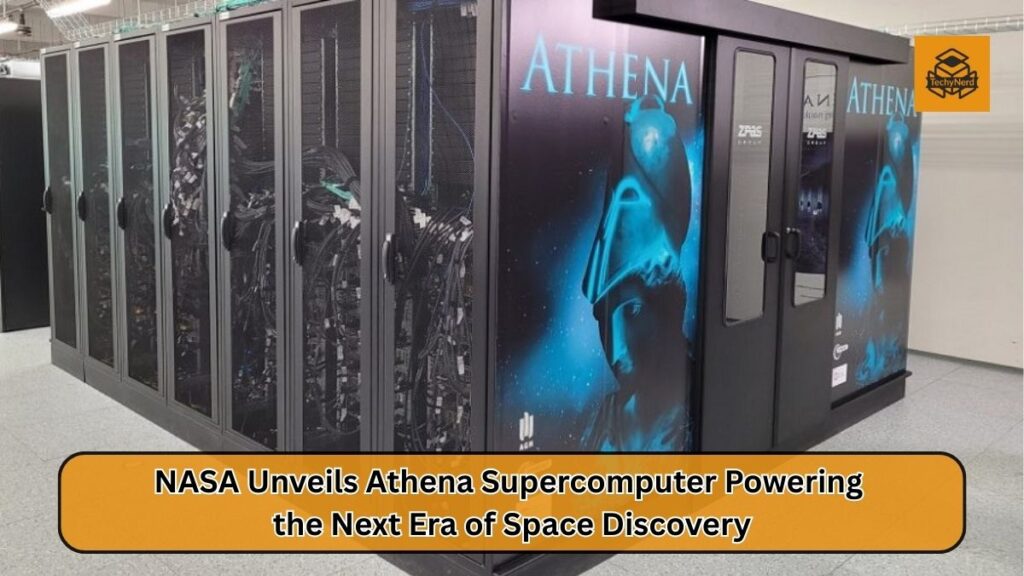
NASA has officially entered a new era of high-performance computing with the debut of Athena, its most powerful and energy-efficient supercomputer to date. Brought online after a successful beta testing phase, Athena is now fully available to researchers and engineers working across NASA’s vast mission portfolio. From deep-space exploration and aeronautics to climate science and artificial intelligence, Athena represents a foundational leap in how the agency tackles its most complex computational challenges.
As space missions grow more ambitious and data-intensive, traditional computing approaches are no longer sufficient. Athena is not merely an upgrade to NASA’s existing systems — it is a strategic investment in computational infrastructure designed to support decades of discovery ahead.
Why High-End Computing Has Become Mission-Critical for NASA
Modern space exploration is increasingly defined by data. Every rocket launch, satellite deployment, planetary landing, and space telescope observation generates massive volumes of information. Processing this data in meaningful timeframes requires extraordinary computing power.
NASA relies on supercomputers to simulate rocket launches before they happen, model airflow over experimental aircraft designs, predict climate patterns on Earth and other planets, and analyze signals from distant cosmic phenomena. These simulations reduce risk, save costs, and accelerate innovation by allowing scientists to test thousands of scenarios virtually before committing to real-world missions.
Athena arrives at a moment when these demands are intensifying. Human missions to the Moon under the Artemis program, preparations for future Mars exploration, and the growing role of artificial intelligence in scientific analysis have pushed computational needs to unprecedented levels.
Athena’s Role in Expanding NASA’s Computational Frontier
Athena was designed specifically to address problems that were previously constrained by computational limits. With more than 20 petaflops of peak performance, the system surpasses earlier NASA platforms such as Pleiades and Aitken, both of which have served the agency reliably for years.
This increase in performance enables scientists to run higher-resolution simulations, process larger datasets, and experiment with more complex models than ever before. Whether simulating the violent physics of atmospheric entry or training AI systems to detect anomalies in spacecraft telemetry, Athena provides the horsepower required to push research forward without compromise.
A Focus on Energy Efficiency and Sustainability
Raw computing power is only part of the equation. Operating large-scale supercomputers is expensive, not only financially but also environmentally. Athena distinguishes itself by delivering significantly improved energy efficiency, lowering operational costs while reducing its environmental footprint.
NASA’s Modular Supercomputing Facility, where Athena is housed, was designed with sustainability in mind. Advanced cooling systems and optimized power distribution allow the system to deliver exceptional performance without the energy demands typically associated with machines of its class.
This focus on efficiency reflects a broader shift across the tech industry, where performance gains are increasingly measured not just in speed but in performance-per-watt.
Supporting Advanced Simulations Across Space and Aeronautics
One of Athena’s primary functions is enabling advanced simulations that would be impractical or impossible on less powerful systems. These simulations allow engineers to model complex physical phenomena with extraordinary precision.
In space exploration, Athena supports simulations of rocket propulsion, spacecraft structural integrity, and planetary environments. Engineers can model how spacecraft materials behave under extreme temperatures and radiation, reducing uncertainty before launch.
In aeronautics, the system plays a crucial role in designing next-generation aircraft. High-fidelity airflow simulations help researchers develop quieter, more fuel-efficient, and environmentally friendly aircraft designs — a key priority as aviation faces increasing pressure to reduce emissions.
Accelerating Scientific Discovery Through Data Analysis
Beyond engineering, Athena is a powerful tool for scientific discovery. Modern science increasingly depends on analyzing massive datasets generated by space telescopes, Earth-observing satellites, and planetary missions.
Athena enables faster processing of this data, allowing scientists to identify patterns, anomalies, and insights that might otherwise remain hidden. This capability is especially critical in fields such as astrophysics, where detecting subtle signals can lead to groundbreaking discoveries about the universe.
Climate science also benefits significantly. By analyzing complex Earth system models, Athena helps researchers better understand climate dynamics, predict extreme weather events, and assess long-term environmental changes.
Artificial Intelligence and Machine Learning at Scale
Artificial intelligence is becoming a core component of NASA’s research strategy. Athena is optimized to support the development and training of AI and machine learning models at scale.
These models are used to analyze satellite imagery, automate spacecraft operations, detect system anomalies, and enhance scientific research. Training such models requires enormous computational resources, particularly when dealing with high-resolution data or real-time mission support.
With Athena, NASA can experiment with more sophisticated AI architectures, shortening development cycles and improving model accuracy. This capability positions the agency at the forefront of AI-driven scientific research.
Access Beyond NASA: Enabling Collaboration
While Athena primarily serves NASA researchers, access to the system extends beyond the agency. External scientists and engineers supporting NASA programs can apply for computing time through the agency’s high-end computing allocation process.
This collaborative approach ensures that Athena’s capabilities benefit a broad scientific community, fostering innovation through shared resources. Universities, research institutions, and industry partners all stand to gain from access to one of the world’s most advanced computing systems.
Athena operates under NASA’s High-End Computing Capability (HECC) portfolio, managed by the Office of the Chief Science Data Officer. This centralized management ensures efficient resource allocation and alignment with mission priorities.
Inside NASA’s Modular Supercomputing Facility
Athena is housed at NASA’s Ames Research Center in Silicon Valley, within the agency’s Modular Supercomputing Facility. This facility represents a modern approach to supercomputing infrastructure, allowing systems to be upgraded and expanded with minimal disruption.
The modular design provides flexibility, enabling NASA to adapt quickly as computing technologies evolve. Athena is not a static installation; it is part of a scalable ecosystem designed to grow alongside future missions.
The Meaning Behind the Name ‘Athena’
The name Athena was selected through an internal contest among NASA’s HECC workforce in 2025. Drawing from Greek mythology, Athena is the goddess of wisdom and strategic warfare — a fitting symbol for a system designed to tackle complex challenges with intelligence and precision.
NASA also highlighted Athena’s connection to Artemis, the goddess’s half-sister and the namesake of the agency’s lunar exploration program. This symbolic link underscores Athena’s role in supporting Artemis missions and beyond.
How Athena Shapes NASA’s Long-Term Strategy
Athena is more than a technological upgrade; it is a strategic asset. As NASA prepares for increasingly complex missions, the ability to simulate, analyze, and optimize systems at scale becomes indispensable.
Future missions to the Moon, Mars, and beyond will depend on computational tools like Athena to reduce risk, enhance safety, and maximize scientific return. The system also serves as a testbed for emerging computing technologies, informing future investments and innovations.
Final Perspective: Computing as the Engine of Discovery
NASA’s debut of Athena signals a clear recognition that computing power is now as critical to exploration as rockets and spacecraft. In an era defined by data and complexity, Athena provides the foundation upon which the next generation of discoveries will be built.
By combining unmatched performance, improved efficiency, and broad accessibility, Athena positions NASA to lead not only in space exploration but in computational science itself. As missions grow bolder and questions grow deeper, Athena will be there — quietly processing the universe, one calculation at a time.
FAQs
1. What is NASA’s Athena supercomputer?
Athena is NASA’s newest and most powerful high-end computing system.
2. When did Athena become operational?
Athena became available to users in January 2026 after beta testing.
3. Where is Athena located?
It is housed at NASA’s Ames Research Center in Silicon Valley.
4. How powerful is Athena?
Athena delivers over 20 petaflops of peak performance.
5. What research does Athena support?
It supports space exploration, aeronautics, AI, climate science, and data analysis.
6. Is Athena more efficient than previous systems?
Yes, it offers significant improvements in energy efficiency.
7. Who can access Athena?
NASA researchers and approved external collaborators can apply for access.
8. What is the HECC portfolio?
It is NASA’s High-End Computing Capability program managing supercomputing resources.
9. Why is Athena important for AI research?
It enables large-scale training and deployment of advanced AI models.
10. How does Athena support future missions?
It reduces risk and accelerates discovery through advanced simulations and analysis.