

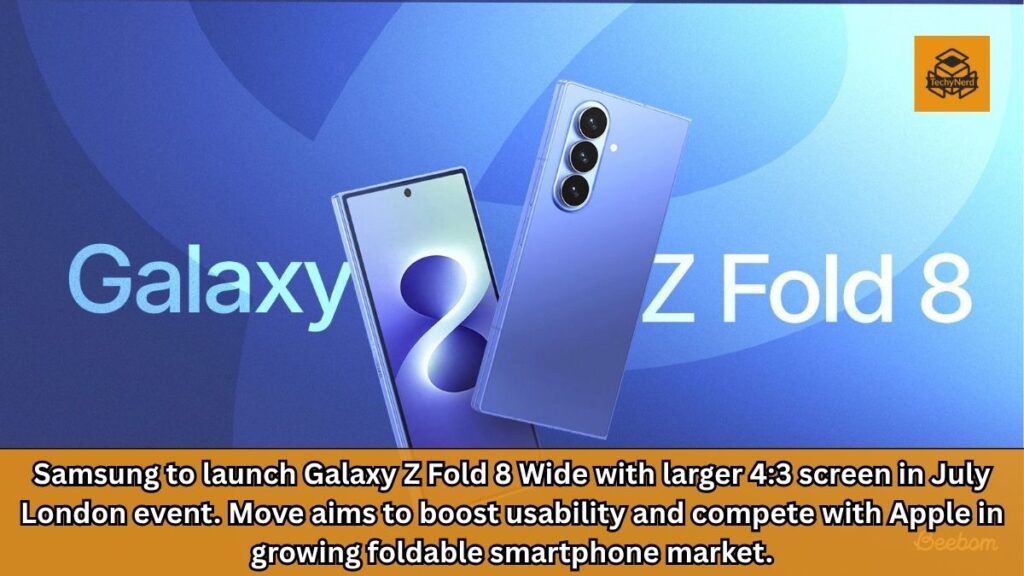
The global smartphone industry is once again preparing for a defining moment as Samsung Electronics gears up to unveil its next generation of foldable devices. Scheduled for a potential launch in London this July, the upcoming Galaxy Unpacked event is expected to introduce the Galaxy Z Fold 8 and Galaxy Z Flip 8 series. However, what is truly capturing industry attention is a rumored new variant tentatively dubbed the Galaxy Z Fold 8 “Wide.”
This anticipated device signals more than just another iterative upgrade. It represents a possible paradigm shift in foldable smartphone design, one that could redefine user expectations and reshape competitive dynamics in a market that is becoming increasingly contested.
The Rise of Foldables: Samsung’s Leadership and Market Context
Samsung has long been the undisputed leader in the foldable smartphone segment. Since pioneering the category with its early Galaxy Fold devices, the company has consistently pushed the boundaries of hardware engineering, display technology, and user experience.
According to industry estimates, Samsung accounted for approximately 40 percent of global foldable shipments last year. This dominance places it well ahead of competitors such as Huawei, Motorola, and Honor, all of which have made significant strides but still trail Samsung’s scale and ecosystem advantages.
Despite this leadership, the competitive landscape is rapidly evolving. Foldables are no longer a niche category; they are becoming a strategic battleground for major technology companies seeking differentiation in a saturated smartphone market.
Galaxy Z Fold 8 Wide: A Potential Design Breakthrough
At the center of this year’s anticipation is the possibility of a wider foldable device. Previous Galaxy Z Fold models have featured an internal display with an aspect ratio close to 1.1:1, resulting in a near-square form factor when unfolded.
The rumored Galaxy Z Fold 8 Wide, however, is expected to adopt a 4:3 aspect ratio. This change may seem subtle on paper, but in practice, it represents a fundamental shift in usability.
A wider display could deliver a more natural viewing experience, particularly for productivity tasks, multimedia consumption, and multitasking. Applications that are traditionally optimized for tablets may function more seamlessly, bridging the gap between smartphones and larger computing devices.
From a design perspective, achieving this transformation requires significant engineering innovation. Adjustments to hinge mechanisms, internal component layout, and weight distribution would be necessary to maintain durability and portability while expanding screen real estate.
Why Aspect Ratio Matters More Than Ever
The importance of aspect ratio in modern devices cannot be overstated. It directly influences how users interact with content, from reading documents and browsing the web to watching videos and running multiple apps simultaneously.
A 4:3 ratio aligns more closely with traditional tablet dimensions, offering advantages in readability and usability. For professionals, this could mean a more efficient workflow, with fewer compromises when switching between mobile and desktop environments.
For consumers, the benefits extend to entertainment. Streaming content, gaming, and social media experiences can feel more immersive and less constrained by awkward screen proportions.
By potentially adopting this format, Samsung is not merely responding to trends; it is proactively shaping the future direction of foldable devices.
The Apple Factor: A Looming Competitive Threat
No discussion of the foldable market would be complete without addressing Apple. While Apple has yet to release a foldable device, persistent reports suggest that the company is actively developing one, possibly featuring a similar 4:3-style display.
If Apple enters the foldable space, it could dramatically alter market dynamics. Known for its meticulous approach to product design and ecosystem integration, Apple’s entry would likely accelerate mainstream adoption of foldables.
Analysts predict that Apple could capture a substantial share of the market shortly after launch, potentially reducing Samsung’s dominance. Estimates suggest Samsung’s share could drop to around 31 percent, with Apple securing approximately 28 percent.
This looming competition may explain Samsung’s willingness to experiment with new form factors. By introducing a wider foldable ahead of Apple’s entry, Samsung can position itself as an innovator rather than a follower.
Galaxy Unpacked in London: Strategic Location and Timing
Samsung’s decision to host its Galaxy Unpacked event in London is noteworthy. The city serves as a global hub for technology, finance, and media, making it an ideal मंच for showcasing cutting-edge innovations.
Holding the event in July also aligns with Samsung’s established product launch cycle. The company typically unveils its Galaxy S series in the first half of the year, followed by foldable devices in the second half.
This timing allows Samsung to maintain a steady stream of flagship releases, keeping the brand at the forefront of consumer attention throughout the year.
Beyond Hardware: Software Optimization and Ecosystem Integration
While hardware innovations often dominate headlines, software plays an equally critical role in the success of foldable devices. A wider display is only as effective as the software that supports it.
Samsung has invested heavily in optimizing its One UI interface for foldables, enabling features such as multi-window multitasking, app continuity, and enhanced productivity tools.
With a 4:3 aspect ratio, new opportunities emerge for software enhancements. Developers can design applications that take full advantage of the expanded screen, creating experiences that are not possible on traditional smartphones.
Integration with Samsung’s broader ecosystem, including tablets, wearables, and smart home devices, further enhances the value proposition. Seamless connectivity and cross-device functionality are becoming key differentiators in the modern tech landscape.
Competitive Pressure from Chinese Manufacturers
While Apple represents a future challenge, Chinese manufacturers are already exerting pressure on Samsung in the present. Companies like Huawei and Honor have introduced innovative foldable designs, often at competitive price points.
These brands have demonstrated agility in experimenting with new form factors, including outward-folding displays and ultra-thin designs. Their rapid iteration cycles enable them to respond quickly to market trends.
Samsung’s response, therefore, must balance innovation with reliability. Maintaining its reputation for quality while pushing the boundaries of design is a delicate but essential task.
Consumer Expectations and Market Adoption
The success of the Galaxy Z Fold 8 Wide will ultimately depend on how well it meets consumer expectations. Early adopters of foldable devices have been willing to accept certain trade-offs, such as higher prices and potential durability concerns.
However, as the market matures, expectations are evolving. Consumers now demand not only innovation but also practicality, reliability, and value.
A wider foldable could address some of these concerns by offering a more versatile and user-friendly experience. If executed effectively, it could attract a broader audience, accelerating the transition of foldables from niche products to mainstream devices.
Challenges Ahead: Engineering, Pricing, and Durability
Despite the excitement surrounding the Galaxy Z Fold 8 Wide, several challenges remain. Engineering a larger display without compromising durability is a complex undertaking. Foldable screens are inherently more fragile than traditional displays, requiring advanced materials and robust testing.
Pricing is another critical factor. Foldable devices are typically positioned as premium products, limiting their accessibility. Samsung must strike a balance between innovation and affordability to maximize adoption.
Durability concerns, while improved in recent generations, still influence consumer perception. Ensuring that the new design can withstand daily use will be essential for building confidence.
The Future of Foldables: A Turning Point
The introduction of a wider foldable device could mark a turning point for the industry. It reflects a broader trend toward convergence, where smartphones, tablets, and even laptops begin to merge into a unified category of devices.
As technology continues to evolve, the distinction between these form factors may become increasingly blurred. Foldables, with their ability to adapt to different use cases, are uniquely positioned to lead this transformation.
Samsung’s upcoming launch, therefore, is not just about a single product. It is about defining the next phase of mobile computing.
Conclusion: Innovation Under Pressure
Samsung stands at a critical juncture. As competition intensifies and consumer expectations rise, the company must continue to innovate while maintaining its leadership position.
The Galaxy Z Fold 8 Wide represents a bold خطوة in this direction. By reimagining the foldable form factor, Samsung has the opportunity to set new standards for the industry.
Whether this gamble pays off will depend on execution. But one thing is certain: the foldable smartphone market is entering a new era, and the stakes have never been higher.
FAQs
1. What is the Galaxy Z Fold 8 Wide?
It is a rumored wider version of Samsung’s foldable smartphone with a 4:3 display ratio.
2. When will Samsung launch the new foldables?
The launch is expected in July 2026 during a Galaxy Unpacked event.
3. Where will the launch event take place?
It is likely to be held in London.
4. How is the new design different from previous models?
It may feature a wider 4:3 screen instead of a near-square display.
5. Why is a wider screen important?
It improves multitasking, readability, and overall user experience.
6. Will Apple release a foldable phone?
Reports suggest Apple may launch one soon, increasing competition.
7. Who are Samsung’s main competitors in foldables?
Huawei, Motorola, Honor, and potentially Apple.
8. What is Samsung’s current foldable market share?
Around 40 percent globally.
9. What challenges do foldable phones face?
Durability, pricing, and software optimization.
10. Will foldables replace traditional smartphones?
Not immediately, but they are becoming increasingly mainstream.