

Samsung Electronics has delivered one of the most striking earnings performances in recent tech history, reporting a more than threefold surge in quarterly profit as demand for artificial intelligence infrastructure reshapes the global semiconductor market. The company’s latest financial results underscore a powerful shift underway across the technology sector, where memory chips—once seen as cyclical and commoditized—have become strategic assets in the AI arms race.
At the heart of Samsung’s earnings boom lies a severe memory shortage fueled by explosive demand for AI data centers, cloud computing, and advanced processors. This dynamic has not only driven up prices but also restored Samsung’s memory division to record-breaking profitability, surpassing even its historic highs from the late 2010s.
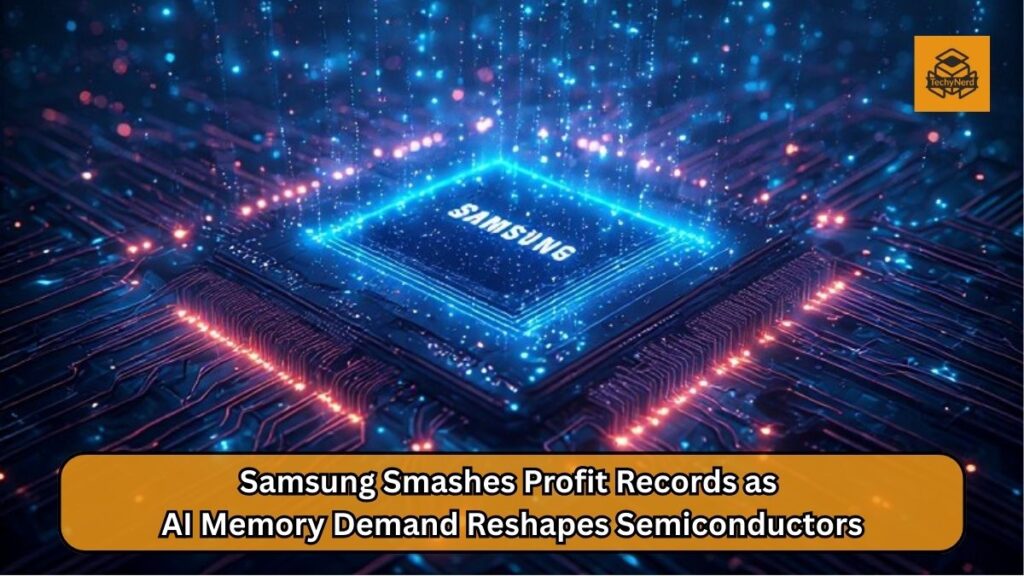
Breaking Down Samsung’s Record-Breaking Quarter
In the fourth quarter, Samsung posted revenue of 93.8 trillion Korean won, translating to approximately $65.6 billion. Operating profit reached 20.1 trillion won, exceeding both analyst expectations and Samsung’s own guidance. Year over year, revenue rose roughly 24 percent, while operating profit surged more than 200 percent.
This performance marked Samsung’s highest quarterly operating profit on record, eclipsing the previous benchmark set in 2018 during an earlier memory supercycle. The results reaffirm Samsung’s status as South Korea’s most valuable company and one of the most influential players in global technology manufacturing.
Despite early gains in its share price following the earnings release, Samsung stock later dipped amid broader market volatility, reflecting investor caution about sustainability rather than concern over near-term performance.
AI Is Rewriting the Economics of Memory Chips
The most important driver behind Samsung’s earnings surge is the transformation of memory chips into mission-critical components for artificial intelligence systems. Modern AI workloads require massive amounts of fast, power-efficient memory to process training data and run inference models at scale.
High-bandwidth memory, or HBM, has emerged as a cornerstone technology for AI accelerators used in data centers. These advanced memory stacks sit close to GPUs and AI processors, enabling rapid data transfer and dramatically improving performance. Demand for HBM has soared as companies race to deploy AI servers, with suppliers struggling to keep pace.
Samsung’s memory division benefited enormously from this trend, achieving all-time highs in both quarterly revenue and operating profit. Rising market prices, combined with strong sales of high-value memory products, created a rare alignment of volume growth and margin expansion.
Supply Constraints Turn Into Pricing Power
As Samsung and its competitors prioritize HBM production to meet AI demand, capacity constraints have rippled across the broader memory market. Chips used in smartphones, PCs, and consumer electronics have also become scarcer, pushing prices higher across multiple categories.
For Samsung, this shortage has translated into unprecedented pricing power. However, company executives cautioned that higher memory prices also raise internal costs for Samsung’s own device businesses, including smartphones and displays. This dual effect highlights the complexity of Samsung’s vertically integrated model, where gains in one division can create pressure in another.
Still, the net impact remains overwhelmingly positive, with the memory business acting as the primary engine of earnings growth.
Capital Discipline and Strategic Investment Shifts
Samsung revealed that it reduced capital expenditure during 2025, maintaining a conservative investment stance amid macroeconomic uncertainty. This restraint contributed to tighter supply conditions, amplifying the price surge now benefiting memory producers.
Looking ahead, the company plans to ramp up investment in memory production during 2026, particularly in high-performance and AI-oriented products. Executives emphasized that future spending would focus on profitability rather than sheer capacity expansion, signaling a more disciplined approach than in previous cycles.
This strategy suggests Samsung aims to avoid the boom-and-bust patterns that have historically plagued the memory industry.
Smartphones Feel the Pressure
While Samsung’s semiconductor business flourished, its mobile experience and networks division faced a more challenging quarter. Operating profit fell to 1.9 trillion won, down nearly 10 percent year over year and more than 45 percent from the previous quarter.
The company attributed the decline to fading launch momentum from new smartphone models and intense global competition. Rising component costs, including memory and displays, further squeezed margins.
To counter these pressures, Samsung plans to double down on artificial intelligence features in its upcoming Galaxy S26 lineup. The company has teased the introduction of “agentic AI experiences,” positioning smartphones as proactive digital assistants rather than passive devices.
Displays Deliver a Bright Spot
Samsung’s display business provided another positive contribution, with operating profit more than doubling to 2 trillion won in the December quarter. Strong demand from smartphone brands helped offset broader market softness, reinforcing the importance of Samsung’s diversified portfolio.
Displays remain a critical pillar of Samsung’s ecosystem, supplying both internal products and external customers across the consumer electronics industry.
Competition Heats Up Across the Memory Landscape
Samsung’s rival SK Hynix also reported record earnings, highlighting how AI-driven demand is lifting the entire memory sector. Meanwhile, customers such as Nvidia continue to push suppliers for greater HBM capacity, intensifying competition among manufacturers.
As AI adoption accelerates across industries, memory producers are likely to remain central beneficiaries—provided they can manage supply, investment discipline, and technological transitions.
What This Means for the Global Tech Industry
Samsung’s results offer a clear signal: artificial intelligence is no longer a niche driver but a structural force reshaping hardware economics. Memory, once undervalued, has become a strategic choke point in AI infrastructure.
For device makers, cloud providers, and consumers, this shift may translate into higher costs and intensified competition. For semiconductor leaders like Samsung, it represents a historic opportunity to redefine long-term profitability.
Conclusion: A New Era for Memory Giants
Samsung’s profit surge is not merely a quarterly anomaly—it reflects a deeper transformation underway in the technology industry. As AI continues to scale, memory chips will remain indispensable, scarce, and highly valuable.
The challenge ahead lies in sustaining growth without repeating past cycles of overinvestment. For now, Samsung stands at the center of the AI memory boom, wielding influence few companies can match.
FAQs
1. Why did Samsung’s profit triple this quarter?
Surging AI-driven demand for memory chips and rising prices fueled earnings.
2. What is high-bandwidth memory (HBM)?
A high-speed memory used in AI accelerators and data center processors.
3. Why is there a memory shortage?
AI demand has outpaced production capacity across the industry.
4. How does this affect smartphone prices?
Higher component costs may pressure margins and retail pricing.
5. Is Samsung investing more in memory now?
Yes, with a focus on high-performance and AI-related products.
6. How did Samsung’s mobile business perform?
Smartphone profits declined due to competition and weaker launch effects.
7. Who are Samsung’s main competitors in memory?
SK Hynix and Micron are key rivals.
8. Will memory prices stay high in 2026?
Prices are expected to remain elevated as AI demand continues.
9. How does AI change the chip industry?
It shifts value toward advanced memory and specialized hardware.
10. Is this a long-term trend or a cycle?
Most analysts view AI-driven memory demand as a structural shift.