

The global digital infrastructure is approaching a historic inflection point. As cyber threats grow in sophistication and scale, conventional encryption methods—once considered unbreakable—are increasingly vulnerable to future quantum computing attacks. In response, a new technological paradigm is rapidly emerging: the satellite quantum internet.
According to a recent report published by ResearchAndMarkets.com, the satellite quantum-internet market is projected to reach $1.82 billion in 2026, up from $1.37 billion in 2025, representing a staggering 32.9% compound annual growth rate (CAGR). Even more striking is the long-term outlook. By 2030, the market is expected to expand to $5.63 billion, sustaining a CAGR of over 32.6%.
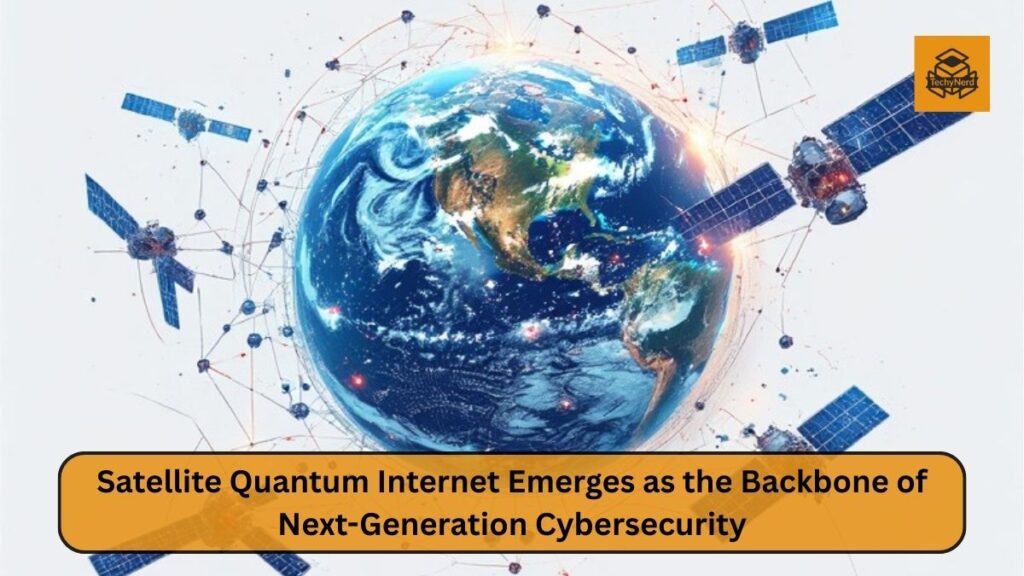
This growth is not driven by hype alone. It reflects a fundamental shift in how governments, defense organizations, financial institutions, and critical infrastructure providers are preparing for a post-quantum world.
Why the Classical Internet Is No Longer Enough
For decades, internet security has relied on mathematical complexity. Encryption protocols such as RSA and ECC depend on the assumption that factoring large numbers or solving discrete logarithms is computationally infeasible. However, quantum computers threaten to upend this assumption entirely.
Once sufficiently powerful quantum machines become operational, today’s encryption standards could be rendered obsolete almost overnight. Sensitive data intercepted today could be decrypted years later—a concept known as “harvest now, decrypt later.”
This looming threat has accelerated the demand for quantum-safe communication, and satellite-based quantum networks are emerging as the most viable solution for global-scale secure connectivity.
Understanding the Satellite Quantum Internet
At its core, the satellite quantum internet leverages quantum mechanics—specifically the properties of photons—to transmit encryption keys securely over vast distances.
The most critical technology enabling this is Quantum Key Distribution (QKD). QKD allows two parties to generate and share encryption keys in a way that is provably secure. Any attempt to intercept the key alters its quantum state, immediately alerting the communicating parties.
While terrestrial fiber-based QKD systems exist, they face significant limitations in distance and scalability. Satellites, on the other hand, can distribute quantum keys across continents, oceans, and even between hemispheres, making them indispensable for a truly global quantum network.
Satellite-Based QKD: From Experiment to Infrastructure
In recent years, satellite quantum communication has moved beyond theoretical research and laboratory demonstrations. Successful real-world experiments have validated the feasibility of space-based QKD.
Notably, multiple national space agencies and research institutions have demonstrated:
- Satellite-to-ground quantum key distribution
- Intercontinental quantum-secure communication links
- High-precision free-space optical transmission of quantum states
These milestones have laid the groundwork for commercial deployment.
The market’s rapid expansion is fueled by these breakthroughs, transforming satellite quantum communication from experimental science into a strategic infrastructure investment.
Market Growth Drivers: Why Adoption Is Accelerating
Rising Cybersecurity Threats
Cybercrime is increasing at an alarming rate worldwide. According to data referenced in the report, the Australian Signals Directorate recorded a 23% increase in cybercrime incidents between 2022 and 2023. Similar trends are visible globally, affecting governments, enterprises, and individuals alike.
Traditional cybersecurity measures are struggling to keep pace with advanced persistent threats, ransomware attacks, and state-sponsored cyber espionage. Quantum-secure networks offer a fundamentally new defense model—one that is immune to both classical and quantum attacks.
Defense and National Security Applications
Defense organizations are among the earliest adopters of satellite quantum-internet technologies. Secure communication is mission-critical for military operations, intelligence sharing, and command-and-control systems.
Satellite-based quantum networks provide:
- Tamper-proof encryption for classified data
- Secure communication across remote and hostile regions
- Resilience against electronic warfare and cyber sabotage
As geopolitical tensions rise and digital warfare becomes more prevalent, investment in quantum-secure satellite infrastructure is increasingly viewed as a strategic necessity.
Financial Sector Demand for Unbreakable Security
Financial institutions are another major driver of adoption. Banks, payment networks, stock exchanges, and clearing houses manage vast volumes of sensitive data and transactions.
A successful cyberattack on financial infrastructure could destabilize entire economies. As a result, financial organizations are actively exploring quantum-safe communication channels to protect:
- Interbank transactions
- Cross-border payment systems
- High-frequency trading data
- Customer financial records
Satellite quantum-internet systems provide the long-range, high-security connectivity required for global financial operations.
Technological Enablers Behind Market Expansion
Advancements in Quantum Hardware
The maturation of quantum processors, photon sources, and quantum memory devices is accelerating the commercialization of satellite quantum networks.
Improvements in:
- Single-photon detectors
- Entangled photon sources
- Quantum error correction techniques
are increasing reliability and reducing operational costs, making large-scale deployment more feasible.
High-Precision Free-Space Optical Links
One of the most critical technical challenges in satellite quantum communication is maintaining stable optical links between fast-moving satellites and ground stations.
Recent innovations in adaptive optics, beam tracking, and atmospheric correction have significantly improved link efficiency and reliability. Projects such as Qu-STAR, developed by TNO and Airbus, demonstrate how advanced optical systems are enabling high-speed, long-distance quantum transmission.
North America Leads, Asia-Pacific Accelerates
Currently, North America dominates the satellite quantum-internet market, driven by strong government funding, advanced research institutions, and an active private sector.
However, the Asia-Pacific region is expected to experience the fastest growth over the coming decade. Countries across the region are heavily investing in quantum technologies as part of broader digital sovereignty and national security strategies.
This regional expansion is expected to reshape the competitive landscape, encouraging global collaboration as well as strategic competition.
Industry Consolidation and Strategic Acquisitions
The rapid growth of the market is also driving consolidation. Companies are acquiring specialized firms to strengthen their quantum networking capabilities.
A notable example is IonQ Inc.’s acquisition of ID Quantique SA, a leader in quantum cryptography. Such moves reflect a broader trend toward building end-to-end quantum communication ecosystems encompassing hardware, software, and satellite infrastructure.
Commercialization of Quantum Cloud and Hybrid Networks
Beyond government and defense, the commercialization of quantum cloud computing is opening new use cases for satellite quantum networks.
Hybrid architectures integrating terrestrial fiber networks with satellite quantum links are emerging as the most practical deployment model. These systems combine the reliability of ground infrastructure with the global reach of satellites.
Challenges That Still Remain
Despite the impressive growth outlook, challenges remain:
- High deployment costs
- Limited availability of quantum-ready satellites
- Regulatory and standardization hurdles
- Need for global interoperability
However, ongoing research, international collaboration, and economies of scale are expected to address these issues over time.
The Road to a Quantum-Secure Global Internet
The satellite quantum internet represents more than just a new market—it signals a profound transformation in global communications.
As cyber threats continue to escalate and quantum computing advances, quantum-secure satellite networks are poised to become a foundational layer of the digital world.
From defense and finance to cloud computing and critical infrastructure, the adoption of satellite quantum-internet technology is shaping a future where data security is no longer based on assumptions—but on the immutable laws of physics.
FAQs
1. What is the satellite quantum internet?
It is a secure communication network using satellites and quantum encryption technologies like QKD.
2. Why is it considered unbreakable?
Because quantum mechanics ensures any interception attempt is immediately detectable.
3. What is driving market growth?
Rising cyber threats, defense adoption, and quantum computing advancements.
4. How fast is the market growing?
At a CAGR of around 32.9%, one of the fastest in tech infrastructure.
5. Who are the primary adopters?
Defense agencies, financial institutions, and government organizations.
6. Why use satellites instead of fiber?
Satellites enable global coverage beyond the limits of terrestrial networks.
7. Which region leads the market?
North America currently leads, while Asia-Pacific shows the fastest growth.
8. What role does QKD play?
It enables secure key exchange protected by quantum physics.
9. Are commercial applications emerging?
Yes, especially in quantum cloud computing and secure data services.
10. What is the long-term outlook?
The market is expected to reach $5.63 billion by 2030.