

When Sir Tim Berners-Lee invented the World Wide Web in 1989, he did not imagine it as a battlefield. His vision was disarmingly simple and radically idealistic: a universal, open system that anyone could use, anyone could build upon, and no one could own. It was meant to be a shared digital commons—free, decentralised, and designed to serve humanity rather than control it.
Nearly four decades later, the web is everywhere, used daily by more than 5.5 billion people. It powers global commerce, communication, education, entertainment, and politics. Yet, in Berners-Lee’s own words, it has been “optimised for nastiness.” What was once a tool for collaboration has, in key corners, become a machine for surveillance, addiction, polarisation, and manipulation.
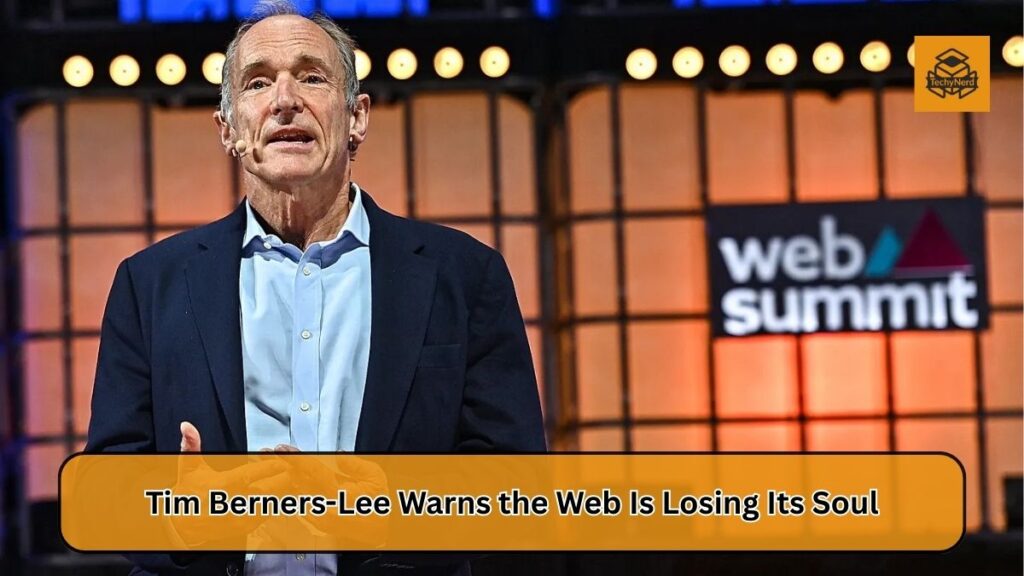
Now in his seventies, Berners-Lee is not retreating into nostalgia. Instead, he is openly framing the moment as a “battle for the soul of the web”—and insisting that the fight is not yet lost.
The Original Dream: A Web for Everyone
The early web emerged from CERN, the European particle physics laboratory, as a practical solution to a human problem: scientists needed a better way to share information across borders, institutions, and disciplines. Berners-Lee designed HTML, HTTP, and URLs not as proprietary products, but as open standards.
That decision—to give the web away for free—was pivotal. It allowed innovation to flourish without permission, licensing, or gatekeepers. Anyone with a computer and a connection could publish, link, and participate.
For Berners-Lee, openness was not just a technical choice; it was a moral one. The web was meant to reflect the best of human collaboration—curiosity, generosity, and shared progress.
From Digital Commons to Commercial Battlefield
The first major fracture in that vision, Berners-Lee argues, came with the commercialisation of the domain name system in the 1990s. What could have been governed as a nonprofit public utility instead became fertile ground for speculation, exploitation, and profit-seeking.
As the web crossed from academia into commerce, incentives shifted. Design decisions were no longer guided primarily by usefulness or social good, but by revenue, scale, and growth.
Advertising-driven business models reshaped the architecture of the web. Engagement became the currency, attention the commodity, and personal data the fuel.
This transformation did not happen overnight, nor was it inevitable—but it was decisive.
The Myth of Neutral Technology
For years, Silicon Valley repeated a comforting mantra: technology is neutral; people determine how it is used. Berners-Lee now openly rejects that idea.
Technology, especially at the scale of the web, encodes values. Algorithms reward certain behaviours. Interfaces nudge choices. Platforms amplify some voices while silencing others.
A social network optimised for engagement will inevitably prioritise outrage, fear, and tribalism. Not because humans are uniquely awful, but because such emotions keep people scrolling.
In Berners-Lee’s view, the web did not accidentally become toxic. It was designed that way, through countless small decisions that favoured profit over people.
2016: A Turning Point for the Web’s Creator
Although Berners-Lee had long been uneasy about the direction of the internet, it was the political and social upheaval of 2016 that crystallised his alarm.
The US election exposed how social media platforms could be weaponised—spreading disinformation, deepening polarisation, and undermining trust in democratic institutions. Two years later, Berners-Lee publicly described himself as “devastated” by the abuses of the web he had created.
That moment marked a shift from concern to action.
Mapping the Web: Good, Bad, and Addictive
In June 2024, Berners-Lee published a striking visual map of “everything on the internet.” Most of it was reassuring: communication tools, education, health resources, creativity, collaboration, and digital empowerment.
But one corner stood out—a dense cluster marked in red. Social media platforms. Feed manipulation. Addiction. Disinformation. Mental health harm.
This segment, he argued, represents only a fraction of the web—but it consumes a disproportionate share of human attention.
Why? Because it is addictive by design.
Monopolies and the Collapse of User Power
Another central problem, Berners-Lee argues, is monopolisation. A small number of tech giants dominate vast swathes of online life, controlling data, identity, and digital infrastructure.
These companies often hold identical copies of users’ data in closed, incompatible systems. Individuals have little visibility into how their information is used, shared, or monetised.
Monopolies, Berners-Lee warns, are fundamentally incompatible with a pro-human web. They stifle innovation, centralise power, and prioritise shareholder value over societal well-being.
Solid: Rewriting the Rules of Data Ownership
Rather than merely criticising the web’s current state, Berners-Lee has spent the past decade building an alternative.
The result is Solid—short for Social Linked Data—a protocol designed to fundamentally change how data is stored and shared online.
In the Solid model, individuals store their data in secure personal repositories known as pods. These pods function like digital backpacks, owned and controlled by the user rather than corporations.
Access is granted selectively. A school might access educational records. A doctor might access medical data. An AI tutor might access learning preferences—each with explicit permission.
The data remains with the person.
From Surveillance to Sovereignty
Solid represents a philosophical reversal of today’s dominant web model.
Instead of platforms extracting data and locking users in, Solid enables interoperability, transparency, and consent. Applications compete on usefulness and trustworthiness, not data hoarding.
This shift could dramatically reduce surveillance capitalism while restoring user autonomy.
Notably, the concept is no longer theoretical. The government of Flanders in Belgium is already using Solid pods to treat citizen data as a public utility rather than a corporate asset.
Why Developers Matter in This Fight
Berners-Lee speaks with visible enthusiasm about developers who understand Solid’s implications.
“When people get it,” he says, “they get a twinkle in their eye.”
As with the early web, he believes change will not come from top-down regulation alone, but from a community of builders choosing to create systems that respect human dignity.
Innovation, in this vision, becomes an act of activism.
Will Today’s Social Media Giants Fade Away?
Berners-Lee does not expect companies like Meta or X to willingly dismantle their platforms. Instead, he predicts that new systems will gradually make parts of today’s web obsolete.
When collaboration, creativity, and trust become more rewarding than outrage and addiction, user behaviour will follow.
The goal is not to ban the old web into irrelevance, but to outgrow it.
Regulation, Children, and the Limits of Bans
Governments are increasingly intervening. Australia’s world-first ban on social media for under-16s is one such attempt.
Berners-Lee remains sceptical. While acknowledging the harms, he questions whether blanket bans address root causes. Messaging services, he notes, can be genuinely useful for young people.
Instead, he advocates for child-specific technology—smartphones and platforms designed with children’s needs and vulnerabilities in mind, not retrofitted controls on adult systems.
Artificial Intelligence: Hope, Fear, and Lost Time
If Berners-Lee is cautiously optimistic about fixing the web, his tone darkens when the conversation turns to artificial intelligence.
AI, he notes, exists only because of the web and its data. Its potential to improve medicine, science, and education is enormous. But so are the risks.
“The horse is bolting,” he says, referring to the pace of AI development without adequate global oversight.
A CERN for AI
Berners-Lee’s proposed solution is radical yet familiar: a CERN for AI.
Just as the world’s physicists collaborate in non-commercial, transparent environments to study fundamental forces, AI research should be subject to collective scrutiny.
Such an institution could evaluate safety, alignment, and societal impact—before systems are deployed at scale.
Today, however, AI development is siloed within competing corporations, each racing to build more powerful models behind closed doors.
Berners-Lee sees little evidence that this trajectory will self-correct.
A Fractured World, a Shared Responsibility
The tragedy, he suggests, is that global cooperation on AI is hardest precisely when it is most needed. The divisions amplified by the web’s toxic corners make collective governance more difficult.
Yet Berners-Lee refuses to surrender to pessimism.
The web was built by people. It can be rebuilt by people.
Conclusion: It’s Still Our Web
Tim Berners-Lee’s warning is not a eulogy. It is a challenge.
The web’s problems are not inevitable consequences of human nature or technological progress. They are the result of choices—and choices can be changed.
Fixing the internet will require collaboration, compassion, and courage. It will demand new economic models, new technical standards, and new ethical commitments.
But if the creator of the web still believes it is not too late, perhaps we should too.
FAQs
1. Did Tim Berners-Lee invent the internet?
No, he invented the World Wide Web, which runs on the internet.
2. What does he mean by “battle for the soul of the web”?
A fight to restore human-centered values online.
3. Why does he criticise social media platforms?
They are designed to maximise engagement, often harming users.
4. What is Solid?
A protocol that gives users control over their personal data.
5. How do Solid pods work?
They store data securely and allow selective sharing.
6. Are monopolies harming the web?
Berners-Lee believes they stifle innovation and user autonomy.
7. Does he support social media bans for children?
He is sceptical and prefers child-specific technology.
8. Why is he worried about AI?
AI is developing rapidly without sufficient global oversight.
9. What is a “CERN for AI”?
A proposed international body for transparent AI research.
10. Is Berners-Lee optimistic or pessimistic?
Cautiously optimistic — he believes change is still possible.