

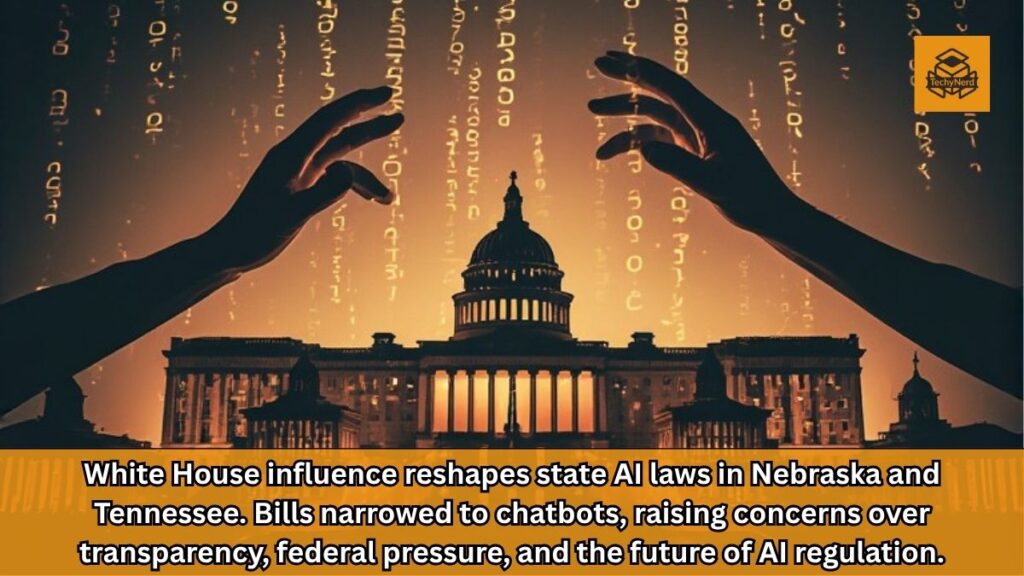
Artificial intelligence is rapidly transforming industries, economies, and societies. As innovation accelerates, so does the urgency to regulate its risks. Yet in the United States, the path toward meaningful AI governance is becoming increasingly complex. A recent development reveals a quiet but significant shift in strategy by the White House under Donald Trump, as it engages directly with Republican-led state governments to influence AI legislation.
This behind-the-scenes effort signals a new phase in the ongoing struggle between federal authority and state-level autonomy in shaping the future of AI regulation. Rather than relying solely on Congress, the administration appears to be intervening at the state level, raising questions about transparency, governance, and political alignment.
The Stakes: Why AI Regulation Matters Now More Than Ever
Artificial intelligence is no longer a futuristic concept. It is deeply embedded in everyday life, from recommendation algorithms and chatbots to autonomous systems and decision-making tools. As capabilities expand, concerns around safety, bias, misinformation, and child protection have intensified.
Public support for AI regulation has grown steadily, driven by fears of unchecked technological power. However, federal efforts to establish comprehensive safeguards have stalled in Congress, leaving a regulatory vacuum that states have begun to fill.
States like California and New York have taken the lead, introducing laws focused on transparency, accountability, and consumer protection. These initiatives have become models for other states seeking to address AI risks.
The Emerging Conflict: Federal Influence Meets State Autonomy
In this evolving landscape, Republican-led states such as Nebraska and Tennessee have introduced their own AI bills. These proposals initially mirrored the transparency-focused approaches seen in more progressive states, suggesting a rare moment of bipartisan alignment on AI governance.
However, according to sources familiar with the matter, the White House has actively engaged with lawmakers in these states, urging them to modify or scale back their proposals. This outreach has been described by some as a form of political pressure, placing state legislators in a difficult position.
On one hand, they seek to address legitimate concerns about AI risks. On the other, they must navigate the expectations of a federal administration aligned with their party.
Inside the Nebraska and Tennessee Bills
The legislative efforts in Nebraska and Tennessee provide insight into the broader debate over AI regulation.
In Nebraska, the proposed bill known as LB 1083, introduced by Tanya Storer, aimed to establish a framework for AI risk management and transparency. The bill sought to ensure that companies developing or deploying AI systems adhere to clear standards for accountability.
In Tennessee, SB 2171, introduced by Ken Yager, focused on public safety and child protection. The legislation included provisions designed to safeguard younger users from potential harms associated with AI technologies.
Both bills represented proactive attempts to address emerging challenges in the AI ecosystem. However, following discussions with White House officials, significant amendments were made.
The Shift Toward Narrower Regulation
One of the most notable outcomes of these interactions was the narrowing of the bills’ scope. Instead of broad AI regulations, the revised proposals focused primarily on chatbots.
This shift reflects a strategic recalibration. By limiting the scope of regulation, lawmakers can address specific concerns without imposing wide-ranging restrictions on AI development.
From a policy perspective, this approach has both advantages and drawbacks. Targeted regulation can be more manageable and easier to implement. However, it may also leave significant gaps, particularly as AI systems become more integrated and complex.
The White House Perspective: A National Framework Approach
The White House has defended its actions by emphasizing its commitment to a unified national AI strategy. Officials have pointed to the administration’s National AI Framework as a comprehensive approach designed to balance innovation with safeguards.
From this perspective, state-level regulations that diverge from federal priorities could create fragmentation, complicating compliance for companies operating across multiple jurisdictions.
The administration’s outreach to state lawmakers can therefore be seen as an effort to align policies and avoid a patchwork regulatory environment.
Criticism and Concerns: Questions of Pressure and Transparency
Despite these justifications, critics argue that the White House’s actions raise serious concerns about transparency and governance.
Some lawmakers have described the outreach as inappropriate, suggesting that unelected officials are exerting influence over state legislation. This perception underscores the tension between federal authority and state independence.
The lack of public visibility into these discussions further complicates the issue. When policy decisions are shaped behind closed doors, it becomes difficult for stakeholders to assess the motivations and implications.
The Broader Political Context
The conflict over AI regulation cannot be understood in isolation. It is part of a larger political landscape characterized by divisions over technology policy, economic priorities, and the role of government.
Efforts to pass federal AI legislation have repeatedly stalled, reflecting disagreements within Congress. In this context, states have emerged as key actors, experimenting with different approaches to governance.
The White House’s shift toward direct engagement with state legislatures represents an adaptation to this reality. Unable to achieve its goals at the federal level, the administration is seeking influence where it can.
Industry Implications: Navigating Uncertainty
For the tech industry, these developments introduce a new layer of complexity. Companies must navigate an evolving regulatory environment shaped by both federal and state dynamics.
Uncertainty can have significant implications for innovation. While clear and consistent rules can foster growth, conflicting regulations may create barriers and increase compliance costs.
At the same time, the absence of robust safeguards carries its own risks, including reputational damage and public backlash.
The Role of Chatbots in the Debate
The focus on chatbots in the revised legislation highlights their growing prominence in the AI ecosystem. As one of the most visible applications of AI, chatbots have become a focal point for concerns about misinformation, bias, and user safety.
By targeting chatbots, lawmakers are addressing an area with immediate and tangible impact. However, this approach may not fully capture the broader challenges posed by AI technologies.
A Fragmented Future or Unified Governance?
The current trajectory raises a fundamental question: will the United States achieve a unified framework for AI regulation, or will it continue to rely on a patchwork of state-level initiatives?
The answer will depend on the ability of policymakers to balance competing priorities. Innovation, safety, economic growth, and political considerations all play a role in shaping the outcome.
Conclusion: A Defining Moment for AI Policy
The quiet intervention of the White House in state-level AI legislation marks a defining moment in the evolution of technology governance. It highlights the challenges of regulating a rapidly advancing field within a complex political system.
As the debate continues, the need for transparency, collaboration, and thoughtful policymaking becomes increasingly clear. The decisions made today will shape the future of AI and its impact on society for years to come.
FAQs
1. What is the main issue in this news?
The White House is influencing state-level AI laws in Republican-led states.
2. Which states are involved?
Nebraska and Tennessee are the key states mentioned.
3. Why is AI regulation important?
It ensures safety, transparency, and accountability in AI systems.
4. What changes were made to the bills?
They were narrowed to focus mainly on chatbots.
5. Who introduced the Nebraska bill?
State Senator Tanya Storer introduced it.
6. What is the Tennessee bill about?
It focuses on AI safety and child protection measures.
7. Why is the White House involved?
To align state laws with its national AI policy framework.
8. What concerns have been raised?
Critics worry about political pressure and lack of transparency.
9. How does this affect tech companies?
It creates uncertainty in regulatory compliance and innovation.
10. Will there be a national AI law soon?
It remains uncertain due to ongoing political disagreements.