

For nearly eight decades, the Central Intelligence Agency has served as the analytical backbone of the United States intelligence community. Its mission has remained consistent: gather fragmented information from human sources, signals intelligence, and covert operations, then synthesize that data into actionable insights for policymakers.
Today, that mission is undergoing a profound transformation. The integration of artificial intelligence into intelligence workflows marks one of the most significant shifts in the agency’s history. Under the direction of leadership figures such as Michael Ellis, the agency is moving toward a future where AI systems act as embedded collaborators—“co-workers”—within its analytic platforms.
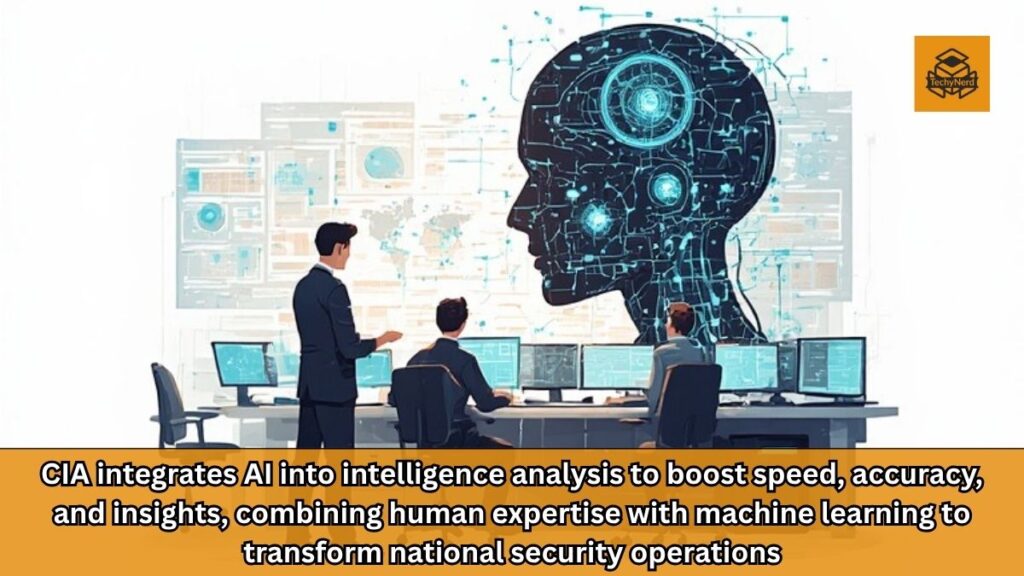
This evolution reflects not only technological advancement but also a strategic imperative. In an era defined by data overload, geopolitical competition, and rapid decision-making, traditional methods of intelligence analysis are no longer sufficient on their own.
The Emergence of AI Co-Workers in Intelligence Systems
The concept of AI co-workers represents a departure from earlier uses of automation in intelligence. Historically, technology has been used to collect and process data, leaving interpretation and decision-making largely to human analysts. The new approach integrates AI directly into the analytical process.
These systems are designed to assist with a wide range of tasks, including drafting intelligence reports, identifying patterns in large datasets, and testing analytical hypotheses. By embedding AI into core platforms, the agency aims to enhance both the speed and rigor of its operations.
Unlike standalone tools, AI co-workers function as continuous collaborators. They operate alongside human analysts, providing real-time insights and recommendations. This integration allows analysts to focus on higher-level reasoning while delegating repetitive or data-intensive tasks to machines.
Enhancing Analytical Rigor Through Machine Intelligence
One of the primary objectives of AI integration is to improve the quality of intelligence analysis. Traditional methods often rely on human judgment, which can be influenced by cognitive biases and limited by the volume of available data.
AI systems offer a complementary capability. By processing vast amounts of information and identifying subtle correlations, they can uncover insights that might otherwise go unnoticed. This capability is particularly valuable in complex geopolitical scenarios, where multiple variables interact in unpredictable ways.
For example, AI can analyze trends across economic data, social media activity, and satellite imagery to provide a more comprehensive understanding of a foreign nation’s intentions. It can also simulate alternative scenarios, helping analysts evaluate the potential outcomes of different policy decisions.
Speed as a Strategic Advantage
In the realm of national security, time is often a critical factor. Delays in intelligence analysis can have significant consequences, from missed opportunities to prevent conflicts to delayed responses to emerging threats.
The integration of AI aims to address this challenge by accelerating the analytical process. Tasks that once required hours or days can now be completed in minutes, enabling faster decision-making.
This increased speed is not merely a matter of efficiency; it represents a strategic advantage. In a rapidly evolving global landscape, the ability to process and act on information quickly can determine the outcome of critical situations.
Autonomous Intelligence Reports: A New Milestone
One of the most notable developments in this transformation is the creation of the agency’s first autonomous intelligence report. This achievement demonstrates the potential of AI to not only assist but also independently generate analytical outputs.
While human oversight remains essential, the ability of AI to produce coherent and comprehensive reports marks a significant step forward. It suggests that future systems could take on more complex analytical roles, further augmenting human capabilities.
However, this development also raises important questions about accountability and trust. Ensuring the accuracy and reliability of AI-generated analysis will be a key challenge moving forward.
Human Oversight and Decision-Making
Despite the increasing role of AI, the agency has emphasized that human analysts will remain central to the decision-making process. AI is intended to support, not replace, human judgment.
This approach reflects a recognition of the limitations of current AI systems. While they excel at data processing and pattern recognition, they lack the contextual understanding and ethical reasoning required for high-stakes decisions.
Maintaining human oversight ensures that intelligence assessments are grounded in broader strategic considerations. It also provides a safeguard against potential errors or biases in AI systems.
Expanding Applications Beyond Analysis
The use of AI within the agency extends beyond analytical tasks. The organization has explored hundreds of AI projects, covering areas such as data processing, language translation, and operational support.
For field operatives, AI tools can enhance situational awareness and improve the efficiency of intelligence collection. Advanced language models can facilitate communication and analysis in multiple languages, breaking down barriers in global operations.
The expansion of AI capabilities into operational domains underscores the technology’s versatility and its potential to transform every aspect of intelligence work.
Cyber Intelligence and Technological Competition
A key driver of AI adoption is the need to maintain a competitive edge in the domain of cyber intelligence. The agency’s Center for Cyber Intelligence plays a central role in this effort, overseeing activities related to digital operations and cybersecurity.
As cyber threats become more sophisticated, the ability to analyze and respond to them in real time becomes increasingly important. AI systems can identify vulnerabilities, detect anomalies, and support defensive and offensive cyber operations.
This focus on cyber intelligence is closely linked to broader geopolitical dynamics. The rapid advancement of technology in countries like China has intensified competition, making innovation a critical component of national security.
Tensions with Private Sector AI Providers
The integration of AI into government operations has also led to tensions with private sector companies. Issues related to control, ethics, and usage restrictions have become points of contention.
Some AI developers have sought to impose limitations on how their technologies can be used, particularly in areas such as surveillance and military applications. Government agencies, on the other hand, emphasize the need for flexibility in deploying tools for national security purposes.
These disagreements highlight the complex relationship between public and private sectors in the development and deployment of advanced technologies. Balancing innovation with ethical considerations will be an ongoing challenge.
Ethical and Political Dimensions of AI in Intelligence
The adoption of AI in intelligence analysis raises important ethical and political questions. Concerns about bias, transparency, and accountability are particularly relevant in this context.
Intelligence assessments play a critical role in shaping policy decisions, and any biases in AI systems could have far-reaching consequences. Ensuring that AI tools are developed and deployed responsibly is essential to maintaining trust in the intelligence process.
Additionally, the use of AI may influence debates about the objectivity of intelligence analysis. As political dynamics evolve, the role of technology in shaping narratives and decisions will likely become a focal point of discussion.
The Future of Intelligence: Human-Machine Collaboration
The integration of AI into intelligence operations represents a shift toward a hybrid model of analysis. In this model, human expertise and machine capabilities are combined to achieve superior outcomes.
This approach leverages the strengths of both humans and machines. While AI excels at processing data and identifying patterns, humans bring contextual understanding, creativity, and ethical judgment.
The success of this model will depend on effective collaboration between these two elements. Developing systems that facilitate seamless interaction will be a key priority for the agency.
Conclusion: A New Paradigm for National Security
The adoption of AI by the Central Intelligence Agency marks a turning point in the evolution of intelligence work. By integrating AI co-workers into its analytic platforms, the agency is positioning itself to להתמודד the challenges of a data-driven world.
This transformation is not without risks. Ensuring the reliability, security, and ethical use of AI will require ongoing effort and vigilance. However, the potential benefits—enhanced speed, improved accuracy, and greater analytical depth—are substantial.
As the global landscape continues to evolve, the ability to harness advanced technologies will be a defining factor in national security. The CIA’s embrace of AI represents a proactive step toward shaping that future.
FAQs
1. Why is the CIA using AI?
To improve speed, accuracy, and depth of intelligence analysis.
2. What are AI co-workers?
AI systems integrated into platforms to assist analysts.
3. Will AI replace human analysts?
No, humans will remain in control of decisions.
4. What tasks can AI perform?
Data analysis, report drafting, trend detection, and translation.
5. What is an autonomous intelligence report?
A report generated primarily by AI systems.
6. How does AI improve intelligence work?
By processing large datasets quickly and identifying patterns.
7. What are the risks of AI in intelligence?
Bias, errors, and over-reliance on automation.
8. Is cybersecurity a focus area?
Yes, AI is heavily used in cyber intelligence operations.
9. Are there conflicts with AI companies?
Yes, over usage restrictions and ethical concerns.
10. What is the future of AI in intelligence?
A hybrid model combining human and machine analysis.