

When Apple introduced the Vision Pro, it marked one of the most ambitious product launches in the company’s history. Positioned as a next-generation spatial computing device, Vision Pro was not just another gadget—it was Apple’s entry into a completely new category.
On paper, the company appeared to have meticulously planned the rollout. Employees were flown to Cupertino for immersive training, structured workshops were designed, and in-store experiences were intended to reflect Apple’s signature blend of precision and polish.
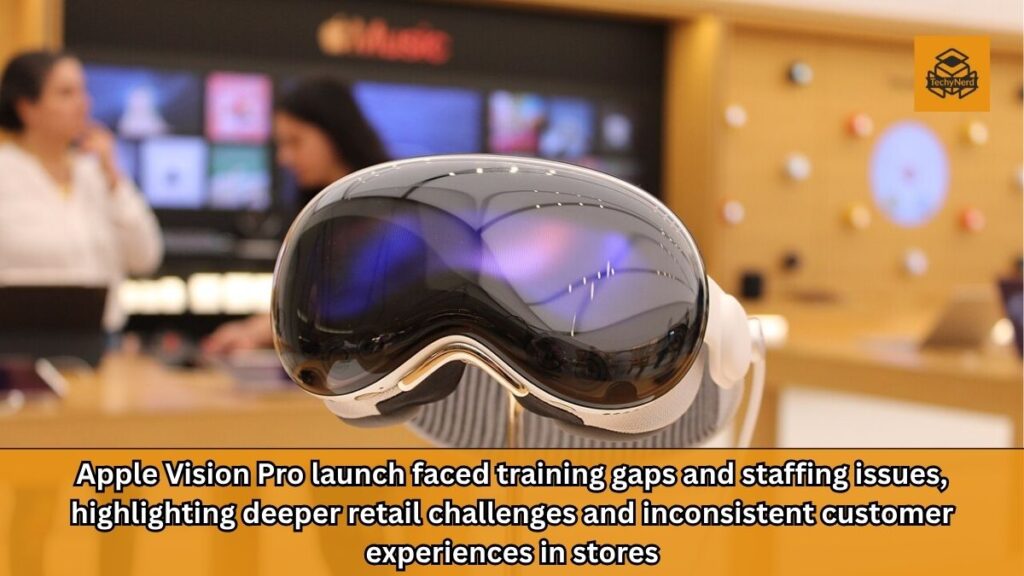
Yet, behind the scenes, the reality in many Apple Stores was far from ideal. Reports from retail employees describe a launch plagued by inadequate preparation, understaffing, and systemic issues that extend beyond a single product.
This article takes a deep dive into what went wrong, why it matters, and what it reveals about the evolving nature of Apple’s retail strategy.
The Promise of a Perfect Launch
Apple’s Retail Legacy
Apple Stores have long been considered the gold standard in retail. Under the leadership of Steve Jobs, the company pioneered a model that emphasized customer experience over traditional sales tactics.
Stores were designed as experiential spaces where customers could explore products, receive personalized guidance, and participate in hands-on workshops. Employees were extensively trained, not just to sell products, but to educate and inspire users.
The Vision Pro Training Blueprint
For the Vision Pro launch, Apple reportedly designed a comprehensive training program. Selected employees were brought to Cupertino for multi-day sessions, where they interacted directly with the device and learned how to demonstrate its capabilities.
The plan was for these trained कर्मचारियों to return to their respective stores and conduct in-depth workshops for their colleagues, ensuring a consistent and high-quality customer experience.
In theory, this approach aligned perfectly with Apple’s retail philosophy.
The Reality: Compressed Training and Chaotic Execution
Limited Preparation Time
Despite the ambitious training plan, many employees reported receiving only minimal hands-on experience before being asked to demonstrate the Vision Pro to customers.
Instead of the expected multi-session rehearsals, some staff members were given as little as one hour to learn a complex demonstration script. This script, spanning multiple screens and interactions, required a deep understanding of both hardware and software.
For a device as sophisticated as Vision Pro, such limited preparation was insufficient.
The Pressure of First Impressions
Retail employees often had only one or two practice attempts before engaging with real customers. In some cases, even these limited opportunities were not available.
This created a high-pressure environment where employees were expected to deliver flawless demonstrations without adequate training. The result was inconsistent customer experiences, with some demos falling short of Apple’s usual standards.
The Complexity of Vision Pro Demonstrations
A New Category, A New Challenge
Unlike traditional Apple products, Vision Pro introduces users to mixed reality—a concept that requires explanation as much as demonstration. Employees must guide customers through spatial interfaces, gesture controls, and immersive environments.
This complexity demands a higher مستوى of training compared to conventional devices like iPhones or MacBooks.
Scripted Experiences vs. Authentic Interaction
The reliance on scripted demonstrations further complicated the situation. Employees were required to memorize and execute detailed scripts, leaving little room for improvisation or personalized interaction.
This approach contrasts with Apple’s traditional emphasis on organic, customer-driven experiences.
Staffing Challenges: A Structural Issue
The Shift from Full-Time Expertise to Temporary Workforce
One of the most significant factors contributing to the launch issues was staffing. Over the years, Apple has increasingly relied on temporary or recently hired employees, particularly during peak seasons.
By the time of the Vision Pro launch, many staff members had limited experience with major product rollouts. This lack of institutional knowledge made it difficult to maintain the high standards associated with Apple Stores.
Understaffing and Workload ضغط
In addition to experience gaps, many stores were understaffed. Employees had to balance regular responsibilities with the demands of Vision Pro demonstrations, leaving little time for training or practice.
This resource constraint undermined the effectiveness of Apple’s carefully designed training programs.
The Evolution of Apple Retail: From Jobs to Today
The Original Vision
Under Steve Jobs, Apple Stores were designed to be educational hubs. A significant portion of staff was dedicated to helping customers learn how to use their devices through one-on-one sessions and small workshops.
This approach not only enhanced customer satisfaction but also built long-term loyalty.
постепенное Erosion of the Model
Over time, this model has evolved. Cost optimization and operational efficiency have led to a کاهش in dedicated training staff and the elimination of certain programs.
Initiatives like one-to-one Creative sessions and small workshops were discontinued, particularly after the pandemic. While programs like Today at Apple continue to exist, they are often less intensive and more promotional in nature.
Impact on Customer Experience
The reduction in training-focused roles has shifted the emphasis from education to sales. While this may improve short-term efficiency, it can compromise the depth of customer engagement—especially for complex products like Vision Pro.
The Broader Implications for Apple
Launch Execution as a Strategic Indicator
Product launches are critical moments for any technology company. They set the tone for public perception and influence adoption rates.
The challenges faced during the Vision Pro launch highlight potential gaps in Apple’s execution capabilities, particularly in the retail domain.
Balancing Innovation and Infrastructure
As Apple continues to innovate, it must ensure that its retail infrastructure evolves accordingly. Introducing groundbreaking products requires equally advanced support systems.
Without adequate training and staffing, even the most innovative products may struggle to achieve their full potential.
Customer Perspective: Mixed Experiences
Positive Interactions Still Exist
It is important to note that not all experiences were negative. Some customers reported excellent demonstrations, reflecting the dedication and skill of individual employees.
These positive cases suggest that the underlying issues are not universal but rather inconsistent across locations.
The Importance of Consistency
However, consistency is key to Apple’s brand identity. Variability in customer experience can undermine trust and dilute the impact of a product launch.
Lessons for the Tech Industry
The Importance of Human عوامل
The Vision Pro launch underscores the importance of human factors in technology deployment. Advanced hardware and software must be complemented by skilled and well-prepared personnel.
Training as a Competitive Advantage
In an increasingly competitive market, training and customer education can serve as differentiators. Companies that invest in these areas are better positioned to succeed with complex products.
Future Outlook: Can Apple Course-Correct?
Potential Improvements
To address these challenges, Apple may need to revisit its retail strategy. This could include increasing staffing levels, enhancing training programs, and reintroducing more personalized customer support initiatives.
The Role of Feedback
Employee and customer feedback will play a crucial role in shaping future improvements. By addressing the मुद्दे highlighted during the Vision Pro launch, Apple can strengthen its retail operations.
Conclusion: A Wake-Up Call for Apple Retail
The Vision Pro launch serves as a reminder that innovation alone is not enough. Execution, particularly at the retail level, is equally critical.
While the product itself represents a significant خطوة forward in spatial computing, the challenges faced during its launch reveal deeper structural issues within Apple’s retail ecosystem.
For Apple, this moment presents an opportunity to reassess and refine its approach. For the broader industry, it highlights the أهمية of aligning technological ambition with operational readiness.
FAQs
1. What is Vision Pro?
A mixed reality headset developed by Apple.
2. Why was the launch called a fiasco?
Due to poor training and inconsistent demos.
3. Were all stores affected?
No, experiences varied by location.
4. What caused training issues?
Limited rehearsal time and understaffing.
5. How were employees trained?
Some attended sessions in Cupertino.
6. What is mixed reality?
A blend of physical and digital environments.
7. Did staffing play a role?
Yes, many stores were understaffed.
8. How has Apple retail changed?
Less focus on training and workshops.
9. Can Apple fix these issues?
Yes, with improved staffing and training.
10. Does this affect Vision Pro sales?
It may influence early customer perception.