

Artificial intelligence was once sold to the American public as a quiet efficiency upgrade—an invisible force working in the background to improve productivity, innovation, and economic growth. That era is ending. AI has stepped into the spotlight, and Americans increasingly do not like what they see.
Across the country, concerns about artificial intelligence are no longer confined to academic panels or technology conferences. They are surfacing in town halls, social media comment sections, labor organizing meetings, and increasingly, in political strategy memos. What was once framed as a neutral or even optimistic technological advancement has become a symbol of unchecked corporate power, rising energy costs, job insecurity, and elite control over economic futures.
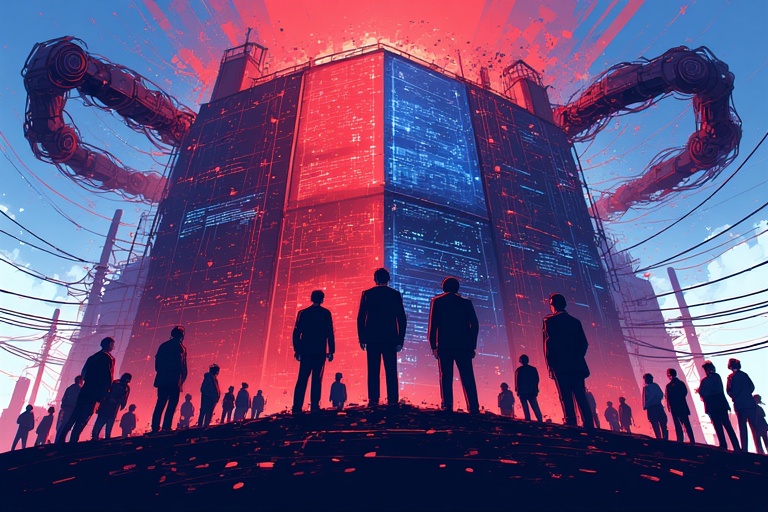
As the 2026 midterms and 2028 presidential election approach, both Democrats and Republicans are grappling with the same uncomfortable realization: AI is becoming deeply unpopular, and voters want someone to blame.
The Roots of America’s AI Anxiety
Public discomfort with AI is not abstract. It is rooted in tangible, lived experiences that cut across class and geography.
Communities near large-scale data centers are seeing electricity bills rise while land is rezoned and water usage spikes. White-collar workers are watching entry-level jobs disappear or get automated before careers can even begin. Blue-collar workers fear the next wave of robotics will reach warehouses, trucking, and manufacturing. Meanwhile, tech executives speak openly about efficiency gains and workforce reductions as inevitable outcomes of progress.
Polling reflects this unease. Surveys consistently show overwhelming support for AI regulation, even if it slows innovation. Only a small minority of Americans believe AI will improve their lives over the long term. This level of distrust places AI among the most negatively viewed developments in modern public policy—ranking worse than Congress itself in some surveys.
In political terms, that is not just a problem. It is an opportunity.
Democrats at a Crossroads: Regulate or Rebel?
Within the Democratic Party, AI has become a fault line that mirrors deeper ideological divides.
On one side are progressive and populist Democrats who argue that the party has a rare chance to reclaim its economic justice narrative. They see AI as the next NAFTA—a policy failure that could permanently alienate working and middle-class voters if mishandled. To them, AI represents concentrated wealth, unchecked corporate influence, and a direct threat to economic stability.
This wing argues that incremental regulation is not enough. They advocate for aggressive measures: halting new data center construction, imposing strict transparency requirements, enforcing worker protections, and openly confronting AI billionaires. In their view, Democrats must be unapologetically anti-AI expansion to align with public sentiment.
On the other side are pro-business Democrats and institutionalists who fear alienating the tech industry. AI investment has become a major driver of economic growth, especially in states that host data centers, research hubs, and semiconductor facilities. For governors and lawmakers in those regions, opposing AI outright risks economic backlash, donor flight, and job losses.
These Democrats argue that AI cannot be stopped, only shaped. They favor targeted regulation, public education, and collaboration with industry leaders. They worry that framing Democrats as the “anti-technology” party would be politically disastrous in the long run.
The Data Center Flashpoint: Where Technology Meets Local Anger
Few symbols encapsulate AI backlash better than the modern data center.
To tech companies, data centers are the backbone of innovation. To many local communities, they are massive concrete structures that strain power grids, consume water, inflate energy prices, and offer few permanent jobs in return. As AI usage grows, so does demand for energy-intensive infrastructure, often built in rural or suburban areas with limited political leverage.
Protests against data center construction have erupted in multiple states, uniting unlikely coalitions of environmentalists, homeowners, farmers, and fiscal conservatives. The anger is visceral because the costs are immediate and visible, while the benefits feel distant and abstract.
Politicians are beginning to notice that opposing data centers can generate grassroots enthusiasm rarely seen in modern politics.
Republicans Enter the AI Skepticism Arena
While Democrats debate strategy, Republicans are quietly building their own anti-AI narratives.
Right-wing skepticism toward AI takes different forms. Some focus on energy costs and infrastructure strain. Others frame AI as a moral or cultural threat, accusing Silicon Valley elites of undermining traditional values, manipulating information, or consolidating power beyond democratic accountability.
Populist conservatives have begun to position AI companies as the new “coastal elites,” replacing Wall Street as the villain of choice. This rhetoric resonates with voters who feel excluded from the benefits of technological progress while bearing its costs.
Importantly, Republican skepticism does not always oppose AI outright. Instead, it often targets specific manifestations—data centers, automation, content moderation, and perceived censorship—allowing the party to channel public anger without rejecting innovation wholesale.
The White-Collar Awakening: A New Political Variable
One of the most significant shifts in the AI debate is who feels threatened.
Historically, automation anxiety was concentrated among blue-collar workers. AI has changed that calculus. White-collar professionals—writers, designers, analysts, junior lawyers, marketers—are now seeing their career ladders erode. Entry-level roles that once trained future leaders are being automated away.
This creates a rare political alignment. White-collar and blue-collar workers now share a common fear: displacement by machines controlled by distant corporations.
For Democrats, this presents a unique opportunity to unify a fractured base. For Republicans, it offers a chance to expand beyond traditional constituencies. For both parties, it raises the stakes of how AI is framed in political discourse.
Economic Populism Rebranded for the AI Era
At its core, the AI backlash is not about technology—it is about power.
Voters are responding to a sense that decisions about their economic futures are being made without their consent, by companies they did not elect and cannot influence. AI becomes the symbol of a broader anxiety about inequality, loss of agency, and the concentration of wealth.
Political strategists increasingly believe that whoever successfully frames AI as an elite-driven project imposed on ordinary people will gain a powerful advantage. The language of economic populism—once associated with trade deals and outsourcing—is being repurposed for the digital age.
Why Neutrality May No Longer Be an Option
For years, political leaders attempted to walk a careful line on AI: supportive but cautious, optimistic but regulated. That middle ground is shrinking.
As public concern intensifies, silence is increasingly interpreted as complicity. Voters want clarity, not nuance. They want to know who is willing to confront the companies reshaping their lives.
This dynamic creates risk for incumbents and opportunity for challengers. Candidates who articulate a clear stance—whether pro-regulation, anti-expansion, or pro-industry—are more likely to mobilize voters than those who hedge.
Looking Ahead: AI as a Defining Issue of the Next Decade
Artificial intelligence is not a passing controversy. It is a structural transformation that will shape labor markets, energy policy, national security, and democratic institutions for decades.
The political battles forming around AI today resemble early fights over industrialization, globalization, and digital privacy. The outcomes will define not just election cycles, but social contracts.
Both parties sense this. Both are afraid of miscalculating. And both are watching the same polls that suggest a simple truth: Americans are scared, and someone will have to answer for it.
Conclusion: The Politics of Fear, Power, and Technology
AI has moved beyond the realm of innovation and into the arena of identity, economics, and trust. Whether Democrats or Republicans benefit from America’s growing discomfort will depend on who can most convincingly claim to stand with ordinary people against concentrated technological power.
What is clear is that AI will no longer be politically invisible. It is becoming a defining issue of modern American politics—one that rewards boldness, clarity, and empathy, and punishes indecision.
FAQs
1. Why are Americans increasingly opposed to AI?
Concerns include job loss, rising energy costs, lack of regulation, and corporate control.
2. Is AI opposition limited to one political party?
No, skepticism exists across both Democrats and Republicans, though for different reasons.
3. Why are data centers such a major issue?
They consume massive energy and water resources while offering limited local benefits.
4. How does AI affect white-collar workers?
AI is automating entry-level and knowledge-based jobs, disrupting career paths.
5. Do polls support stronger AI regulation?
Yes, a large majority of Americans favor regulation even if it slows innovation.
6. Why are Democrats divided on AI?
Some prioritize economic populism, while others fear alienating tech investment.
7. How are Republicans framing AI concerns?
Often around energy costs, moral values, and corporate power concentration.
8. Is AI becoming an election issue?
Yes, especially ahead of the 2026 midterms and 2028 presidential race.
9. Can AI development be stopped?
Most experts believe it can only be shaped and regulated, not reversed.
10. What’s the biggest political risk around AI?
Ignoring public anxiety and allowing distrust to grow unchecked.