

Virtual Reality has long been positioned as the future of interactive entertainment, yet one persistent limitation continues to hold it back from mass social adoption: accessibility. While VR hardware has become more affordable and sophisticated, it is still far from ubiquitous. Most players simply do not own a headset, creating a divide between early adopters and the broader gaming community.
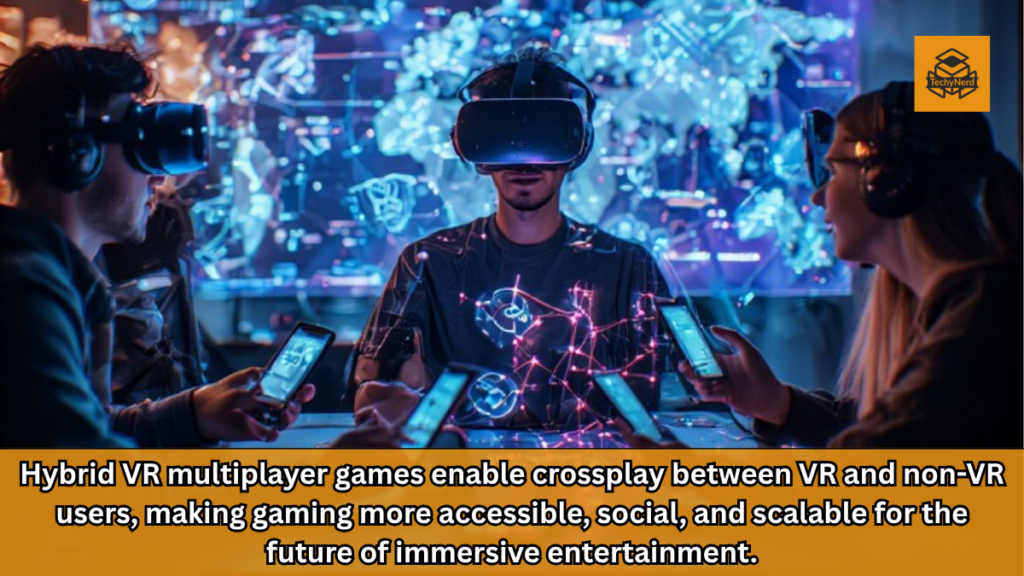
However, a compelling solution has quietly emerged within the industry—hybrid VR multiplayer games. These titles are redefining how social gaming works by allowing VR users to play seamlessly with friends who are using traditional platforms like PCs, consoles, or even smartphones. This design philosophy is not just a workaround; it represents a fundamental evolution in multiplayer game architecture.
The Rise of Asymmetrical Gameplay Design
At the heart of hybrid VR multiplayer lies asymmetrical gameplay. Unlike traditional multiplayer games where all players share identical mechanics and perspectives, asymmetrical titles assign different roles, abilities, and interfaces depending on the platform being used.
This design approach is particularly effective in VR environments because it embraces the strengths and limitations of each platform rather than forcing uniformity. A VR player might experience immersive, physics-driven interactions, while non-VR players engage through simplified controls and broader situational awareness.
The result is a dynamic, cooperative—or competitive—experience where each participant contributes uniquely to the gameplay. This shift is not just innovative; it is necessary for VR to scale socially.
Social Barriers in VR and Why Hybrid Games Matter
One of the most overlooked challenges in VR adoption is social friction. Multiplayer gaming thrives on shared experiences, yet VR often isolates users due to hardware constraints. Public lobbies can feel impersonal, and coordinating sessions with other VR users is often difficult.
Hybrid multiplayer eliminates this barrier by expanding the player pool. Friends and family members can participate without investing in expensive hardware, making VR sessions more inclusive and spontaneous.
From an industry perspective, this model significantly enhances user retention and engagement. Developers benefit from larger audiences, while players enjoy richer social interactions. It is a win-win scenario that aligns with the broader trend toward cross-platform gaming ecosystems.
Standout Hybrid VR Multiplayer Experiences
Several games have successfully implemented this hybrid model, each offering a unique take on asymmetrical gameplay and cross-platform interaction.
Acron: Attack of the Squirrels
This party game exemplifies accessibility and fun. One player in VR takes on the role of a towering tree defending golden acorns, while others use a mobile app to control mischievous squirrels attempting to steal them.
The brilliance of this design lies in its simplicity. There is no need for complex movement systems, making it ideal for casual players and social gatherings. The ability to rotate the VR headset among participants further enhances its appeal as a party game.
Keep Talking and Nobody Explodes
Few games demonstrate the power of communication in VR as effectively as this one. The VR player is tasked with defusing a bomb, while others rely on a manual to provide instructions.
What makes this experience compelling is the inherent tension and reliance on teamwork. The VR player operates under pressure, often dealing with sensory distractions, while non-VR participants must interpret and communicate instructions accurately.
This game has become a benchmark for hybrid VR design, proving that immersion does not require everyone to wear a headset.
Carly and the Reaperman
Blending dark humor with cooperative platforming, this title assigns the VR player the role of a giant skeletal entity who manipulates the environment. Meanwhile, the non-VR player controls a character navigating through obstacles.
The gameplay emphasizes coordination and timing, especially as levels become more complex. It showcases how VR can enhance traditional genres like platformers by introducing new layers of interaction.
Among Us 3D
The evolution of this social deduction phenomenon into a hybrid VR experience marks a significant milestone. By supporting crossplay between VR and non-VR platforms, the game expands its already massive player base.
The immersive perspective of VR adds a new dimension to deception and strategy, while traditional players maintain accessibility. This hybrid approach ensures that no one is excluded from the experience.
Elsewhere Electric
This escape room-style game builds on the cooperative puzzle-solving formula. One player explores a virtual environment in VR, while another provides guidance through a companion app.
Although it demands strong communication skills, the experience highlights the potential of hybrid gameplay in narrative-driven and puzzle-centric genres.
VR Giants and Panoptic
These titles explore scale and perspective in innovative ways. VR players often take on the role of a giant interacting with a miniature world inhabited by non-VR players.
This contrast creates unique gameplay mechanics, such as using the VR player as a moving platform or engaging in hide-and-seek dynamics. It demonstrates how VR can redefine spatial relationships in gaming.
Demeo Series
Tabletop-inspired RPG experiences like Demeo bring a different flavor to hybrid VR. Players can join sessions using VR headsets or traditional screens, participating in strategic, turn-based gameplay.
The inclusion of expansions and licensed content further enriches the experience, making it a robust platform for cooperative storytelling.
Phasmophobia
This co-op horror game leverages hybrid gameplay to create tension and unpredictability. VR players experience the environment with heightened immersion, while non-VR players provide support and coordination.
The combination of perspectives enhances the horror elements, making it one of the most engaging hybrid experiences available.
Social VR Platforms
Beyond structured games, social platforms also play a critical role in hybrid VR. Applications that support both VR and flatscreen users allow for shared virtual spaces where players can interact, explore, and create content together.
These platforms represent the broader vision of the metaverse, where accessibility and inclusivity are key.
Tetris Effect: Connected and No Man’s Sky
Even traditional and large-scale games have embraced hybrid VR. From the timeless mechanics of Tetris to expansive space exploration experiences, crossplay ensures that VR remains integrated within the larger gaming ecosystem rather than isolated from it.
Industry Implications and Future Outlook
The success of hybrid VR multiplayer games signals a shift in how developers approach immersive experiences. Rather than treating VR as a standalone medium, the industry is moving toward integration with existing platforms.
This approach aligns with broader trends such as cloud gaming, cross-platform ecosystems, and user-generated content. It also addresses one of the biggest challenges facing VR—network effects.
For VR to achieve mainstream adoption, it must be social. Hybrid multiplayer is a crucial step in that direction, enabling shared experiences without requiring universal hardware adoption.
Looking ahead, advancements in augmented reality, mixed reality, and spatial computing will further blur the lines between platforms. Hybrid gameplay models will likely become the norm rather than the exception, driving innovation across the industry.
Conclusion
Hybrid VR multiplayer games are not just a niche category; they are a strategic solution to one of the most significant barriers in virtual reality adoption. By enabling crossplay between VR and non-VR users, these games create inclusive, engaging, and socially rich experiences.
As the technology continues to evolve, the importance of accessibility and connectivity will only grow. Developers who embrace hybrid design principles will be better positioned to shape the future of gaming, where immersion is not limited by hardware but enhanced by collaboration.
FAQs
1. What are hybrid VR multiplayer games?
Hybrid VR multiplayer games allow VR and non-VR players to play together using different devices like PCs, consoles, or smartphones.
2. Do all players need a VR headset?
No, only one player may need a headset while others can join via standard devices.
3. What is asymmetrical gameplay in VR?
It means players have different roles and experiences depending on their platform.
4. Are hybrid VR games good for parties?
Yes, many are designed for social gatherings and group entertainment.
5. Can mobile users join VR games?
Yes, some games offer companion apps for mobile participation.
6. Is internet required for hybrid VR multiplayer?
Most games support online play, but some also allow local multiplayer.
7. Are these games beginner-friendly?
Many are designed with simple controls for non-VR players.
8. What genres work best for hybrid VR?
Puzzle, party, horror, and co-op adventure games perform best.
9. Is crossplay stable in VR games?
Yes, most modern hybrid games are optimized for smooth cross-platform play.
10. Will hybrid VR become the future standard?
Industry trends suggest hybrid and cross-platform play will dominate future VR experiences.