

The global race to dominate quantum computing has entered a decisive phase, and IBM is positioning itself at the forefront with an ambitious proposal to expand its quantum manufacturing footprint in Poughkeepsie. The company’s plan to construct a sprawling, state-of-the-art facility signals not only a deep commitment to next-generation computing technologies but also a broader transformation in how the tech industry approaches infrastructure, scalability, and long-term innovation.
At its core, this proposal is not merely about adding more square footage to an existing campus. It represents a strategic recalibration of how quantum systems are designed, assembled, and deployed at scale. The implications extend far beyond a single town or region, touching on global supply chains, energy systems, workforce dynamics, and the competitive landscape of emerging technologies.
The Strategic Vision Behind the Expansion
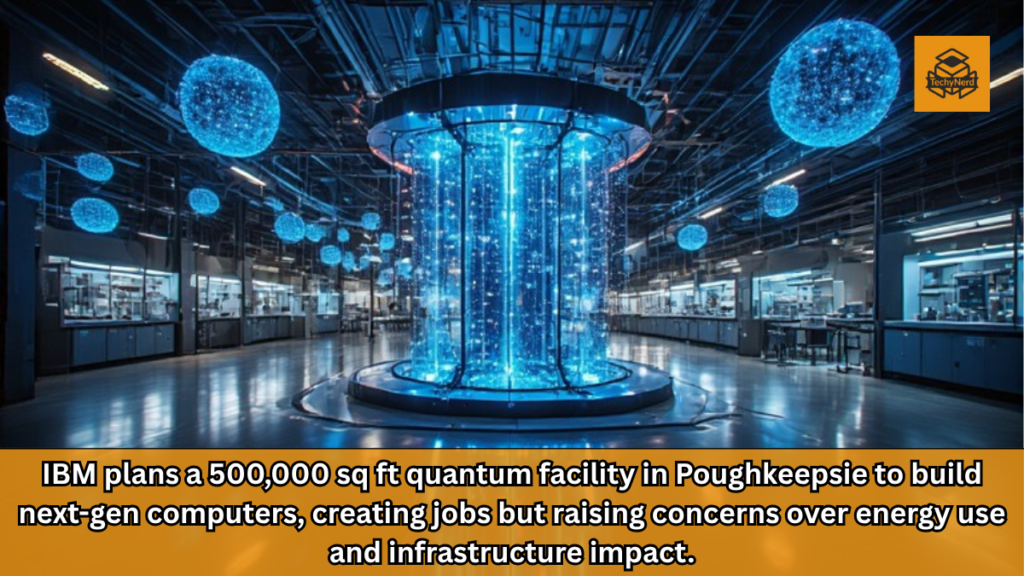
IBM’s proposal outlines the construction of a 500,000-square-foot facility dedicated to the manufacturing and assembly of advanced quantum computers. The development would involve replacing older structures with modern, purpose-built buildings capable of supporting highly specialized production environments.
This initiative aligns with IBM’s long-term roadmap to develop quantum systems that dramatically outperform classical computers in specific domains. The company has already established itself as a pioneer in quantum research, and this expansion is a natural progression toward industrial-scale production.
What distinguishes this effort is its focus on manufacturing rather than purely research. While many organizations remain in the experimental phase, IBM is moving toward operationalizing quantum technology, bridging the gap between theoretical capability and real-world application.
Why Poughkeepsie Matters in the Quantum Ecosystem
The choice of Poughkeepsie as the site for this expansion is deeply rooted in history and infrastructure. Once a hub of traditional computing during the mainframe era, the region has evolved into a center for advanced technological development.
IBM’s campus in Poughkeepsie has long served as a cornerstone of its manufacturing operations. By investing further in this location, the company is leveraging existing expertise, facilities, and supply chain networks.
This continuity is crucial in an industry where precision, reliability, and institutional knowledge play a significant role. Quantum computing systems require highly controlled environments and specialized engineering capabilities, making established sites like Poughkeepsie particularly valuable.
Understanding the Scale of Quantum Advancement
The proposed facility is expected to produce quantum systems with processing capabilities far exceeding current models. IBM has indicated that its upcoming systems could achieve performance levels tens of thousands of times greater than today’s quantum machines.
To understand the significance of this claim, it is essential to consider the nature of quantum computing. Unlike classical computers, which process information in binary bits, quantum systems use qubits that can exist in multiple states simultaneously. This allows them to solve complex problems that are practically impossible for traditional systems.
Applications range from drug discovery and materials science to financial modeling and cryptography. As these systems become more powerful and accessible, they have the potential to redefine entire industries.
Infrastructure Challenges and Energy Considerations
Despite the promise of technological advancement, the proposed expansion has raised important questions about infrastructure and sustainability. Quantum manufacturing facilities, while not identical to data centers, still require significant energy resources to maintain controlled environments and support advanced equipment.
Local officials in Poughkeepsie have expressed concerns about the potential strain on the regional power grid. Ensuring a stable and sufficient energy supply will be critical to the success of the project.
However, IBM has emphasized that the facility will initially operate within existing energy capacities. This suggests a phased approach to scaling operations, allowing for infrastructure upgrades to be implemented over time.
The broader issue of energy consumption is not unique to this project. As the tech industry continues to expand into areas such as artificial intelligence and quantum computing, the demand for power is becoming a central challenge. Balancing innovation with sustainability will be a defining issue in the coming decade.
Differentiating Quantum Facilities from Data Centers
One of the key points of discussion surrounding the proposal is the distinction between quantum manufacturing facilities and traditional data centers. While both involve advanced computing technologies, their operational characteristics differ significantly.
Data centers are designed to handle large volumes of data processing and storage, often requiring continuous high levels of power and cooling. In contrast, quantum manufacturing facilities focus on the assembly and calibration of specialized hardware.
This difference has important implications for energy consumption, environmental impact, and regulatory oversight. By clarifying this distinction, IBM and local officials aim to address concerns and provide a more accurate understanding of the project’s footprint.
Economic Impact and Workforce Development
The proposed expansion is expected to create approximately 200 jobs, primarily focused on the construction and assembly of quantum systems. While this number may seem modest compared to large-scale manufacturing projects, it reflects the highly specialized nature of the work involved.
Quantum computing requires expertise in fields such as physics, engineering, and computer science. As a result, the jobs created are likely to be high-value positions that contribute to the development of a skilled workforce.
Beyond direct employment, the project could also stimulate economic activity in the surrounding region. Suppliers, contractors, and service providers may benefit from increased demand, creating a ripple effect throughout the local economy.
IBM’s Long-Term Investment Strategy
This expansion is part of a broader investment strategy that IBM has been pursuing for several years. The company previously announced a multi-billion-dollar commitment to advancing technologies such as semiconductors, artificial intelligence, and quantum computing.
By integrating these areas, IBM aims to create a cohesive ecosystem that supports innovation across multiple domains. Quantum computing, in particular, is seen as a cornerstone of this strategy, offering capabilities that complement and enhance existing technologies.
The development of “Starling” quantum systems, expected to be released by 2029, represents a key milestone in this journey. These systems are designed to push the boundaries of what is currently possible, enabling new applications and use cases.
Community Concerns and Regulatory Oversight
As with any major infrastructure project, the proposed expansion is subject to rigorous review by local authorities. Issues such as traffic, noise, and environmental impact are being carefully evaluated.
Community engagement will play a critical role in shaping the outcome of the proposal. By addressing concerns transparently and proactively, IBM can build trust and ensure that the project aligns with local priorities.
Regulatory oversight also ensures that the facility meets all necessary standards and requirements. This process, while sometimes lengthy, is essential for balancing innovation with public interest.
The Global Context: A Race for Quantum Supremacy
IBM’s expansion must be viewed within the context of a global competition to achieve quantum supremacy. Governments and corporations around the world are investing heavily in this field, recognizing its potential to transform industries and national economies.
Countries such as the United States, China, and members of the European Union are prioritizing quantum research and development. In this environment, infrastructure investments like the Poughkeepsie facility are critical for maintaining competitive advantage.
By scaling its manufacturing capabilities, IBM is positioning itself as a leader in this race. The ability to produce quantum systems at scale could become a decisive factor in determining market leadership.
The Future of Quantum Manufacturing
Looking ahead, the evolution of quantum manufacturing will likely involve increased automation, improved materials, and more efficient production processes. As technologies mature, costs are expected to decrease, making quantum systems more accessible to a wider range of users.
The proposed facility represents an early step in this transition. By establishing a foundation for large-scale production, IBM is helping to pave the way for a future in which quantum computing becomes a mainstream technology.
This transformation will not happen overnight. It will require sustained investment, collaboration, and innovation. However, the potential rewards are immense, offering solutions to some of the most complex challenges facing humanity.
Conclusion: A Defining Moment for Technology Infrastructure
IBM’s proposed expansion in Poughkeepsie is more than just a construction project. It is a reflection of the shifting priorities and possibilities within the tech industry. As quantum computing moves from theory to practice, the need for advanced infrastructure will only continue to grow.
This initiative highlights the intersection of innovation, economics, and sustainability. It underscores the importance of strategic planning and collaboration in shaping the future of technology.
For the residents of Poughkeepsie, the project represents both an opportunity and a challenge. For the global tech community, it is a clear signal that the quantum era is no longer a distant vision—it is rapidly becoming a reality.
FAQs
1. What is IBM planning in Poughkeepsie?
IBM plans to build a large quantum computing manufacturing facility.
2. How big will the new facility be?
The proposed facility will span approximately 500,000 square feet.
3. What will be produced there?
Advanced quantum computers and related components will be manufactured.
4. How many jobs will be created?
Around 200 jobs are expected during the construction and operational phases.
5. Why is quantum computing important?
It enables solving complex problems beyond the capability of classical computers.
6. Are there environmental concerns?
Yes, including energy usage, traffic, and potential emissions.
7. Will it impact the local power grid?
Officials are reviewing whether the grid can support the facility’s needs.
8. When will the project be completed?
Timelines depend on approvals and construction progress.
9. What are Starling quantum systems?
They are IBM’s next-generation quantum computers planned for release by 2029.
10. Is this part of a larger strategy?
Yes, it aligns with IBM’s long-term investment in advanced technologies.