

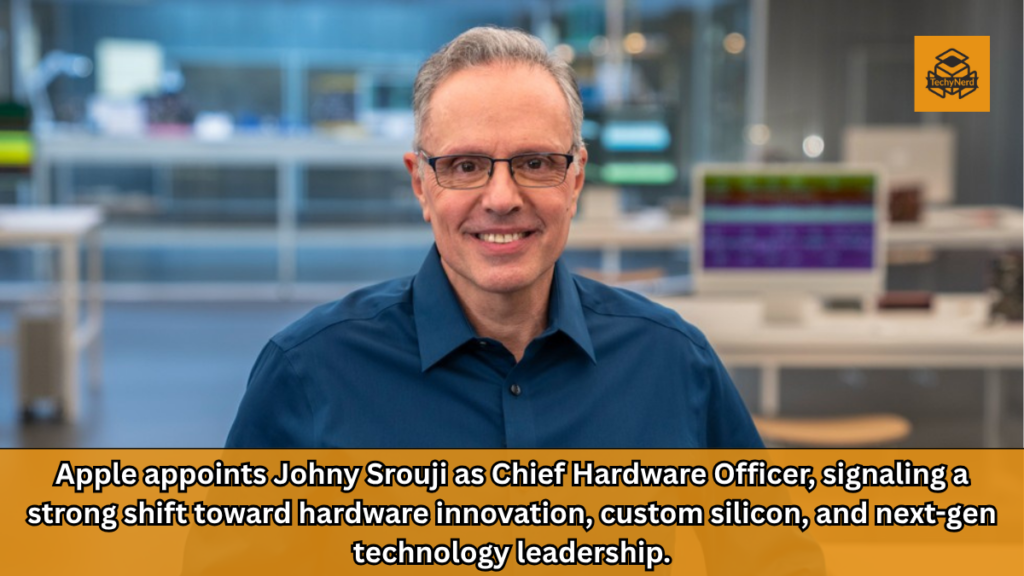
The latest leadership transition at Apple marks one of the most significant organizational shifts in the company’s modern history. As Tim Cook prepares to step down from the CEO role and transition into chairman, and John Ternus takes over as the new chief executive, another equally important development is quietly reshaping Apple’s long-term trajectory. The appointment of Johny Srouji as Chief Hardware Officer reflects a strategic pivot that underscores the growing importance of silicon, hardware integration, and deep engineering leadership within the company.
This transition is not simply a reshuffling of executive titles. It represents a recalibration of Apple’s priorities at a time when the global technology landscape is becoming increasingly competitive, hardware-centric, and innovation-driven.
The Strategic Context Behind Apple’s Leadership Transition
Apple has long been recognized for its ability to maintain stability while evolving its leadership structure in response to industry changes. The transition from Tim Cook to John Ternus is a continuation of this philosophy, ensuring continuity while injecting new perspectives into the company’s executive ranks.
Tim Cook’s tenure has been defined by operational excellence, supply chain mastery, and unprecedented financial growth. Under his leadership, Apple expanded its ecosystem, diversified its product lineup, and strengthened its global presence. Moving into the chairman role allows Cook to continue influencing the company’s strategic direction while stepping back from day-to-day operations.
John Ternus, who has overseen hardware engineering, brings a deep understanding of product development and innovation. His appointment as CEO signals a renewed emphasis on engineering-led leadership, aligning with Apple’s historical roots as a product-driven company.
Within this broader transition, Johny Srouji’s elevation to Chief Hardware Officer is particularly significant. It highlights Apple’s recognition that the future of computing will be defined not just by software ecosystems, but by the underlying hardware that powers them.
Johny Srouji: The Architect Behind Apple’s Silicon Revolution
Johny Srouji’s journey within Apple is a testament to the company’s commitment to technical excellence. Over the past decade, he has played a pivotal role in transforming Apple into one of the world’s leading semiconductor design companies.
Under his leadership, Apple developed its custom silicon architecture, culminating in the transition from Intel processors to in-house chips. This shift fundamentally changed the performance, efficiency, and integration of Apple’s devices.
Apple’s silicon strategy has enabled tighter control over hardware and software integration, resulting in improved battery life, enhanced performance, and unique capabilities that differentiate its products from competitors.
Srouji’s hands-on approach and attention to detail have earned him a reputation as one of the most influential figures within Apple’s engineering organization. His new role formalizes this influence, placing him at the center of the company’s hardware strategy.
The Role of Chief Hardware Officer: A New Power Center
The creation of the Chief Hardware Officer position represents a structural evolution within Apple’s leadership framework. Traditionally, hardware engineering responsibilities were distributed across multiple divisions. By consolidating these functions under a single executive, Apple is streamlining decision-making and enhancing coordination.
This role encompasses a wide range of responsibilities, including chip design, device engineering, and hardware integration. It effectively positions Srouji as the architect of Apple’s physical products, overseeing the technologies that define the user experience.
In an era where hardware innovation is becoming increasingly complex, this level of centralized leadership is critical. It allows Apple to maintain its competitive edge by accelerating development cycles and ensuring consistency across its product portfolio.
Hardware as the Core of Apple’s Competitive Advantage
Apple’s success has always been rooted in its ability to seamlessly integrate hardware and software. However, the importance of hardware has grown significantly in recent years as the company expands into new domains such as augmented reality, wearable technology, and advanced computing systems.
Custom silicon is at the heart of this strategy. By designing its own chips, Apple can optimize performance for specific use cases, enabling features that are not possible with off-the-shelf components.
This approach also provides greater control over supply chains and reduces dependency on external vendors. In a world where semiconductor shortages and geopolitical tensions can disrupt production, this level of autonomy is a strategic advantage.
Srouji’s leadership will be instrumental in advancing this vision, ensuring that Apple continues to push the boundaries of what is possible in hardware design.
Implications for Apple’s Product Roadmap
The elevation of Johny Srouji is likely to have a profound impact on Apple’s future product lineup. As hardware becomes more central to the company’s strategy, we can expect increased investment in areas such as custom processors, advanced sensors, and specialized computing architectures.
This could lead to significant advancements in products like the iPhone, Mac, and Apple Watch, as well as entirely new categories. Augmented reality devices, for example, require highly optimized hardware to deliver immersive experiences.
Similarly, developments in artificial intelligence and machine learning are increasingly dependent on specialized chips. Apple’s ability to design these components in-house gives it a unique advantage in integrating AI capabilities directly into its devices.
Leadership Style and Organizational Impact
Johny Srouji is known for his deeply technical and hands-on leadership style. Unlike traditional executives who focus primarily on high-level strategy, Srouji is actively involved in the engineering process, often engaging with teams at the granular level.
This approach fosters a culture of innovation and accountability, encouraging engineers to push boundaries while maintaining rigorous standards. It also ensures that decision-making is informed by technical expertise rather than purely business considerations.
As Chief Hardware Officer, Srouji’s influence will extend across multiple teams and disciplines. This could lead to greater alignment within the organization, as well as more cohesive product development processes.
The Broader Industry Perspective
Apple’s leadership changes come at a time when the tech industry is undergoing significant transformation. The convergence of hardware, software, and services is reshaping competitive dynamics, with companies increasingly seeking to control every aspect of the user experience.
Competitors are investing heavily in custom silicon and hardware innovation, recognizing the strategic importance of these areas. Apple’s decision to elevate Srouji reflects its commitment to staying ahead in this evolving landscape.
The move also underscores a broader trend toward engineering-driven leadership in the tech industry. As technologies become more complex, companies are placing greater emphasis on technical expertise at the highest levels of management.
Diversity, Representation, and Global Influence
Johny Srouji’s background adds another dimension to his appointment. As an Arab Israeli engineer from Haifa, his rise to one of the most influential positions in the global tech industry highlights the increasing diversity within leadership roles.
This representation is significant not only from a social perspective but also in terms of innovation. Diverse teams bring different perspectives, fostering creativity and enabling companies to address a wider range of challenges.
Apple’s global workforce reflects its international reach, and leadership appointments like this reinforce the company’s commitment to inclusivity and merit-based advancement.
Challenges Ahead
While the appointment of Johny Srouji is a positive step for Apple, it also comes with challenges. The pace of technological change is accelerating, and maintaining leadership in hardware innovation requires continuous investment and adaptation.
Competition in the semiconductor space is intensifying, with companies across the globe racing to develop next-generation chips. Ensuring that Apple remains at the forefront will require not only technical excellence but also strategic foresight.
Additionally, as hardware becomes more complex, managing supply chains and manufacturing processes will become increasingly challenging. Balancing innovation with operational efficiency will be critical to sustaining growth.
The Future of Apple Under Its New Leadership
The combination of John Ternus as CEO and Johny Srouji as Chief Hardware Officer represents a powerful alignment of product vision and technical expertise. This leadership structure positions Apple to navigate the next phase of technological evolution with confidence.
As the company continues to expand into new areas, from spatial computing to advanced AI, the role of hardware will only become more central. Srouji’s leadership ensures that Apple has the expertise needed to drive these innovations forward.
Tim Cook’s transition to chairman provides continuity and stability, allowing the company to build on its existing strengths while exploring new opportunities.
Conclusion: A Defining Moment for Apple’s Next Chapter
Apple’s leadership reshuffle is more than a routine transition—it is a strategic move that reflects the company’s evolving priorities. By elevating Johny Srouji to Chief Hardware Officer, Apple is signaling a clear commitment to hardware innovation as the foundation of its future.
This decision underscores the importance of engineering excellence in a rapidly changing industry. It also highlights Apple’s ability to adapt and evolve while maintaining its core values.
As the tech world watches closely, one thing is clear: the next chapter of Apple’s journey will be defined not just by software and services, but by the powerful hardware innovations that bring its vision to life.
FAQs
1. Who is Johny Srouji?
Johny Srouji is Apple’s newly appointed Chief Hardware Officer and a key leader in its chip development.
2. What is the Chief Hardware Officer role?
It oversees Apple’s hardware engineering, including chip design and device development.
3. Why is this role important?
It centralizes hardware leadership, improving innovation and efficiency.
4. What changes are happening at Apple’s leadership level?
Tim Cook is becoming chairman, and John Ternus is the new CEO.
5. What is Srouji known for?
He led Apple’s transition to custom silicon chips.
6. How does this impact Apple products?
It could accelerate innovation in performance and efficiency.
7. Will Apple focus more on hardware now?
Yes, hardware is becoming central to its strategy.
8. What industries could benefit from this shift?
AI, AR/VR, and advanced computing sectors.
9. Is this part of a global trend?
Yes, many tech companies are emphasizing hardware innovation.
10. What challenges might Apple face?
Competition, supply chain complexity, and rapid technological changes.