

Modern game development has reached a point where theoretical design often collides with real-world player behavior in unpredictable ways. This dynamic is especially evident in live-service titles, where systems evolve after launch based on how millions of players actually engage with the game. The latest example comes from Arc Raiders, where the development team has openly acknowledged shortcomings in one of its core systems: the skill tree.
According to insights shared by design leadership, the current implementation does not fully align with how players interact with the game’s mechanics. This admission is significant, not as a failure, but as a reflection of the iterative nature of modern game design. It also highlights a broader industry trend where developers increasingly rely on post-launch data to refine systems rather than treating release versions as final products.
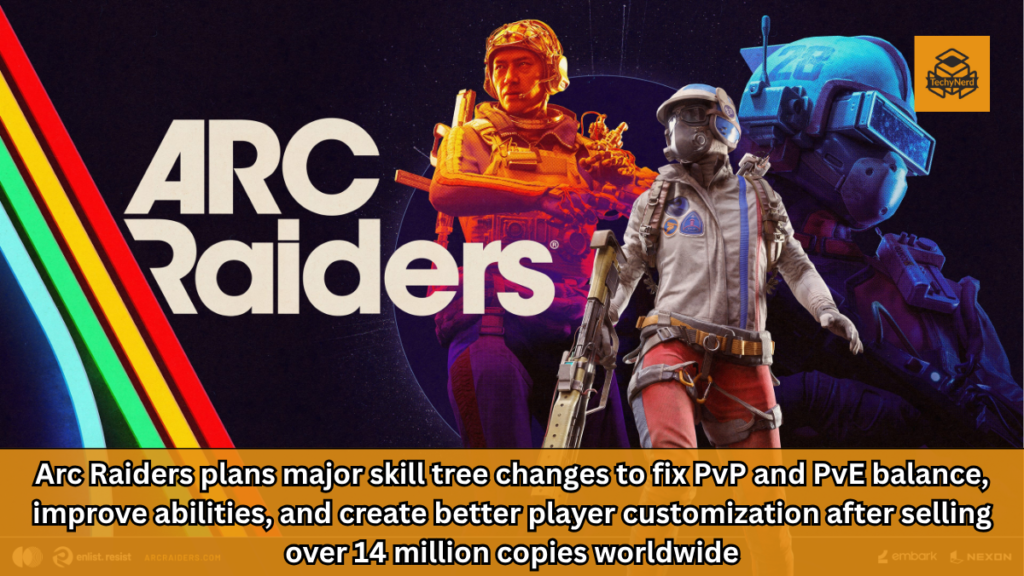
The Core Issue: A Skill Tree That Doesn’t Fully Deliver
At the center of the discussion is the realization that the skill tree, while ambitious in scope, does not consistently deliver meaningful choices across all player types. Some abilities provide clear advantages, while others fail to justify their inclusion. This imbalance creates a system where optimal builds dominate, reducing diversity in playstyles.
From a design perspective, this is a classic challenge. Skill trees are intended to empower players, offering meaningful customization and progression. However, when certain paths outperform others, the system inadvertently funnels players into a narrow set of choices. This undermines the very purpose of the feature.
The developers have acknowledged that some skills are currently “underserving their purpose,” which suggests a deeper structural issue rather than a simple balancing problem.
The PvP and PvE Conflict: A Design Dilemma
One of the most complex aspects of the skill tree is its role in both player-versus-player and player-versus-environment gameplay. Balancing a system across these two modes is inherently difficult because the requirements are fundamentally different.
PvE environments allow for controlled tuning. Developers can adjust enemy difficulty, damage scaling, and encounter design to create a balanced experience. PvP, on the other hand, introduces human unpredictability. Players will always find ways to exploit advantages, making balance far more challenging.
In the case of Embark Studios, the challenge is compounded by the hybrid nature of the game. Skills that are effective in PvE may not translate well to PvP scenarios, and vice versa. This creates a situation where players who specialize in one area may feel disadvantaged in the other.
Design Philosophy: Meaningful Choices vs Statistical Upgrades
Another key insight from the development team is their preference for impactful abilities over minor statistical boosts. This reflects a broader trend in game design, where players increasingly expect abilities that change how they play rather than simply improving numbers.
However, this approach introduces its own challenges. Unique abilities are harder to balance because they can interact with other systems in unpredictable ways. Statistical upgrades, while less exciting, are easier to manage from a balance perspective.
The current skill tree appears to sit somewhere between these two philosophies, resulting in a system that lacks consistency. Some skills feel transformative, while others feel insignificant. This inconsistency contributes to the perception that the system is not fully realized.
Player Identity and Playstyle Expression
One of the stated goals of the skill tree is to help players define their playstyle. Whether someone prefers stealth, agility, or direct combat, the system is intended to support diverse approaches.
This concept of player identity is central to modern game design. Players want to feel that their choices matter and that their character reflects their personal preferences. When a skill tree fails to deliver on this promise, it can lead to disengagement.
The developers have indicated that future changes will focus on strengthening this aspect. The aim is to create a system where different elements, including weapons, gadgets, and abilities, work together to form a cohesive playstyle.
The Role of Data in Post-Launch Development
One of the most important factors driving these changes is player data. Unlike traditional game development, where systems were largely finalized before release, modern live-service games rely heavily on analytics.
By observing how players interact with the game, developers can identify patterns, imbalances, and unintended behaviors. This data-driven approach allows for more informed decision-making but also requires a willingness to adapt and iterate.
In the case of Nexon, the success of Arc Raiders has provided a large dataset to work with. With millions of players engaging with the game, the development team has access to valuable insights that can guide future updates.
Commercial Success and Its Impact on Development
The commercial performance of Arc Raiders adds another layer to the discussion. With over 14 million copies sold in just a few months, the game has exceeded expectations. This level of success increases both the opportunity and the responsibility for the development team.
On one hand, a large player base provides the data needed to refine systems. On the other hand, it raises expectations for continuous improvement. Players who invest time in a live-service game expect regular updates and meaningful enhancements.
The planned skill tree overhaul can be seen as a response to these expectations, demonstrating a commitment to long-term support.
Balancing Complexity and Accessibility
Another challenge in redesigning the skill tree is maintaining a balance between complexity and accessibility. A system that is too complex can overwhelm new players, while one that is too simple may fail to engage experienced users.
The current feedback suggests that the system may not be fully achieving either goal. By refining the structure and improving clarity, the developers aim to create a more intuitive experience without sacrificing depth.
This balance is critical in ensuring that the game remains accessible to new players while retaining its appeal for dedicated fans.
Future Direction: What Significant Changes Could Mean
While specific details about the upcoming changes have not been fully disclosed, the phrase “significant changes” suggests more than minor adjustments. It could involve restructuring the skill tree, reworking abilities, or even introducing entirely new progression systems.
Such changes carry risks. Altering a core system can disrupt existing player strategies and require a period of adjustment. However, it also presents an opportunity to address longstanding issues and enhance the overall experience.
The success of these changes will depend on how well they align with player expectations and how effectively they are communicated.
Industry Implications: A Case Study in Live-Service Evolution
The situation with Arc Raiders reflects a broader trend in the gaming industry. Live-service games are increasingly viewed as evolving platforms rather than static products. This requires a shift in mindset for both developers and players.
Developers must be prepared to iterate and adapt, while players must accept that systems may change over time. When managed effectively, this approach can lead to more dynamic and engaging experiences.
Conclusion: Iteration as a Path to Excellence
The planned overhaul of the Arc Raiders skill tree represents a critical step in the game’s evolution. By acknowledging shortcomings and committing to improvement, the development team is embracing the iterative nature of modern game design.
While challenges remain, the willingness to adapt and refine systems is a positive sign. In an industry where player expectations continue to rise, this approach may ultimately determine the long-term success of the game.
FAQs
1. What changes are coming to Arc Raiders skill tree
Developers are planning significant updates to improve balance and usability
2. Why is the skill tree being redesigned
Some skills are not effective and do not serve their intended purpose
3. What is the main issue with the current system
There is imbalance between different skills and playstyles
4. How does PvP affect skill balance
PvP introduces unpredictability, making balancing more complex
5. Will new abilities be added
It is possible, but details have not been fully confirmed
6. How does PvE differ in balancing
PvE is easier to control and adjust compared to PvP
7. Who is developing Arc Raiders
The game is developed by Embark Studios
8. Who publishes the game
It is published by Nexon
9. How successful is the game so far
It has sold over 14 million copies in a few months
10. When will the changes be released
No exact date has been announced yet