

For decades, the global technology landscape has been dominated by the United States and, more recently, China. From cloud computing to artificial intelligence and semiconductor manufacturing, Europe has often found itself trailing behind, rich in research but slower in commercialization. However, in the emerging field of quantum computing, the narrative may finally be shifting.
At the center of this is a new generation of European कंपनियाँ and research institutions determined to convert theoretical physics into industrial शक्ति. Among them, the Paris-based startup Alice & Bob stands out as a symbol of Europe’s ambition to lead rather than follow.
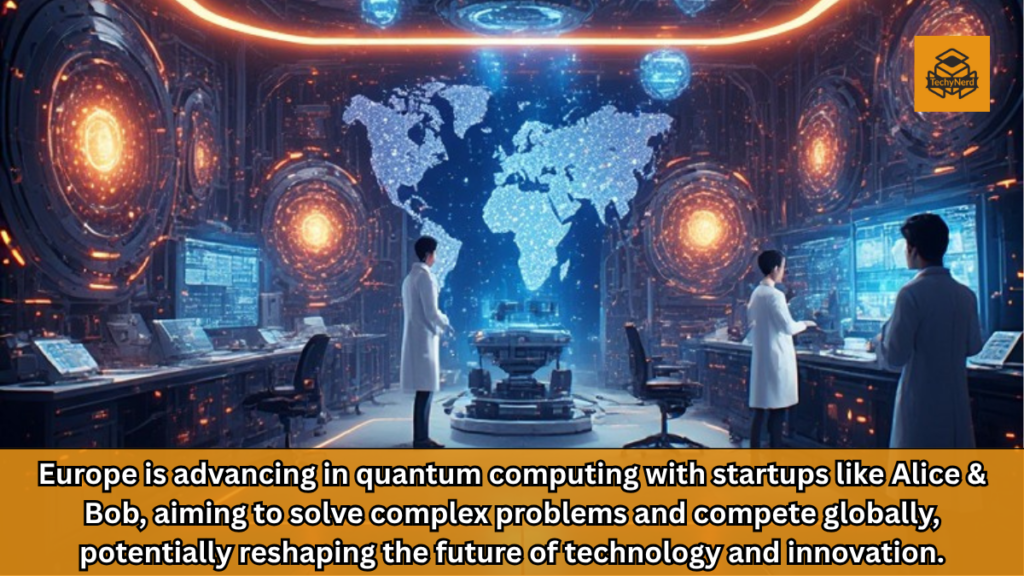
Quantum computing is not simply another technological upgrade. It represents a fundamental rethinking of computation itself. If realized at scale, it could redefine industries ranging from pharmaceuticals to logistics, finance, and climate modeling. The stakes are enormous, and for the first time in decades, Europe has a credible opportunity to compete at the highest level.
Inside the Quantum Lab: Engineering at the Edge of Physics
To understand the significance of Europe’s progress, one must first grasp the extraordinary conditions required for quantum computation. Inside advanced laboratories, machines resembling intricate chandeliers descend into cryogenic chambers, where temperatures approach absolute zero.
At approximately minus 273 degrees Celsius, thermal noise is virtually eliminated. This is essential because quantum systems rely on delicate states that are easily disrupted by the environment. Within these cryostats, specialized chips host quantum bits, or qubits, which behave in ways that defy classical intuition.
The phenomenon underlying these systems traces back to foundational work by Albert Einstein and other pioneers of quantum mechanics. Unlike classical bits, which exist as either 0 or 1, qubits can exist in superpositions, enabling them to perform complex calculations exponentially faster than traditional computers in specific domains.
The machines being built today are not yet powerful enough to outperform classical systems in most tasks. However, they represent the शुरुआती चरण of an exponential curve that could lead to transformative breakthroughs.
The Promise of Quantum Computing: Beyond Speed to Possibility
One of the most common misconceptions about quantum computing is that it is merely about speed. In reality, its true value lies in enabling computations that are currently impossible.
In drug discovery, for example, quantum systems could simulate molecular interactions with unprecedented precision. This would transform pharmaceutical development from a largely trial-and-error process into a more deterministic science. Researchers could predict how molecules interact, identify optimal compounds, and reduce both time and cost.
In logistics and supply chain optimization, quantum algorithms could solve complex routing problems that overwhelm classical computers. Financial modeling, climate simulations, and materials science are other areas where quantum computing could unlock new possibilities.
The economic implications are profound. The first organization to achieve scalable, reliable quantum computing could gain a decisive advantage, potentially reshaping entire industries.
The Fragility Problem: Quantum Computing’s Greatest Challenge
Despite its promise, quantum computing faces a fundamental obstacle: fragility. Qubits are अत्यंत sensitive to environmental disturbances, leading to errors that can quickly accumulate and render calculations unreliable.
This issue, known as decoherence, is the central challenge for researchers worldwide. Traditional approaches rely on redundancy, using thousands of physical qubits to create a single reliable logical qubit. While effective in principle, this method dramatically increases complexity and cost.
Here is where Alice & Bob has taken a different path. The company has developed “cat qubits,” inspired by Schrödinger’s famous thought experiment. These qubits are designed to correct certain errors automatically, reducing the need for extensive redundancy.
This innovation has the potential to simplify quantum architectures, making them more scalable and economically viable. If successful, it could provide a significant competitive advantage.
Europe’s Quantum Ecosystem: Diversity as Strength
France is not alone in this race. Across Europe, a diverse ecosystem of companies and research institutions is exploring different approaches to quantum computing.
In addition to Alice & Bob, notable French firms include Pasqal, Quandela, Quobly, and C12. Each focuses on different qubit technologies, ranging from neutral atoms to photonic systems and semiconductor approaches.
Elsewhere in Europe, Finland’s IQM and the UK’s Oxford Quantum Circuits and Riverlane are making significant contributions.
This diversity is a strategic advantage. Rather than betting on a single technological path, Europe is exploring multiple संभावनाएँ simultaneously. This increases the likelihood that at least one approach will achieve scalable success.
Government Support and Strategic Vision
Recognizing the importance of quantum computing, European governments have begun to invest heavily in the field. France’s PROQCIMA program, for example, aims to develop practical quantum systems and support national champions.
Such initiatives are critical because quantum computing requires substantial capital. Building and maintaining cryogenic systems, developing specialized chips, and conducting advanced research are all resource-intensive endeavors.
Europe’s ability to mobilize funding and coordinate efforts across countries will play a निर्णायक role in determining its success. Unlike previous tech revolutions, where fragmentation hindered progress, the quantum race offers an opportunity for greater सहयोग.
Integration with High-Performance Computing
One of the most promising near-term applications of quantum computing is its integration with high-performance computing systems. Rather than replacing classical computers, quantum systems are expected to complement them.
By connecting quantum processors to HPC infrastructure, researchers can offload specific समस्याएँ that benefit from quantum algorithms while relying on classical systems for other tasks. This hybrid approach allows for practical उपयोग even before fully scalable quantum computers are realized.
Several European companies have already begun deploying quantum systems within industrial environments. These early प्रयोग are helping to build expertise and prepare the workforce for the future quantum era.
The Talent Advantage: Europe’s علمی Foundation
Europe’s strong foundation in physics and mathematics provides a critical advantage in the quantum race. Institutions such as École Polytechnique and École Normale Supérieure have produced world-class researchers who are driving innovation in the field.
The region’s academic tradition ensures a steady pipeline of talent, capable of tackling the complex theoretical and engineering challenges involved in quantum computing.
This intellectual capital is perhaps Europe’s most valuable asset. While funding and infrastructure are essential, the सफलता of quantum computing ultimately depends on the ability to solve deeply complex problems.
Global Competition: The Race Against Giants
Despite its strengths, Europe faces intense competition from global tech giants. Companies like IBM, Google, and others are investing billions in quantum research.
These organizations benefit from विशाल resources, established infrastructure, and extensive experience in scaling technologies. However, quantum computing presents a unique opportunity because it is still in its early stages.
Unlike classical computing, where incumbents have decades of advantage, the quantum field remains relatively open. This creates a rare window for नए players to emerge as leaders.
Economic and Strategic Implications
The implications of winning the quantum race extend far beyond technology. Quantum computing has the potential to become a cornerstone of economic शक्ति, influencing industries, national security, and global competitiveness.
For Europe, success in this المجال could help reduce dependence on foreign technologies and strengthen its strategic autonomy. It could also position the region as a hub for advanced الصناعات and innovation.
The stakes are high, but so is the potential reward.
Challenges Ahead: Funding, Scale, and Coordination
While Europe has made significant progress, several challenges remain. Funding continues to be a प्रमुख issue, as quantum projects require sustained investment over long periods.
Scaling quantum systems from laboratory prototypes to industrial उपकरण is another major hurdle. Achieving reliability, reducing costs, and integrating systems into existing infrastructure will require continued innovation.
Coordination across countries and institutions is also critical. Fragmentation could undermine Europe’s efforts, while collaboration could amplify its strengths.
Conclusion: A Rare Opportunity to Redefine the Global Tech Order
The quantum computing race represents a unique moment in technological history. For Europe, it is an opportunity to move from follower to leader, leveraging its strengths in research, talent, and innovation.
Companies like Alice & Bob are at the forefront of this effort, developing नए approaches that चुनौती conventional wisdom.
While the outcome remains uncertain, one thing is clear: the quantum era is approaching, and Europe intends to be a प्रमुख player in shaping it.
FAQs
1. What is quantum computing?
It is a computing method using qubits to solve complex problems beyond classical computers.
2. Why is Europe important in quantum computing?
It has strong research institutions and emerging innovative startups.
3. What is Alice & Bob known for?
Developing “cat qubits” that reduce quantum errors.
4. What is a qubit?
A quantum bit that can exist in multiple states simultaneously.
5. What is the biggest challenge in quantum computing?
Fragility and error rates due to environmental interference.
6. How can quantum computing impact medicine?
By simulating molecules to accelerate drug discovery.
7. Are quantum computers usable today?
They exist but are not yet fully scalable or practical.
8. What is HPC integration?
Combining quantum and classical computing systems.
9. Who are Europe’s competitors?
Companies like IBM and major US tech firms.
10. Can Europe lead the quantum race?
Yes, if it maintains funding, talent, and collaboration.