

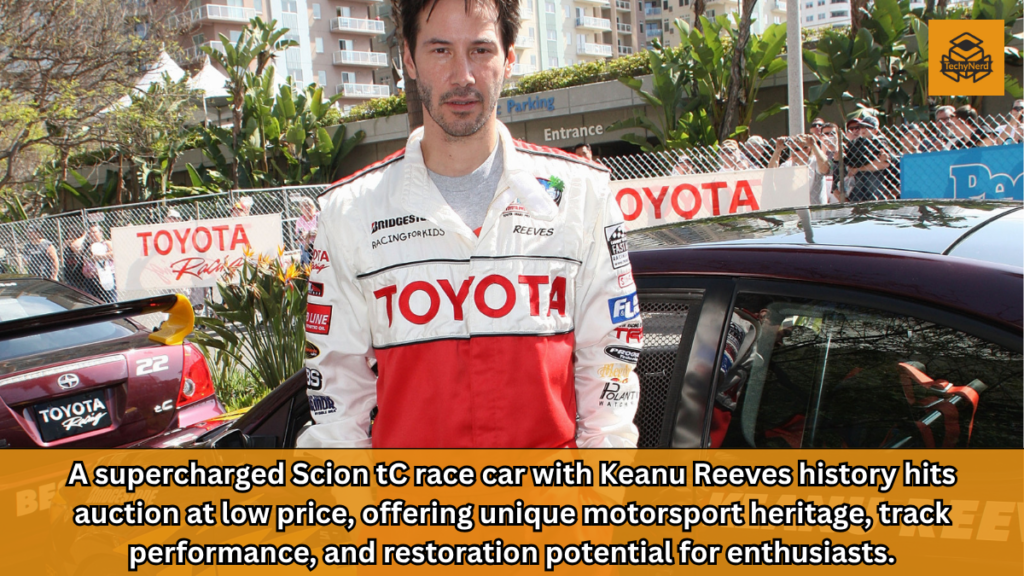
In the modern automotive landscape, opportunities to own a genuine race car with verified celebrity history are exceptionally rare. Even more unusual is when such a vehicle originates from a structured motorsport program backed by a major automaker. The story of the supercharged Scion tC once driven by Keanu Reeves offers a compelling case study at the intersection of performance engineering, brand strategy, and motorsport culture.
This car is not merely a modified street vehicle. It is a purpose-built race machine developed for a unique competitive format that blended professional racing talent with celebrity participants. Its current availability in the secondary market highlights broader themes in automotive depreciation, track vehicle economics, and the lifecycle of motorsport assets.
The Legacy of the Toyota Pro/Celebrity Race
To fully understand the significance of this vehicle, it is essential to examine the context in which it was created. The Toyota Pro/Celebrity Race was a distinctive motorsport event that ran for decades as part of the Long Beach Grand Prix weekend. Unlike traditional racing series, it combined professional drivers with celebrities, creating a hybrid competition that emphasized both entertainment and skill.
The format introduced a deliberate competitive balance by giving celebrity drivers a head start, allowing them to compete meaningfully against seasoned professionals. Over time, this event became a proving ground for celebrities who developed a genuine interest in racing, with some continuing their involvement in motorsport long after their initial participation.
Within this framework, vehicles like the Scion tC race car were engineered to provide consistent performance across all participants, ensuring fairness while maintaining a high level of driving engagement.
Scion’s Role in Performance Branding
During the mid-2000s, Toyota leveraged its Scion sub-brand to appeal to younger, enthusiast-oriented audiences. At a time when Toyota’s core lineup prioritized reliability and efficiency, Scion served as an experimental platform for injecting excitement into the brand.
The decision to use the Scion tC in the Pro/Celebrity Race reflects this strategy. While the production version of the tC was not designed as a high-performance vehicle, its adaptability made it a suitable candidate for motorsport modification. By transforming the tC into a race-ready machine, Toyota demonstrated how engineering enhancements could elevate an otherwise modest platform.
Engineering Transformation: From Road Car to Race Machine
The race-spec Scion tC underwent significant modifications to meet the demands of competitive driving. At the heart of this transformation was the addition of a supercharger to the 2.4-liter inline-four engine. This modification increased output by approximately 60 horsepower, bringing total performance to around 220 horsepower.
While these figures may appear modest by modern standards, they were carefully calibrated to ensure parity among competitors. The focus was not on outright speed but on delivering a balanced and controllable driving experience.
Additional upgrades included a racing clutch, performance exhaust system, coilover suspension, and a high-performance braking system. These enhancements improved handling, responsiveness, and durability under track conditions.
The inclusion of lightweight wheels, aerodynamic components, and essential safety features such as a roll cage and harness system further reinforced the car’s suitability for racing. Collectively, these modifications transformed the tC into a capable track vehicle.
The Human Element: Keanu Reeves and Motorsport Passion
Keanu Reeves’ involvement in the Pro/Celebrity Race adds a unique dimension to this vehicle’s history. Known globally for his acting career, Reeves has also demonstrated a genuine passion for motorsport. His victory in the 2009 event underscores his capability as a driver, challenging the perception that celebrity participants are merely symbolic.
Reeves’ continued involvement in racing activities highlights a broader trend in which public figures engage deeply with technical disciplines. This intersection of celebrity and engineering contributes to the cultural significance of vehicles like this Scion tC.
Lifecycle of a Race Car: From Competition to Secondary Market
Race cars follow a distinct lifecycle that differs significantly from consumer vehicles. After their competitive use, they are often repurposed for training, testing, or recreational driving. This particular Scion tC was reportedly used in a racing school environment, exposing it to extensive track use under demanding conditions.
Such usage accelerates wear and tear, particularly on mechanical components. While the odometer may indicate relatively low mileage, the intensity of track driving means that each mile represents significantly higher stress compared to normal road use.
This factor plays a crucial role in determining the vehicle’s market value. Unlike collector cars that appreciate over time, many race cars depreciate due to their specialized nature and maintenance requirements.
Condition Assessment: Balancing History and Wear
The current condition of the vehicle reflects its extensive operational history. Visible signs of wear, including cosmetic damage and aging components, are typical for a car that has spent years on the track. Safety equipment such as harnesses and window nets may require replacement to meet modern standards.
From a mechanical perspective, the engine’s long-term reliability is a key consideration. The 2AZ engine platform is known for its durability, but sustained high-performance use and forced induction can accelerate degradation. Prospective buyers must evaluate the potential need for rebuilding or replacing critical components.
Despite these challenges, the car’s historical significance and unique provenance contribute to its appeal.
Economic Perspective: Why Is the Price So Low
One of the most intriguing aspects of this listing is its relatively low auction price. Several factors contribute to this phenomenon. First, the car is not street-legal, limiting its usability to track environments. Second, the cost of maintenance and potential repairs can be substantial, deterring casual buyers.
Additionally, the niche nature of race cars reduces the pool of potential buyers. Unlike conventional vehicles, these machines require specialized knowledge and resources to operate effectively.
However, for enthusiasts and collectors, this pricing represents an opportunity. Acquiring a factory-built race car with celebrity history at a fraction of the cost of modern racing vehicles is a rare proposition.
Comparative Analysis: Modern Racing Alternatives
To contextualize the value of this Scion tC, it is useful to compare it with contemporary racing platforms. Entry-level race cars in modern series can cost well into six figures, reflecting advancements in technology and performance.
In contrast, this vehicle offers a more accessible entry point into track driving. While it may lack the sophistication of newer models, it provides a tangible connection to motorsport history and a platform for experiential learning.
Cultural Significance: Motorsport Meets Popular Culture
The intersection of motorsport and popular culture is a defining characteristic of the Pro/Celebrity Race. Vehicles like this Scion tC embody that connection, serving as artifacts that bridge two distinct worlds.
For fans of both racing and cinema, the association with Keanu Reeves adds an अतिरिक्त layer of meaning. It transforms the car from a purely mechanical object into a piece of cultural history.
Conclusion: A Unique Opportunity in Automotive History
The Scion tC race car driven by Keanu Reeves represents a convergence of engineering, entertainment, and motorsport heritage. Its availability in the secondary market offers a rare opportunity to engage with a piece of automotive history.
While the vehicle’s condition and limitations must be carefully considered, its significance extends beyond conventional metrics of performance and value. It serves as a reminder that innovation and passion often intersect in unexpected ways, creating enduring legacies in both technology and culture.
FAQs
1. What makes this Scion tC special?
It is a factory-built race car with celebrity racing history.
2. Who drove this car?
Keanu Reeves raced a similar car in the Pro/Celebrity Race.
3. What engine does it use?
A supercharged 2.4-liter inline-four engine.
4. Is the car street legal?
No, it is designed for track use only.
5. Why is it priced so low?
Due to wear, limited usability, and niche demand.
6. Can it still be raced?
Yes, with proper maintenance and safety updates.
7. What modifications does it have?
Supercharger, racing suspension, brakes, and safety equipment.
8. Is it a good investment?
It depends on the buyer’s interest in motorsport and restoration.
9. How reliable is the engine?
It is durable but may need rebuilding after heavy use.
10. What is its historical significance?
It represents a unique blend of motorsport and celebrity culture.