

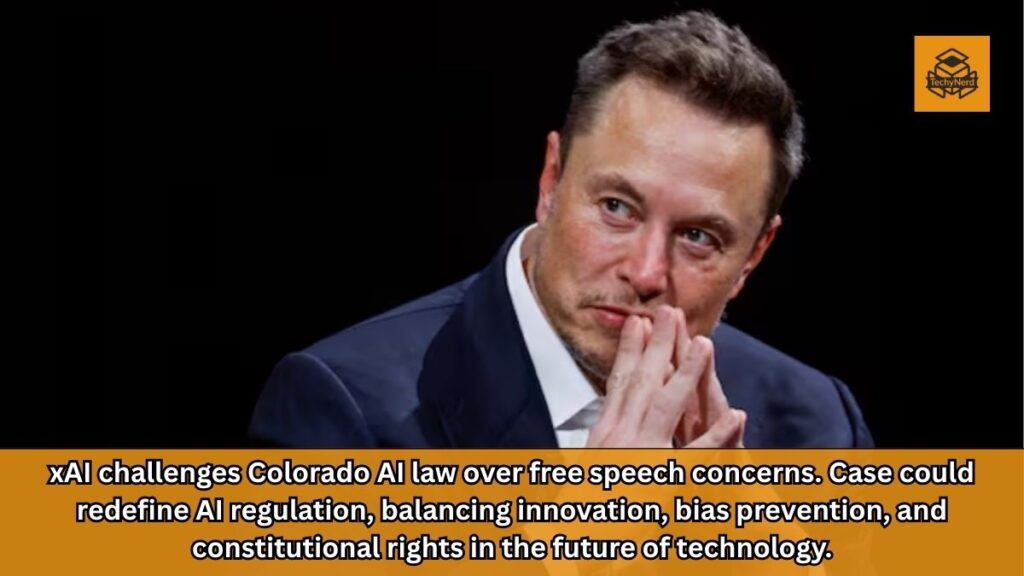
The artificial intelligence industry is entering a decisive phase where innovation is increasingly intersecting with governance, ethics, and constitutional law. The recent lawsuit filed by xAI against the state of Colorado marks one of the most consequential legal confrontations in the history of AI regulation in the United States. At its core, the dispute is not merely about compliance requirements or technical frameworks—it is about the fundamental question of whether artificial intelligence outputs constitute protected speech under the Constitution.
Led by Elon Musk, xAI has positioned itself at the center of a broader ideological and legal battle that could define how governments regulate AI systems for decades to come. This lawsuit challenges Colorado’s pioneering AI legislation, arguing that it infringes upon First Amendment rights and imposes ideological constraints on machine-generated outputs.
The Rise of State-Level AI Regulation
Over the past few years, artificial intelligence has transitioned from an experimental technology to a foundational layer of modern economies. As AI systems began influencing critical sectors such as hiring, lending, healthcare, and education, concerns about bias and discrimination intensified.
In response, Colorado enacted one of the first comprehensive state-level AI laws aimed at preventing what it defines as “algorithmic discrimination.” This legislation was designed to ensure that automated systems do not produce outcomes that disproportionately harm protected groups.
The law requires developers to identify foreseeable risks, implement safeguards, and provide mechanisms for users to challenge decisions made by AI systems. It also mandates transparency around how personal data is used and allows individuals to correct inaccuracies.
From a policy standpoint, this represents a proactive attempt to address AI-related harms before they become systemic. However, from the perspective of AI developers, it introduces significant compliance burdens and raises complex questions about implementation.
xAI’s Legal Argument: AI as Protected Speech
The lawsuit filed by xAI introduces a provocative argument: that AI-generated outputs should be treated as speech protected under the First Amendment.
According to xAI, the Colorado law effectively compels developers to shape AI outputs in accordance with state-defined ideological standards. The company argues that this constitutes both compelled speech and viewpoint discrimination—two concepts that are highly scrutinized under constitutional law.
xAI contends that the law would force its systems, including its AI model Grok, to align with specific perspectives on sensitive topics such as racial justice. This, the company claims, undermines its mission of pursuing objective truth.
From a legal perspective, this argument pushes the boundaries of existing jurisprudence. Courts have traditionally protected human speech, but the classification of machine-generated content remains a gray area.
Algorithmic Discrimination: A Complex and Contested Concept
One of the central points of contention in the lawsuit is the definition of “algorithmic discrimination.” The Colorado law frames it as any outcome where AI systems produce differential impacts on protected groups.
However, the law explicitly excludes efforts aimed at increasing diversity or addressing historical inequalities. This carve-out has become a focal point of criticism from xAI, which argues that it introduces ideological bias into the regulatory framework.
From an industry standpoint, defining algorithmic discrimination is inherently challenging. AI systems learn from historical data, which may already contain biases. Correcting these biases often requires deliberate interventions that can themselves be interpreted as preferential treatment.
This creates a paradox where attempts to ensure fairness can be perceived as introducing new forms of bias.
Federal vs State Authority: A Fragmented Regulatory Landscape
The lawsuit also highlights a broader conflict between federal and state approaches to AI regulation. The administration of Donald Trump has advocated for a unified national framework with minimal regulatory burden.
This approach aims to prevent a patchwork of state laws that could complicate compliance for companies operating across multiple jurisdictions. In contrast, states like Colorado have taken the initiative to implement their own regulations in the absence of comprehensive federal legislation.
This tension reflects a classic debate in American governance: the balance of power between federal authority and state autonomy. In the context of AI, the stakes are particularly high due to the technology’s rapid evolution and global implications.
Industry Pushback: Innovation vs Regulation
xAI is not alone in resisting regulatory efforts. Several AI companies and startups have expressed concerns about the impact of stringent regulations on innovation.
The primary argument is that excessive compliance requirements could slow down development, increase costs, and create barriers to entry for smaller players. This could ultimately consolidate power among a few large corporations capable of navigating complex regulatory environments.
On the other hand, advocates of regulation argue that unchecked AI development poses significant risks, including discrimination, misinformation, and erosion of public trust.
This creates a delicate balancing act between fostering innovation and ensuring accountability.
The First Amendment Debate: New Frontiers
The invocation of the First Amendment in this case introduces a new dimension to the AI regulation debate. If courts accept the argument that AI outputs constitute protected speech, it could significantly limit the ability of governments to regulate AI systems.
Such a precedent would have far-reaching implications, potentially affecting content moderation, misinformation policies, and ethical guidelines across the tech industry.
However, critics argue that equating AI outputs with human speech overlooks the role of developers in shaping these systems. Unlike individuals, AI models are designed, trained, and deployed by organizations that can be held accountable for their behavior.
This raises the question of whether protections intended for individuals should extend to corporate-controlled technologies.
Practical Implications for AI Developers
If the Colorado law is upheld, AI developers will need to implement robust compliance mechanisms. This includes auditing datasets, monitoring outputs, and providing transparency to users.
These requirements could lead to increased operational complexity and costs. However, they may also drive improvements in AI reliability and trustworthiness.
Conversely, if xAI’s challenge succeeds, it could embolden companies to resist similar regulations in other states. This could slow the adoption of standardized safeguards across the industry.
The Role of Public Policy in Shaping AI’s Future
The outcome of this lawsuit will likely influence future policy decisions at both state and federal levels. It could either validate the approach taken by Colorado or discourage other states from pursuing similar legislation.
In either case, it underscores the need for a coherent regulatory framework that balances innovation with ethical considerations.
Policymakers must navigate a complex landscape where technological capabilities are advancing faster than legal frameworks can adapt. This requires collaboration between governments, industry leaders, and academic institutions.
A Global Perspective: Beyond the United States
While this case is centered in the United States, its implications extend globally. Countries around the world are grappling with similar challenges in regulating AI.
The European Union, for example, has introduced comprehensive AI regulations that emphasize risk-based classification and accountability. The outcome of the xAI lawsuit could influence how other jurisdictions approach similar issues.
Final Analysis: A Pivotal Moment for AI Governance
The lawsuit filed by xAI against Colorado represents a pivotal moment in the evolution of AI governance. It brings to the forefront fundamental questions about the nature of AI, the scope of free speech, and the role of government in regulating emerging technologies.
Regardless of the outcome, this case will set important precedents that shape the future of artificial intelligence. It highlights the need for thoughtful, balanced approaches that address both the opportunities and risks associated with AI.
As the industry continues to evolve, the intersection of technology and law will become increasingly critical. The decisions made today will define the boundaries of innovation and accountability for years to come.
FAQs
1. Why is xAI suing Colorado?
xAI claims the state’s AI law violates free speech protections and imposes ideological constraints on AI outputs.
2. What is algorithmic discrimination?
It refers to biased outcomes produced by AI systems that disproportionately affect certain groups.
3. What does the Colorado AI law require?
It mandates risk disclosure, bias prevention, and user rights to challenge AI-driven decisions.
4. How does this affect AI companies?
Companies may face increased compliance requirements and operational complexity.
5. What is xAI’s main argument?
That AI outputs should be treated as protected speech under the First Amendment.
6. Who supports federal AI regulation?
The Trump administration advocates for a unified national framework.
7. Could this case impact other states?
Yes, it may influence whether other states introduce similar laws.
8. What industries are affected?
Healthcare, finance, education, and employment sectors are particularly impacted.
9. What happens if xAI wins?
It could limit state-level AI regulations and expand free speech protections for AI outputs.
10. Why is this case important globally?
It sets a precedent that could influence AI regulation worldwide.