

The pursuit of practical quantum computing has long been defined by a paradox. On one hand, quantum systems promise computational capabilities far beyond classical machines, with the potential to transform industries ranging from pharmaceuticals to cybersecurity. On the other hand, these systems remain notoriously fragile, with their core building blocks—qubits—prone to losing information due to environmental interference.
Now, researchers at Chalmers University of Technology have introduced a groundbreaking theoretical concept that could redefine how quantum systems are built and stabilized. Known as “giant superatoms,” this new architecture merges two previously distinct quantum frameworks into a unified system capable of protecting, controlling, and distributing quantum information in fundamentally new ways.
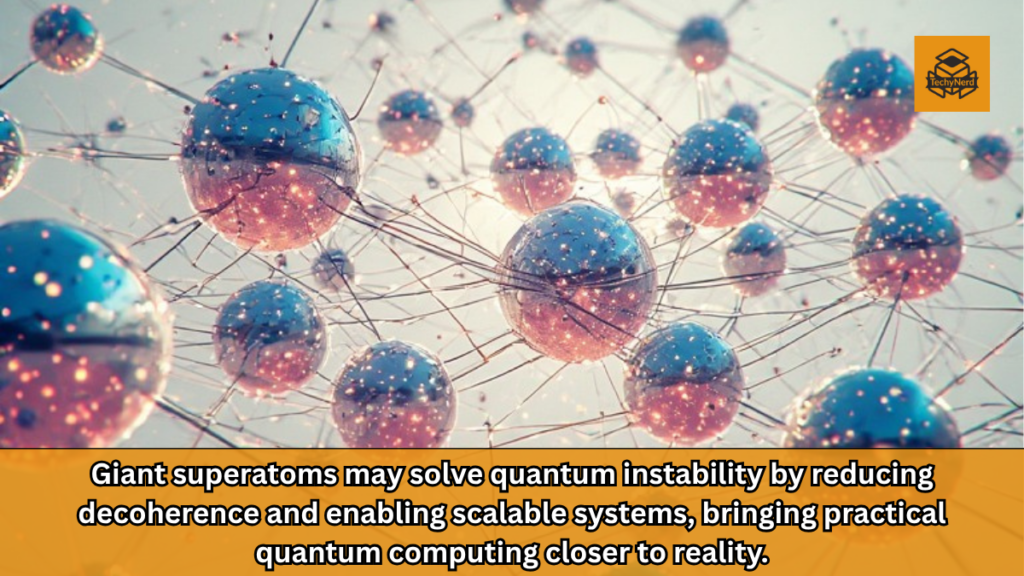
This development is not merely incremental. It represents a conceptual leap that could address one of the most persistent and limiting challenges in quantum computing: decoherence. By rethinking how qubits interact with their environment and with each other, giant superatoms may provide the foundation for scalable, reliable quantum machines.
The Core Challenge: Why Quantum Computing Remains Fragile
To understand the significance of this breakthrough, it is essential to examine the fundamental limitation it seeks to overcome. Quantum computers rely on qubits, which differ from classical bits by existing in multiple states simultaneously. This property enables extraordinary computational power, particularly for complex problems involving optimization, simulation, and cryptography.
However, qubits are extremely sensitive to external disturbances. Even minimal exposure to electromagnetic noise, temperature fluctuations, or environmental interactions can cause them to lose coherence. This phenomenon, known as decoherence, disrupts quantum states and leads to computational errors.
Decoherence has been the primary bottleneck in scaling quantum systems. While researchers have developed error-correction techniques and improved isolation methods, these solutions often introduce additional complexity, making systems harder to build and maintain.
The concept of giant superatoms directly addresses this issue by redesigning how quantum systems interact with their surroundings.
Introducing Giant Superatoms: A Hybrid Quantum Architecture
The innovation of giant superatoms lies in its hybrid nature. It combines the principles of two distinct constructs in Quantum Physics: giant atoms and superatoms.
Giant atoms are engineered quantum systems that interact with their environment at multiple spatial points simultaneously. Unlike conventional atoms, which interact locally, giant atoms can connect to electromagnetic or acoustic waves across several locations. This multi-point interaction creates feedback effects that help stabilize quantum states.
Superatoms, on the other hand, consist of multiple atoms behaving collectively as a single quantum entity. By sharing the same quantum state, these systems exhibit enhanced coherence and collective behavior.
By merging these two ideas, giant superatoms create a structure where multiple giant atoms operate as a unified system. This architecture enables distributed quantum information storage while maintaining stability and coherence.
The Quantum Echo Effect: A Built-In Memory Mechanism
One of the most intriguing aspects of giant superatoms is their ability to leverage what researchers describe as a “quantum echo.” This phenomenon arises from the multi-point interactions characteristic of giant atoms.
When a quantum signal is emitted from one connection point, it can travel through the environment and return to influence the system at another point. This feedback loop effectively allows the system to “remember” its past interactions.
This built-in memory mechanism plays a crucial role in reducing decoherence. By reinforcing quantum states through repeated interactions, the system becomes more resilient to external disturbances.
In practical terms, this means that quantum information can be preserved for longer periods, increasing the reliability of computations.
Enhancing Entanglement: The Key to Quantum Power
Another critical advantage of giant superatoms is their ability to facilitate quantum entanglement. Entanglement is a fundamental property that allows multiple qubits to share a single quantum state, enabling coordinated behavior across a system.
In traditional quantum architectures, creating and maintaining entanglement across multiple qubits is challenging. The process often requires complex circuitry and precise control mechanisms.
Giant superatoms simplify this process by enabling entanglement within a single unified structure. Multiple qubits can be stored and manipulated collectively, reducing the need for intricate external systems.
This capability is particularly important for scaling quantum computers. As the number of qubits increases, managing their interactions becomes exponentially more difficult. A system that inherently supports entanglement offers a significant advantage.
Redefining Quantum System Design
The introduction of giant superatoms represents a shift in how quantum systems are conceptualized. Instead of focusing solely on isolating qubits from their environment, this approach embraces interaction as a tool for stability.
By carefully designing how quantum systems connect to their surroundings, researchers can harness environmental interactions to enhance performance rather than degrade it.
This paradigm shift could lead to simpler and more efficient hardware designs. Instead of relying on extensive error-correction mechanisms, future systems may achieve stability through their intrinsic architecture.
Applications Across Industries
The implications of this breakthrough extend across multiple sectors. In pharmaceuticals, stable quantum systems could accelerate drug discovery by simulating complex molecular interactions. In finance, they could optimize risk models and portfolio strategies. In cybersecurity, they could both challenge and strengthen encryption systems.
Quantum communication is another area poised to benefit. Giant superatoms enable the distribution of entanglement over long distances, which is essential for building quantum networks. These networks could provide ultra-secure communication channels resistant to hacking.
Additionally, the ability to control quantum information flow with precision opens new possibilities for sensing and measurement technologies. Quantum sensors could achieve unprecedented levels of accuracy, impacting fields such as navigation, geology, and environmental monitoring.
Toward Scalable Quantum Computing
Scalability has been the ultimate goal of quantum research. While small-scale systems have demonstrated impressive capabilities, building large, practical quantum computers remains a challenge.
Giant superatoms offer a pathway toward scalability by reducing the complexity of system design. By integrating multiple qubits into a single stable unit, they simplify the architecture required for large-scale operations.
This approach aligns with the broader trend toward hybrid quantum systems, where different technologies are combined to leverage their respective strengths. Giant superatoms could serve as a foundational component in these hybrid architectures.
Integration with Existing Technologies
One of the strengths of the giant superatom concept is its compatibility with existing quantum platforms. Researchers envision integrating these systems with current technologies, enhancing their performance without requiring a complete overhaul.
This compatibility is crucial for accelerating adoption. Rather than starting from scratch, the industry can build upon existing investments and infrastructure.
As research progresses from theory to practical implementation, collaborations between academic institutions and industry players will be essential. The transition from laboratory experiments to commercial applications will define the next phase of quantum development.
Challenges and Future Research Directions
Despite its promise, the concept of giant superatoms is still in the theoretical stage. Translating this design into physical systems will require significant experimentation and engineering innovation.
Challenges include precise fabrication, maintaining coherence in real-world conditions, and integrating these systems into larger networks. Additionally, scaling production while maintaining quality will be a critical hurdle.
Future research will focus on validating the theoretical models and exploring practical implementations. As these efforts progress, the feasibility of large-scale quantum computing will become clearer.
A Turning Point for Quantum Technology
The introduction of giant superatoms marks a potential turning point in the evolution of quantum computing. By addressing the fundamental challenge of decoherence, this approach could unlock the full potential of quantum systems.
It represents a shift from incremental improvements to transformative innovation. If successfully implemented, giant superatoms could accelerate the transition from experimental prototypes to practical, industry-ready solutions.
For the tech industry, this breakthrough underscores the importance of foundational research in driving technological progress. It also highlights the collaborative nature of innovation, where ideas from different domains converge to create new possibilities.
Conclusion: Building the Future of Computing
Quantum computing has long been described as the future of technology, yet its realization has remained elusive. The development of giant superatoms brings that future closer to reality.
By reimagining how quantum systems are structured and how they interact with their environment, researchers have opened a new pathway toward stability and scalability. This innovation has the potential to redefine computing as we know it, enabling solutions to problems that were once considered unsolvable.
As the journey from theory to application continues, one thing is clear: the era of practical quantum computing is no longer a distant dream. With breakthroughs like giant superatoms, it is rapidly becoming an achievable reality.
FAQs
1. What are giant superatoms?
They are engineered quantum systems combining giant atoms and superatoms into a unified structure.
2. Why are they important for quantum computing?
They help reduce decoherence and improve stability.
3. What is decoherence?
It is the loss of quantum information due to environmental interference.
4. How do giant superatoms improve stability?
They use multi-point interactions and feedback mechanisms.
5. What is quantum entanglement?
A phenomenon where qubits share a single quantum state.
6. Can giant superatoms scale quantum systems?
Yes, they simplify architecture for larger systems.
7. Are these systems available now?
No, they are currently theoretical.
8. Which industries will benefit most?
Healthcare, finance, cybersecurity, and communications.
9. What is the quantum echo effect?
A feedback loop that reinforces quantum states.
10. What is the next step in research?
Experimental validation and real-world implementation.