

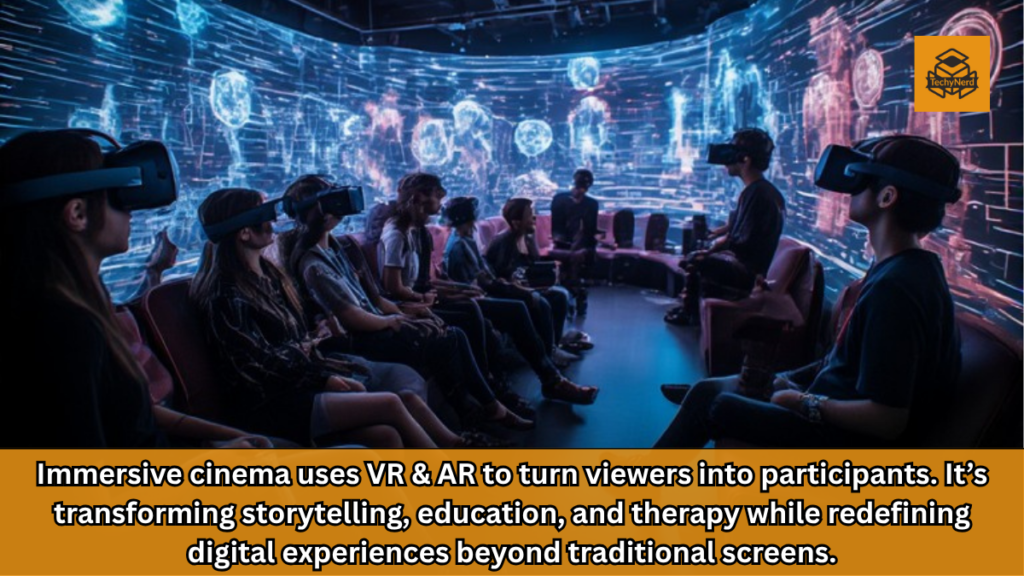
Cinema has always evolved alongside technology, but the current transition into immersive media represents a fundamental shift rather than an incremental upgrade. Traditional filmmaking positioned audiences as passive observers, sitting in dark rooms while stories unfolded on flat screens. Today, immersive technologies such as virtual reality (VR), augmented reality (AR), and panoramic environments are redefining that relationship. The audience is no longer merely watching a story; they are stepping inside it.
The emergence of immersive exhibition formats at global film festivals signals a transformation in how narratives are conceived, produced, and consumed. This shift is not confined to entertainment alone. It extends into education, therapy, tourism, and cultural preservation, creating a new digital ecosystem where storytelling intersects with human experience in unprecedented ways.
The Evolution of Cinematic Technology
To understand the significance of immersive cinema, it is essential to trace the historical trajectory of film technology. From silent films to synchronized sound, from black-and-white to color, and from analog to digital, each advancement has enhanced realism and emotional engagement. However, these innovations maintained a consistent framework: the audience remained external to the narrative world.
Immersive technologies disrupt this paradigm by collapsing the boundary between viewer and story. Instead of projecting images onto a screen, VR environments surround users completely, while AR overlays digital elements onto the real world. Panoramic installations extend visual storytelling across entire rooms, creating spatial narratives that unfold around the viewer. This transformation marks the beginning of what can be described as experiential cinema.
Defining Immersive Media
Immersive media refers to content designed to envelop the user in a multi-sensory environment, often leveraging spatial computing technologies. Unlike conventional formats, immersive experiences rely on interaction, presence, and perception.
Virtual reality creates fully simulated environments where users can explore digital worlds through headsets and motion tracking. Augmented reality enhances the physical environment by layering digital objects in real time. Mixed reality blends both approaches, enabling seamless interaction between real and virtual elements.
These technologies are not isolated innovations; they are converging into a broader ecosystem often associated with the concept of the metaverse. Within this ecosystem, storytelling becomes dynamic, adaptive, and participatory.
Immersive Film Festivals: A New Cultural Frontier
Film festivals have traditionally been platforms for showcasing cinematic innovation. The introduction of immersive sections at major festivals demonstrates the growing importance of experiential storytelling. These curated spaces present VR films, AR installations, and interactive narratives that challenge conventional definitions of cinema.
Visitors to immersive exhibitions often describe a profound sense of presence. Instead of watching characters on a screen, they stand beside them, move through environments, and influence narrative outcomes. This level of engagement transforms storytelling into a personal experience, where each viewer’s journey may differ based on their interactions.
Such exhibitions also highlight the global nature of immersive media. Creators from diverse cultural backgrounds are experimenting with new forms of expression, blending traditional storytelling techniques with advanced technology.
From Entertainment to Multi-Dimensional Experiences
One of the most significant developments in immersive media is its expansion beyond entertainment. While early VR applications focused primarily on gaming and cinematic experiences, the technology is now being applied across multiple domains.
In cultural tourism, immersive environments allow users to explore historical sites and heritage locations without physical travel. These experiences can recreate ancient cities, cultural rituals, and natural landscapes with remarkable accuracy.
In healthcare, immersive technologies are being used for psychological therapy, including treatments for anxiety, PTSD, and phobias. By simulating controlled environments, therapists can guide patients through exposure-based interventions in a safe and manageable way.
Education is another area undergoing transformation. Immersive learning environments enable students to engage with complex subjects through interactive simulations, making abstract concepts more tangible and accessible.
The Technology Behind Immersion
The effectiveness of immersive media depends on several technological components working in harmony. High-resolution displays, advanced motion tracking, spatial audio, and real-time rendering engines are essential for creating convincing experiences.
Latency reduction is particularly critical. Any delay between user movement and system response can break the illusion of presence. Advances in hardware and software optimization are addressing this challenge, enabling smoother and more responsive interactions.
Artificial intelligence also plays a growing role in immersive experiences. AI-driven systems can adapt narratives based on user behavior, creating personalized storylines that evolve in real time. This level of interactivity represents a significant departure from linear storytelling.
Challenges Facing Immersive Cinema
Despite its potential, immersive cinema faces several challenges that must be addressed for widespread adoption.
One of the primary barriers is accessibility. High-quality VR and AR systems can be expensive, limiting their reach to niche audiences. While costs are gradually decreasing, affordability remains a concern for mainstream adoption.
Content creation is another challenge. Developing immersive experiences requires specialized skills, including 3D modeling, interaction design, and spatial storytelling. This complexity increases production costs and extends development timelines.
User comfort is also a critical factor. Motion sickness, eye strain, and physical fatigue can affect the user experience, particularly during extended sessions. Ongoing research aims to mitigate these issues through improved hardware design and user interface optimization.
The Role of Interactivity in Storytelling
Interactivity is the defining characteristic of immersive media. Unlike traditional films, where narratives are fixed, immersive experiences allow users to influence outcomes through their actions.
This shift introduces new storytelling paradigms. Creators must design narratives that accommodate multiple pathways, ensuring coherence while allowing flexibility. The result is a hybrid form of storytelling that combines elements of cinema, gaming, and theater.
Interactivity also enhances emotional engagement. When users actively participate in a story, they develop a deeper connection with characters and events. This level of immersion can amplify the impact of narratives, making them more memorable and meaningful.
Economic Implications and Industry Growth
The rise of immersive media is creating new opportunities within the entertainment industry and beyond. Companies are investing heavily in research and development, exploring applications across various sectors.
The immersive entertainment market is expected to grow significantly in the coming years, driven by advancements in hardware, software, and content creation tools. This growth is attracting investment from technology companies, media organizations, and startups alike.
At the same time, traditional film studios are experimenting with immersive formats, integrating VR and AR elements into their storytelling strategies. This convergence of industries is reshaping the media landscape, blurring the boundaries between different forms of entertainment.
Cultural Impact and Global Adoption
Immersive media has the potential to reshape cultural expression on a global scale. By enabling creators to craft experiences that transcend language and geography, these technologies can foster cross-cultural understanding and collaboration.
At the same time, immersive storytelling raises questions about cultural authenticity and representation. As creators experiment with new formats, it becomes essential to ensure that narratives remain respectful and inclusive.
The global adoption of immersive media also highlights disparities in access to technology. Bridging this digital divide will be crucial for ensuring that the benefits of immersive experiences are widely shared.
The Future of Immersive Storytelling
Looking ahead, immersive media is poised to become an integral part of the digital ecosystem. Advances in hardware, including lighter and more powerful headsets, will improve accessibility and user comfort.
The integration of immersive technologies with other emerging fields, such as artificial intelligence and quantum computing, could unlock new possibilities for storytelling and interaction. These developments may lead to fully adaptive environments where narratives evolve continuously based on user input.
As immersive media continues to evolve, it will challenge traditional notions of authorship, audience, and narrative structure. The line between creator and participant will become increasingly blurred, giving rise to collaborative storytelling models.
Conclusion: A New Era of Digital Experience
The transition from screen-based media to immersive experiences represents a defining moment in the evolution of storytelling. By transforming audiences into participants, immersive technologies are redefining the relationship between humans and digital content.
While challenges remain, the potential of immersive media is undeniable. From entertainment and education to healthcare and cultural preservation, these technologies are opening new frontiers of human experience.
The future of cinema is no longer confined to screens. It is unfolding in spaces where reality and imagination converge, creating experiences that are as transformative as they are engaging.
10 Unique FAQs
1. What is immersive cinema?
Immersive cinema uses technologies like VR and AR to place viewers inside the story rather than watching it on a screen.
2. How does VR differ from traditional film?
VR provides a 360-degree interactive environment, allowing users to explore and engage with the narrative.
3. What are the main technologies behind immersive media?
Key technologies include VR headsets, AR systems, spatial audio, motion tracking, and real-time rendering engines.
4. Can immersive media be used outside entertainment?
Yes, it is widely used in education, healthcare, tourism, and training simulations.
5. What challenges does immersive cinema face?
Major challenges include high costs, technical complexity, limited accessibility, and user comfort issues.
6. How does interactivity change storytelling?
It allows users to influence the narrative, creating personalized and dynamic story experiences.
7. Are immersive experiences replacing traditional films?
Not entirely; they are complementing traditional formats and expanding storytelling possibilities.
8. What is the role of AI in immersive media?
AI helps personalize experiences and adapt narratives based on user behavior.
9. Why are film festivals embracing immersive content?
They showcase innovation and provide a platform for experimental storytelling formats.
10. What is the future of immersive cinema?
It will likely integrate with other technologies, becoming more accessible and widely adopted across industries.