

The virtual reality industry continues to evolve rapidly, with hardware manufacturers refining not only performance but also ergonomics and usability. In this context, Bigscreen has unveiled a significant redesign of its Halo Strap system for the Beyond 2 and Beyond 2e PC VR headsets. This development highlights a broader industry shift toward user-centric design, where comfort, modularity, and adaptability are becoming as important as raw technical specifications.
The updated Halo Strap is more than a simple accessory refresh. It represents a response to real-world feedback, iterative engineering, and a willingness to absorb financial costs in pursuit of a better user experience. With shipping expected to begin in June, this redesign arrives at a crucial moment when competition in the PC VR segment is intensifying.
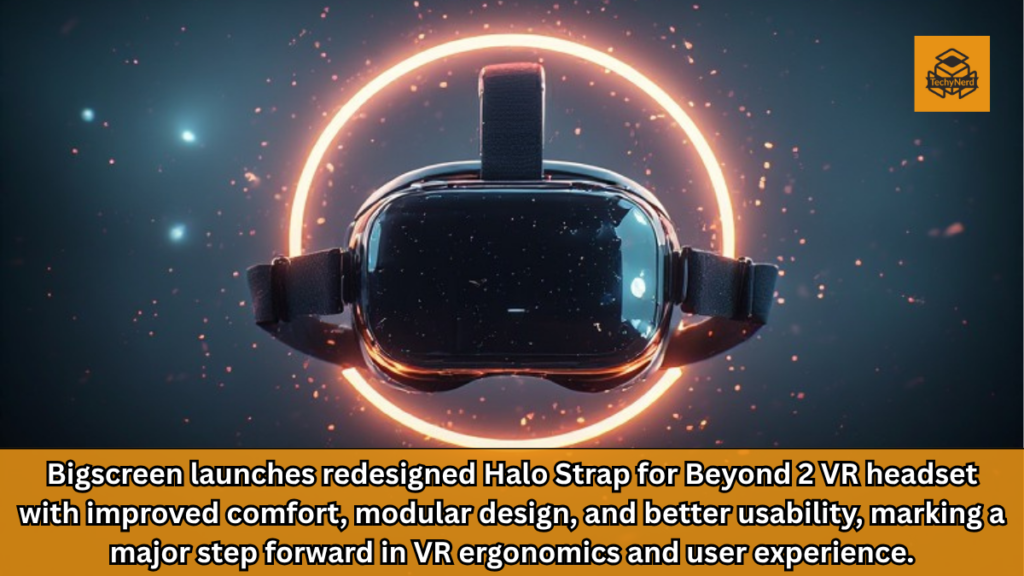
The Evolution of the Bigscreen Beyond 2 Ecosystem
The Bigscreen Beyond 2 was originally positioned as one of the thinnest and lightest PC VR headsets on the market, targeting enthusiasts who value immersion without bulk. While the headset itself received praise for its compact form factor, the initial headstrap solutions revealed the challenges of balancing weight distribution and long-session comfort.
VR headsets inherently place pressure on the face and forehead, making strap design a critical component of overall usability. Early adopters of the Beyond 2 highlighted both strengths and shortcomings in the original Halo Mount prototypes, prompting Bigscreen to rethink its approach.
This iterative process reflects a broader truth about VR hardware: even small ergonomic improvements can significantly impact user satisfaction. Unlike traditional computing devices, VR headsets are worn directly on the body, making comfort a primary determinant of adoption and retention.
From Prototype to Production: Lessons From User Feedback
Bigscreen’s journey toward the redesigned Halo Strap underscores the importance of community-driven development. Initial development test versions, often referred to as DVT units, were distributed to users for evaluation. These early models met several design goals but fell short in key areas, particularly in ease of use and long-term comfort.
Rather than proceeding with mass production, Bigscreen made the strategic decision to delay the product. This move, while costly, allowed the company to incorporate feedback and refine the design. In an industry where speed to market often takes precedence, this decision reflects a commitment to quality and user experience.
The revised Halo Strap incorporates insights gained from months of testing, resulting in a more polished and practical solution. This approach aligns with best practices in hardware development, where iterative refinement is essential for achieving optimal results.
Key Innovations in the Redesigned Halo Strap
One of the most notable improvements in the new Halo Strap is the introduction of a clip-on mechanism that eliminates the need for adhesives. This change simplifies installation and reduces the risk of damage to the headset, addressing a common concern among users.
The addition of an M3 brass-threaded screw hole represents another significant enhancement. This feature enables compatibility with third-party accessories, opening the door for customization and modding. In the VR community, where personalization is highly valued, this level of flexibility is a major advantage.
The strap also features an improved flip-up mechanism, allowing users to quickly lift the headset without removing it entirely. This is particularly useful in mixed-use scenarios where users need to transition between virtual and real-world tasks.
Additionally, the redesigned system includes better cable management through extended USB routing, as well as enhanced vertical adjustment for improved forehead positioning. These changes contribute to a more balanced and comfortable fit, reducing strain during extended sessions.
Compatibility and Modularity: Expanding User Options
A key strength of the new Halo Strap lies in its compatibility with a wide range of accessories. It can be used with various strap configurations, including the standard soft strap, optional audio strap, and even third-party solutions such as the Apple Vision Pro Knit Band.
This level of interoperability reflects a growing trend in the VR industry toward modular ecosystems. By allowing users to mix and match components, manufacturers can cater to diverse preferences and use cases.
The Halo Strap is also compatible with different facial interface options, including custom-fit and universal-fit cushions. Users can even opt to use the headset without a cushion to maximize peripheral vision, demonstrating the system’s versatility.
Production Challenges and Supply Chain Realities
While the redesigned Halo Strap represents a significant step forward, its rollout has not been without challenges. Bigscreen has acknowledged that supply chain disruptions, particularly those linked to geopolitical tensions in the Middle East, have impacted production timelines.
Rising air freight costs and component shortages have further complicated logistics, leading to delays in certain configurations. These issues highlight the broader challenges facing the tech industry, where global supply chains remain vulnerable to external factors.
Despite these obstacles, Bigscreen has made notable progress in improving production efficiency. Orders for the Beyond 2 and Beyond 2e headsets are now shipping within one to three business days in most cases, indicating a stabilization of manufacturing processes.
Market Demand and Pre-Order Dynamics
The strong demand for the Halo Strap underscores the importance of comfort-focused accessories in the VR market. Priced at $180 or €169, the product has attracted significant interest, resulting in a backlog of pre-orders.
Bigscreen has indicated that initial shipments will be limited, with a larger production run planned for July. The company expects to fulfill all pre-orders by the end of the summer, after which inventory levels should support faster shipping.
This phased rollout strategy allows Bigscreen to manage demand while maintaining quality control. It also reflects a cautious approach to scaling production, ensuring that early units meet the company’s standards.
The Broader Implications for VR Hardware Design
The redesign of the Halo Strap is emblematic of a larger shift within the VR industry. As the technology matures, manufacturers are increasingly focusing on refining the user experience rather than solely pursuing performance gains.
Comfort, ease of use, and adaptability are becoming key differentiators in a competitive market. Users are no longer satisfied with basic functionality; they expect products that integrate seamlessly into their daily routines.
This trend is particularly relevant for PC VR, where enthusiasts demand high levels of performance and customization. By addressing these expectations, companies like Bigscreen are helping to drive the next phase of VR adoption.
Comparing Approaches: Halo Straps vs Traditional Designs
Halo-style straps distribute weight across the forehead rather than relying solely on facial pressure. This design can significantly improve comfort, especially during extended use. However, achieving the right balance requires careful engineering.
Traditional strap designs, while simpler, often result in uneven weight distribution and increased fatigue. The Halo Strap approach aims to mitigate these issues by providing a more stable and ergonomic fit.
Bigscreen’s redesign demonstrates how incremental improvements can enhance this concept. By refining the attachment mechanism, adjustability, and accessory support, the company has created a more user-friendly solution.
Future Outlook: What This Means for VR Adoption
The continued refinement of VR hardware components such as headstraps is critical for the technology’s long-term success. As barriers to entry decrease and user experiences improve, VR is likely to attract a broader audience.
The introduction of more comfortable and customizable solutions will play a key role in this process. By addressing common pain points, manufacturers can encourage longer usage sessions and greater engagement.
Looking ahead, it is likely that future VR systems will place even greater emphasis on modularity and personalization. The Halo Strap redesign can be seen as an early step in this direction, setting a precedent for future innovations.
Conclusion: A Thoughtful Redesign With Industry-Wide Impact
Bigscreen’s redesigned Halo Strap for the Beyond 2 is a clear example of how user feedback and iterative development can lead to meaningful improvements in hardware design. It reflects a mature approach to product development, where quality and usability take precedence over speed.
While challenges remain, particularly in terms of supply chain stability, the overall direction is promising. As the VR industry continues to evolve, innovations like this will help shape a more accessible and user-friendly future.
FAQs
1. What is the Bigscreen Halo Strap?
It is a headstrap accessory designed to improve comfort and fit for Beyond 2 VR headsets.
2. What makes the new design different?
It features a clip-on system, better adjustability, and support for third-party accessories.
3. When will it be available?
Shipping is expected to begin in June 2026.
4. Is it compatible with older straps?
Yes, it works with multiple strap options including third-party designs.
5. Why was the launch delayed?
Bigscreen delayed production to address user feedback and improve the design.
6. Does it improve comfort significantly?
Yes, it distributes weight more evenly and reduces pressure on the face.
7. Can it be customized?
Yes, it includes mounting options for mods and accessories.
8. What is the price?
It is priced at $180 or €169.
9. Are there supply issues?
Yes, some delays occurred due to global supply chain disruptions.
10. Will more units be available later?
Yes, larger production runs are planned for July and beyond.