

When Google introduced its latest update to Gemini for Home, the announcement might have sounded incremental at first glance. A feature called “continued conversations” doesn’t carry the dramatic flair of a brand-new device or a revolutionary AI model. However, beneath its simplicity lies a transformative shift in how humans interact with machines. This update marks a decisive move toward making artificial intelligence feel less like a tool and more like a conversational partner embedded seamlessly into everyday life.
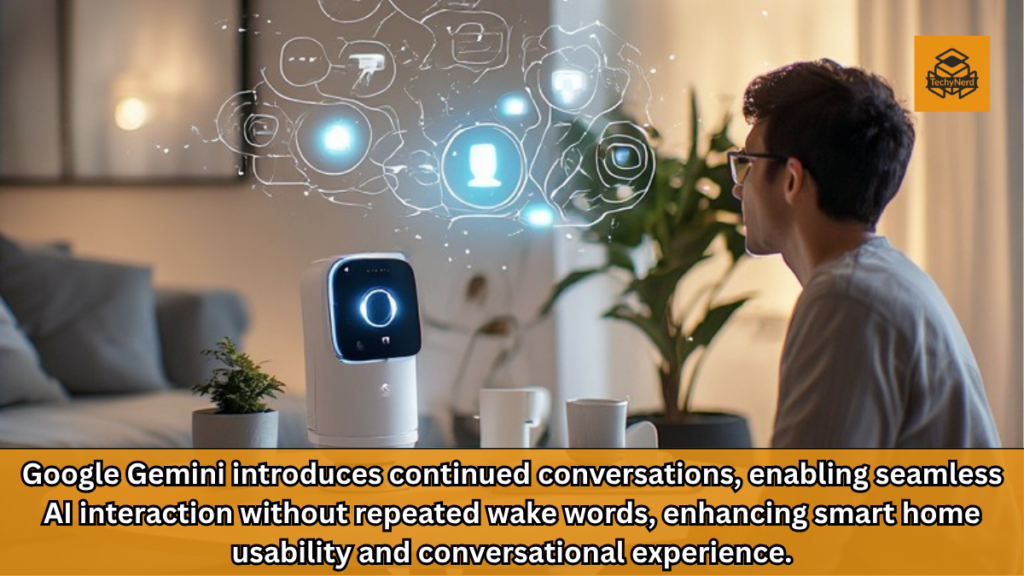
The concept is straightforward: users no longer need to repeatedly say a wake phrase such as “Hey Google” before every command. Instead, the system remains momentarily attentive after responding, allowing for natural follow-up questions. While technically modest, this change represents a fundamental rethinking of human-computer interaction, especially within the smart home ecosystem.
The Evolution of Voice Assistants: From Commands to Conversations
Voice assistants have undergone a rapid evolution over the past decade. Early systems were rigid, command-based interfaces requiring precise phrasing. Users had to adapt their language to the machine, rather than the machine adapting to human speech patterns.
With the rise of AI models and natural language processing, assistants like Google Assistant began to interpret more flexible inputs. However, even these systems retained a fundamental limitation: interactions were fragmented. Each request was treated as an isolated event, forcing users to repeat context and trigger phrases.
Gemini for Home represents the next logical step in this evolution. By maintaining conversational context across multiple queries, it shifts from transactional interactions to fluid dialogues. This mirrors how humans naturally communicate, where context builds over time rather than resetting after every sentence.
Understanding Continued Conversations: How It Works
At its core, the continued conversations feature allows the microphone of a smart device to remain active briefly after responding to a user’s query. During this window, the device signals its attentiveness through visual cues such as glowing or pulsing lights.
This small design choice has significant usability implications. Users can ask follow-up questions, refine requests, or explore related topics without restarting the interaction. For example, instead of saying:
“Hey Google, what’s the weather?”
“Hey Google, what about tomorrow?”
The user can simply ask, “What about tomorrow?” and expect a context-aware response.
The system also leverages contextual memory, allowing it to interpret follow-ups intelligently. This reduces redundancy and enhances efficiency, especially in multi-step tasks such as planning schedules, controlling smart devices, or searching for information.
The Role of Context Awareness in Modern AI
Context awareness is one of the defining characteristics of advanced AI systems. It allows machines to understand not just individual commands but the broader intent behind them.
In Gemini for Home, context awareness operates on multiple levels. It interprets the semantic relationship between queries, remembers relevant details, and adapts responses accordingly. This capability is powered by large language models and sophisticated machine learning algorithms that analyze patterns in human speech.
The result is an interaction model that feels intuitive rather than mechanical. Users can speak naturally, make corrections, or shift topics without losing continuity. This aligns with the broader trend in AI development, where the goal is not just accuracy but also conversational coherence.
Smart Homes and the Rise of Ambient Computing
The introduction of continued conversations is closely tied to the concept of ambient computing. This paradigm envisions technology that operates seamlessly in the background, responding to human needs without explicit commands.
Smart homes are the primary testing ground for this vision. Devices such as speakers, displays, and connected appliances form an ecosystem where AI acts as the central interface. By enabling continuous dialogue, Gemini for Home reduces friction in this ecosystem, making interactions more fluid and less intrusive.
Instead of thinking about technology as something you “use,” ambient computing encourages a mindset where technology simply “exists” and responds when needed. Continued conversations are a critical step toward achieving this vision.
Privacy Concerns and the Challenge of Always-Listening Systems
While the benefits of continued conversations are clear, they also raise important questions about privacy. The idea of a device that remains attentive, even briefly, can be unsettling for many users.
Google has attempted to address these concerns by limiting the listening window and providing visual indicators when the microphone is active. Additionally, the feature must be manually enabled, giving users control over their experience.
However, skepticism remains, particularly given the history of voice assistants unintentionally capturing background conversations. Ensuring user trust will require not just technical safeguards but also transparent communication about how data is handled and protected.
The Competitive Landscape: AI Assistants in Transition
The launch of continued conversations comes at a time when the AI assistant market is undergoing significant transformation. Traditional voice assistants are being replaced or upgraded with AI-driven systems that offer deeper contextual understanding.
Google’s transition from Assistant to Gemini reflects this shift. By integrating advanced AI capabilities into its smart home platform, the company aims to stay ahead in a highly competitive landscape that includes rivals investing heavily in conversational AI.
The emphasis is no longer just on functionality but on experience. The assistant that feels most natural, responsive, and reliable is likely to dominate user preference in the coming years.
Technical Challenges Behind Seamless Conversations
Creating a system that supports continuous dialogue is far from trivial. It requires solving several complex challenges, including speech recognition accuracy, context retention, and noise differentiation.
One of the most critical challenges is distinguishing between commands directed at the assistant and unrelated conversations happening nearby. Gemini must accurately identify intent without intruding on private discussions.
Another challenge lies in managing computational efficiency. Maintaining context and processing real-time input demands significant resources, especially in devices with limited hardware capabilities. Achieving this balance is essential for delivering a smooth user experience.
User Experience: Reducing Friction in Daily Interactions
From a user experience perspective, continued conversations significantly reduce friction. The need to repeatedly invoke a wake word has long been a barrier to natural interaction. By eliminating this requirement for follow-ups, Gemini creates a more seamless and engaging experience.
This improvement is particularly valuable in scenarios where users are multitasking, such as cooking, working, or managing household tasks. The ability to interact with AI without interruption enhances convenience and efficiency.
Moreover, the feature encourages exploration. Users may feel more comfortable asking additional questions or refining requests when the interaction feels conversational rather than procedural.
The Future of Conversational AI in Homes
The introduction of continued conversations is likely just the beginning. As AI models become more advanced, we can expect even deeper integration of conversational capabilities into smart home environments.
Future developments may include longer context retention, multi-user recognition, and proactive assistance based on user behavior. AI could anticipate needs, suggest actions, and provide insights without explicit prompts.
This evolution will blur the line between human and machine interaction, creating a more intuitive and responsive digital environment.
Conclusion: A Small Step Toward a Conversational Future
Google’s continued conversations feature may appear incremental, but it represents a significant milestone in the journey toward natural human-AI interaction. By reducing friction, enhancing context awareness, and aligning with the principles of ambient computing, Gemini for Home moves closer to the vision of technology that feels truly integrated into daily life.
The success of this feature will depend on its reliability, privacy safeguards, and user adoption. If executed effectively, it could redefine expectations for voice assistants and set a new standard for conversational AI in smart homes.
FAQs
1. What is the continued conversations feature in Gemini for Home?
It allows users to continue speaking without repeating the wake word for follow-up queries.
2. How long does the device stay active after responding?
The microphone remains active for a few seconds, indicated by visual cues.
3. Is the feature enabled by default?
No, users must manually enable it in the settings.
4. Does Gemini remember previous questions?
Yes, it retains context to provide more relevant responses.
5. Can it distinguish between conversations and commands?
Google claims it can, though real-world accuracy may vary.
6. Is this feature available globally?
Yes, it is rolling out across all supported regions and languages.
7. How is this different from Google Assistant?
Gemini offers improved contextual understanding and conversational flow.
8. Does it raise privacy concerns?
Yes, as with any always-listening feature, but safeguards are in place.
9. Can it control smart home devices during conversations?
Yes, it integrates seamlessly with connected devices.
10. What does this mean for the future of AI assistants?
It signals a shift toward more natural, human-like interactions.