

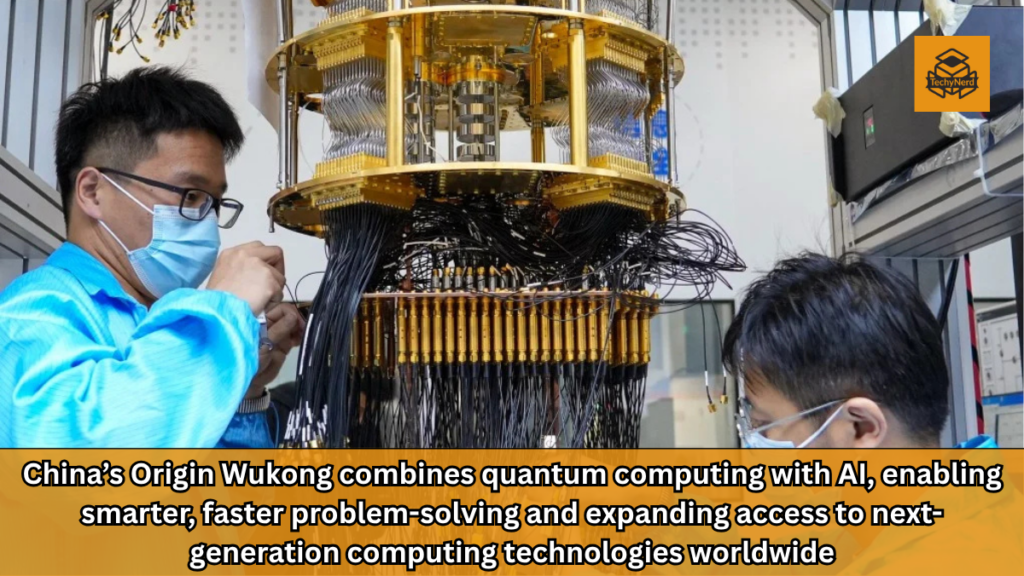
The global race toward next-generation computing has reached a critical milestone with the emergence of hybrid systems that combine quantum computing and artificial intelligence. China’s latest advancement, the Origin Wukong superconducting quantum computer, represents a significant step in this direction. By integrating AI capabilities directly into its quantum computing architecture, this system is redefining how computational power can be accessed, utilized, and scaled across industries.
This development is not merely incremental. It signals a shift from experimental quantum systems toward practical, user-oriented platforms capable of addressing real-world challenges. The convergence of quantum computing and AI introduces a new paradigm that could reshape sectors ranging from energy and finance to scientific research and industrial optimization.
The Evolution of Quantum Computing: From Theory to Application
Quantum computing has long been positioned as the successor to classical computing for solving complex problems beyond the reach of traditional systems. Unlike classical computers, which process information in binary form, quantum systems leverage quantum bits, or qubits, enabling them to perform calculations in parallel through superposition and entanglement.
However, despite its theoretical advantages, quantum computing has faced significant barriers to widespread adoption. These include hardware instability, high costs, and the complexity of programming quantum systems. Early-stage quantum computers were primarily research tools, accessible only to specialized scientists and institutions.
The introduction of platforms like Origin Wukong marks a transition from purely functional systems to more accessible and user-friendly environments. By integrating AI, these systems aim to simplify interaction, reduce technical barriers, and broaden participation in quantum computing.
Origin Wukong: A Fully Integrated Quantum Ecosystem
Origin Wukong stands out as a fully integrated, domestically developed quantum computing system. Built on superconducting technology, it encompasses the entire stack—from quantum chips to operating systems—ensuring greater control, optimization, and scalability.
This full-stack approach is strategically significant. It reduces dependency on external technologies and allows for tighter integration between hardware and software components. As a result, performance can be optimized more effectively, and innovations can be implemented more rapidly.
The system has already demonstrated extensive global engagement, serving millions of computational tasks across numerous countries. This level of usage indicates a growing interest in quantum computing as a practical tool rather than a distant technological aspiration.
The Role of Artificial Intelligence in Quantum Systems
Artificial intelligence plays a transformative role in enhancing the usability and efficiency of quantum computing. By embedding AI capabilities into the system, developers aim to streamline interactions, automate complex processes, and provide intelligent support to users.
AI can assist in various aspects of quantum computing, including error correction, optimization of algorithms, and interpretation of results. These functions are critical in overcoming some of the inherent challenges of quantum systems, such as noise and instability.
Moreover, AI enables a more intuitive interface for users. Instead of requiring deep expertise in quantum mechanics, users can interact with the system through natural language or simplified workflows, making the technology more accessible to a broader audience.
Origin Brain: Bridging Knowledge and Computation
One of the key innovations within the Origin Wukong ecosystem is the introduction of Origin Brain, a specialized model designed to integrate quantum computing expertise with AI-driven knowledge services. This tool serves as a bridge between complex quantum concepts and practical application.
Origin Brain provides researchers, educators, and developers with intelligent insights, helping them navigate the intricacies of quantum computing. By offering context-aware guidance and recommendations, it reduces the learning curve associated with quantum technologies.
This approach reflects a broader trend in technology, where knowledge systems are embedded directly into platforms to enhance usability. By combining computation with intelligence, Origin Brain exemplifies how AI can democratize access to advanced technologies.
Conversational Quantum Computing: A New Interaction Paradigm
Another significant development is the introduction of conversational interfaces for quantum computing tasks. Through tools like QPanda3 Runtime MCP, users can submit and manage quantum workloads באמצעות interaction with AI-driven agents.
This represents a shift from traditional programming models to more intuitive, dialogue-based interactions. Users can describe their computational needs in natural language, and the system translates these requests into executable quantum operations.
Such capabilities are particularly valuable in lowering barriers to entry. They enable individuals without extensive programming or quantum expertise to engage with the technology, fostering innovation and experimentation.
Expanding Access to Quantum Computing Power
Accessibility has been one of the primary challenges in the adoption of quantum computing. High costs, specialized hardware, and limited availability have restricted its use to a small group of experts.
The Origin Wukong platform addresses this issue by providing on-demand access to quantum computing resources. By leveraging cloud-based infrastructure and AI-driven interfaces, it allows users to access computational power without the need for physical hardware.
This model aligns with broader trends in cloud computing, where resources are delivered as services rather than products. It enables scalability, flexibility, and cost efficiency, making quantum computing more viable for a wide range of applications.
Quantum-AI Hybrid Algorithms: Unlocking New Possibilities
The integration of quantum computing and AI opens the door to hybrid algorithms that combine the strengths of both technologies. These algorithms can tackle complex problems that are difficult or impossible to solve using classical methods alone.
In sectors such as energy, finance, and industrial optimization, hybrid approaches can provide more accurate predictions, optimize resource allocation, and enhance decision-making processes. For example, quantum algorithms can process large datasets more efficiently, while AI models can interpret and refine the results.
This synergy represents a significant advancement in computational capabilities. It enables organizations to address challenges that were previously beyond reach, driving innovation and competitive advantage.
Industrial Applications and Strategic Implications
The practical applications of quantum-AI systems are vast and diverse. In the energy sector, they can optimize power grid management and improve efficiency. In finance, they can enhance risk analysis and portfolio optimization. In manufacturing, they can streamline processes and reduce costs.
These capabilities have strategic implications at both national and global levels. Countries that lead in quantum-AI integration are likely to gain a competitive edge in technology, economics, and innovation.
The development of domestically controlled systems like Origin Wukong also reflects broader geopolitical considerations. By building independent technological ecosystems, nations can reduce reliance on external suppliers and strengthen their technological sovereignty.
Challenges and Future Directions
Despite its promise, the integration of quantum computing and AI is not without challenges. Technical issues such as qubit stability, error rates, and scalability remain significant hurdles. Additionally, the development of effective hybrid algorithms requires interdisciplinary expertise and extensive research.
There are also ethical and regulatory considerations. As with any powerful technology, ensuring responsible use is critical. This includes addressing concerns related to data privacy, security, and potential misuse.
Looking ahead, continued investment in research and development will be essential. Collaboration between academia, industry, and government can accelerate progress and ensure that the benefits of quantum-AI integration are realized responsibly.
Conclusion: A New Chapter in Computing Innovation
The emergence of systems like Origin Wukong marks a pivotal moment in the evolution of computing. By integrating quantum capabilities with artificial intelligence, these platforms are transforming how computational power is accessed and applied.
This convergence represents more than a technological advancement; it is a paradigm shift that has the potential to redefine industries and reshape the global technological landscape. As these systems continue to विकसित, they will play a crucial role in addressing some of the most complex challenges facing society.
The journey toward fully realized quantum-AI systems is still ongoing, but the progress achieved so far offers a glimpse into a future where computation is not only more powerful but also more accessible and intelligent.
FAQs
- What is Origin Wukong?
It is a superconducting quantum computer developed in China with integrated AI capabilities. - How does quantum computing differ from classical computing?
Quantum computing uses qubits and can process multiple possibilities simultaneously. - What is the role of AI in this system?
AI enhances usability, optimizes algorithms, and provides intelligent user interaction. - What is Origin Brain?
It is an AI-powered tool that offers knowledge and support for quantum computing tasks. - How can users interact with the system?
Through conversational AI interfaces that simplify task submission and execution. - What are hybrid quantum-AI algorithms?
They combine quantum processing with AI analysis for complex problem-solving. - Which industries can benefit from this technology?
Energy, finance, manufacturing, and scientific research are key sectors. - Is quantum computing widely accessible?
New platforms are making it more accessible through cloud-based services. - What challenges remain?
Technical limitations, scalability, and ethical considerations are ongoing challenges. - Why is this development significant globally?
It represents a major step in next-generation computing and technological leadership.