

The evolution of filmmaking has always been closely tied to technological advancement. From practical effects to CGI, from film reels to digital cameras, each leap has redefined storytelling possibilities. Now, with the integration of spatial computing devices like Apple Vision Pro, the industry appears to be entering yet another transformative era.
In a fascinating development, director Jon Favreau has revealed how Apple Vision Pro played a pivotal role in shaping the visual experience of the upcoming Star Wars film, The Mandalorian & Grogu. This revelation highlights not just a singular use case but a broader shift in how filmmakers approach production, visualization, and creative control.
The Rise of Consumer Technology in Professional Filmmaking
Historically, filmmaking tools were highly specialized, expensive, and limited to elite studios. Motion capture systems, previsualization software, and high-end rendering tools were accessible only to a handful of professionals. However, the rise of consumer-grade technology—particularly in gaming and extended reality—has democratized access to powerful creative tools.
Favreau emphasizes that innovation is happening faster in consumer technology than in niche professional equipment. Gaming hardware, real-time rendering engines, and mixed reality headsets are evolving rapidly due to mass-market demand. This innovation cycle is now feeding directly into Hollywood production pipelines.
Apple Vision Pro exemplifies this shift. Originally designed as a consumer-facing mixed reality headset, it has quickly found applications in industrial and creative domains. Its high-resolution displays, spatial awareness, and immersive capabilities make it uniquely suited for cinematic visualization.
Apple Vision Pro as a Virtual IMAX Theater
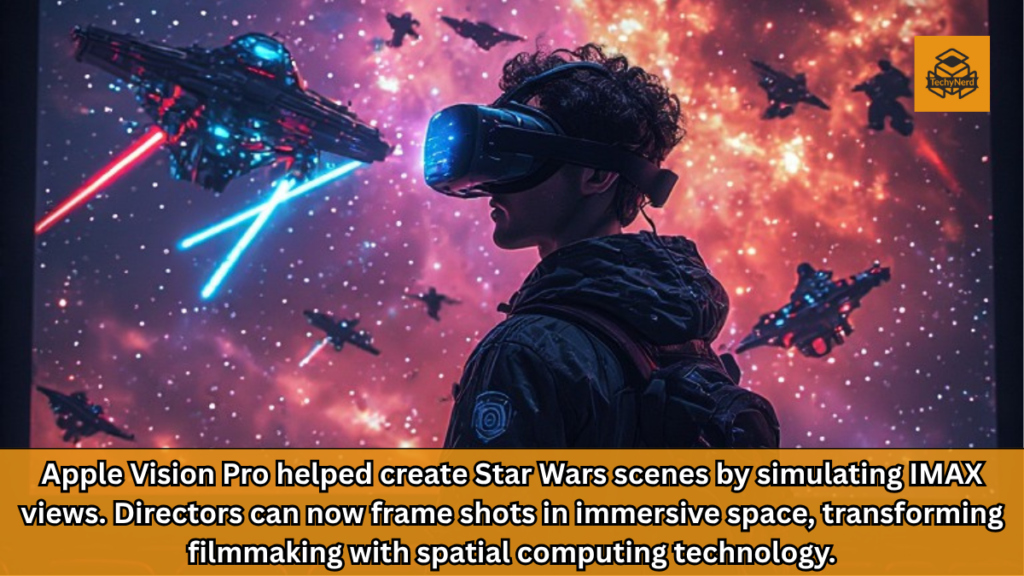
One of the most compelling aspects of Apple Vision Pro’s use in filmmaking is its ability to simulate an IMAX viewing environment. Traditional filmmaking often requires directors to rely on monitors that cannot accurately replicate the scale and immersion of a theater screen—let alone an IMAX screen.
Favreau addressed this limitation by leveraging Apple Vision Pro as a personal, portable IMAX theater. Through custom-built software layered on top of the device, he could visualize scenes exactly as audiences would experience them in theaters.
This capability fundamentally changes the creative process. Instead of imagining how a shot might translate to a massive screen, directors can now see it in real-time, within an immersive environment that mirrors the final viewing experience. This reduces guesswork and allows for more precise framing, composition, and storytelling decisions.
Redefining Previsualization and Shot Composition
Previsualization, or “pre-vis,” has long been a crucial step in filmmaking. It involves creating rough versions of scenes to plan camera angles, lighting, and movement. Traditionally, pre-vis required specialized tools and often lacked the fidelity needed to fully capture the director’s vision.
With Apple Vision Pro, pre-vis becomes an immersive experience. Directors can step inside their scenes, observe them from multiple angles, and adjust compositions dynamically. This spatial understanding enhances creativity and enables more informed decision-making.
In the case of The Mandalorian & Grogu, Favreau used the headset as his primary viewpoint for framing IMAX shots. This approach ensures that every frame is optimized for large-format viewing, enhancing the cinematic impact.
The Intersection of Gaming Technology and Cinema
Favreau’s comments also underscore the growing influence of gaming technology on filmmaking. Real-time engines, motion capture systems, and interactive environments—originally developed for video games—are now integral to modern film production.
The use of gaming hardware in motion capture and pre-vis pipelines demonstrates how these technologies are converging. Apple Vision Pro fits seamlessly into this ecosystem, acting as both a visualization tool and an interface for interacting with digital environments.
This convergence is not accidental. Gaming and cinema share a common goal: immersive storytelling. As the boundaries between these mediums blur, tools developed for one are increasingly being adopted by the other.
Custom Software: Unlocking Industrial Potential
While Apple Vision Pro provides the hardware foundation, its true power in filmmaking comes from custom software development. Favreau’s team built specialized applications to adapt the headset for cinematic use.
This customization allows filmmakers to tailor the device to their specific needs, whether it’s simulating an IMAX screen, integrating with motion capture systems, or enabling real-time collaboration.
The ability to build on top of consumer hardware is a key advantage. It reduces costs, accelerates development, and opens up new possibilities for innovation. In essence, Apple Vision Pro becomes a platform rather than just a device.
A Broader Trend: Spatial Computing in Creative Industries
The use of Apple Vision Pro in a major Hollywood production signals a broader trend: the adoption of spatial computing across creative industries. Architecture, design, education, and entertainment are all exploring how immersive technologies can enhance workflows and outcomes.
In filmmaking, spatial computing offers unique advantages. It allows creators to visualize complex scenes, experiment with ideas, and collaborate in new ways. It also bridges the gap between pre-production and final output, ensuring greater consistency and efficiency.
As these technologies mature, they are likely to become standard tools in the filmmaker’s toolkit, much like digital cameras and editing software today.
The Legacy of Apple and Star Wars Collaboration
Apple and Star Wars share a long history of collaboration, particularly in the realm of technology and creative tools. From sound design powered by Mac systems to secure scriptwriting on isolated devices, Apple’s ecosystem has played a role in various aspects of Star Wars production.
The integration of Apple Vision Pro represents the latest chapter in this relationship. It highlights how Apple’s innovations continue to influence not just consumer experiences but also professional creative processes.
Implications for the Future of Filmmaking
The adoption of Apple Vision Pro in The Mandalorian & Grogu offers a glimpse into the future of filmmaking. As spatial computing becomes more accessible, it is likely to reshape how movies are conceived, produced, and experienced.
Directors will have greater control over their vision, with tools that allow them to see and refine their work in immersive environments. Production teams will benefit from improved collaboration and efficiency. Audiences, in turn, will enjoy more visually compelling and immersive cinematic experiences.
This shift also raises important questions about the role of technology in storytelling. While tools like Apple Vision Pro enhance creative possibilities, they also require filmmakers to adapt and evolve. The challenge will be to balance technological innovation with artistic expression.
Conclusion: A New Era of Cinematic Innovation
The use of Apple Vision Pro in the production of The Mandalorian & Grogu is more than a technological novelty—it is a sign of a broader تحول in the filmmaking industry. By enabling directors to visualize their work in immersive environments, it bridges the gap between imagination and execution.
As consumer technology continues to evolve, its impact on professional industries will only grow. Apple Vision Pro stands at the forefront of this परिवर्तन, offering a glimpse into a future where creativity is no longer محدود by physical constraints.
For filmmakers, this represents an opportunity to push boundaries and redefine storytelling. For audiences, it promises richer, more immersive experiences. And for the tech industry, it underscores the transformative power of innovation when it intersects with art.
FAQs
1. How was Apple Vision Pro used in the Star Wars film?
It was used by the director to visualize scenes in an immersive IMAX-like environment during filming.
2. Why is Apple Vision Pro important for filmmakers?
It allows real-time immersive visualization, improving shot composition and creative decision-making.
3. What makes Apple Vision Pro different from traditional monitors?
It provides a spatial, theater-like experience instead of a flat screen view.
4. Did Apple create special software for this use?
Custom software was developed on top of the device to enable cinematic workflows.
5. How does this impact IMAX filmmaking?
It ensures shots are optimized for large-format viewing from the production stage itself.
6. Is this technology widely used in Hollywood?
It’s emerging, but adoption is growing rapidly with spatial computing advancements.
7. What role does gaming technology play here?
Gaming tech powers real-time rendering and motion capture systems used in filmmaking.
8. Can smaller filmmakers use this technology?
Yes, as it is based on consumer hardware, making it more accessible.
9. Will this change how movies are made in the future?
Yes, it is expected to significantly influence production workflows and storytelling.
10. Is Apple Vision Pro only for entertainment use?
No, it is being adopted across multiple industries including design, education, and engineering.