

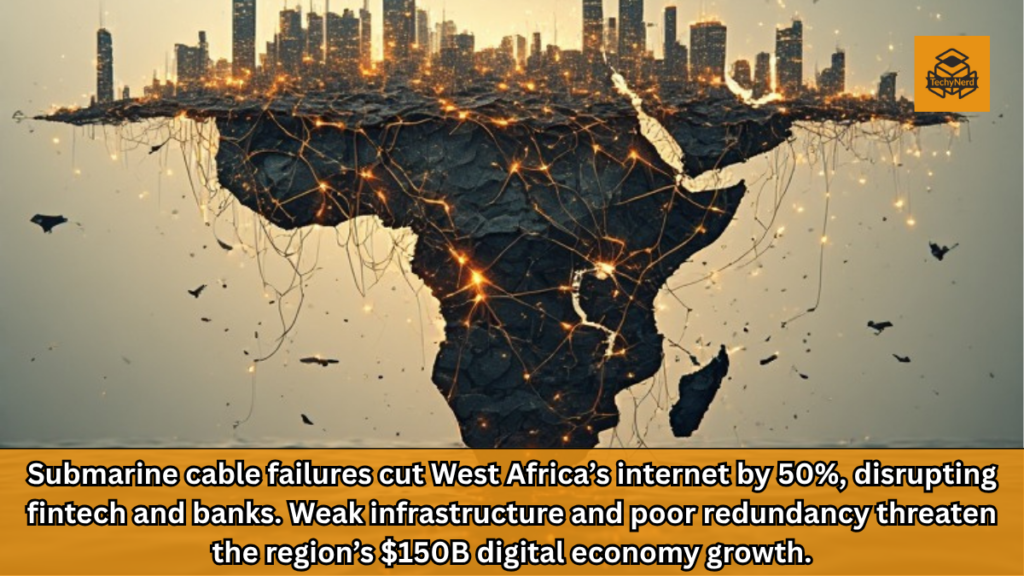
West Africa’s digital economy has emerged as one of the fastest-growing regions in the global technology landscape, with estimates placing its value at nearly $150 billion. Fueled by rapid mobile adoption, fintech innovation, and increasing cloud integration, the region has become a magnet for both local entrepreneurs and international investors. However, beneath this impressive growth lies a structural vulnerability that was dramatically exposed in 2024, when a series of submarine cable failures triggered widespread internet outages across multiple countries.
These outages were not merely technical glitches. They represented a systemic failure of critical infrastructure that underpins modern digital economies. The incident forced governments, regulators, and investors to confront a difficult reality: the digital backbone supporting West Africa’s growth is far more fragile than previously assumed.
The Critical Role of Submarine Cables in Global Connectivity
Submarine cables form the invisible yet indispensable infrastructure of the modern internet. Stretching across ocean floors, these fiber-optic networks carry more than 95 percent of global data traffic. From financial transactions and cloud computing to video streaming and communication platforms, nearly every aspect of the digital world depends on these undersea connections.
In West Africa, submarine cables are particularly crucial due to the region’s limited terrestrial network alternatives. Countries such as Nigeria and Ghana rely heavily on a small number of major cable systems to connect to global data networks. This dependence creates a concentration risk, where disruptions to a few key cables can have cascading effects across entire economies.
The 2024 Outage: A Turning Point for the Region
The events of March 2024 marked a निर्णायक moment for West Africa’s digital infrastructure. Multiple submarine cables, including major systems serving the region, were damaged almost simultaneously off the coast near Côte d’Ivoire. This clustering of failures is highly unusual and proved devastating in its impact.
Internet traffic across affected countries dropped by more than 50 percent at the peak of the outage. In some areas, connectivity was reduced to minimal levels, severely disrupting both personal and business activities. Recovery was slow, with certain services taking days to return to normal.
This incident exposed not just the physical vulnerabilities of the cable network but also the lack of preparedness for large-scale disruptions. It highlighted how a single point of failure—or in this case, multiple simultaneous failures—can bring an entire digital ecosystem to a standstill.
Economic Shockwaves Across Key Sectors
The consequences of the outage extended far beyond inconvenience. In a region where digital services are increasingly integrated into everyday life, the loss of connectivity had immediate and far-reaching economic implications.
Banks struggled to process transactions, leading to delays and disruptions in financial services. Fintech platforms, which have become a cornerstone of financial inclusion in Africa, experienced significant downtime. Businesses relying on cloud-based tools found themselves unable to access critical systems, halting operations and reducing productivity.
For countries like Nigeria, which is actively promoting a cashless economy, the outage served as a stark reminder of the risks associated with digital dependency. When connectivity fails, the entire financial ecosystem is affected, from large institutions to individual users.
Structural Weaknesses: Limited Redundancy and Concentration Risk
One of the most significant issues revealed by the outage is the lack of redundancy in West Africa’s internet infrastructure. In more developed regions such as Europe and North America, multiple overlapping networks provide alternative routes for data traffic in the event of a failure.
In contrast, West Africa’s network architecture is characterized by limited redundancy. Many cables follow similar routes along the coastline, increasing the likelihood that a single घटना can impact multiple systems simultaneously. This lack of diversification makes the region particularly vulnerable to disruptions caused by natural घटनाएँ, human activity, or technical faults.
The concentration of infrastructure also means that recovery efforts are more complex and time-consuming. Without sufficient backup routes, restoring connectivity requires repairing the damaged cables themselves, a process that can take days or even weeks.
The High Cost and Slow Pace of Repairs
Repairing submarine cables is a highly specialized and expensive process. It requires dedicated vessels equipped with advanced तकनीक to locate and fix faults on the ocean floor. In West Africa, these vessels are often stationed far from the region, typically in locations such as Cape Town.
As a result, response times can be slow, particularly when multiple cables are affected simultaneously. The cost of repairing a single cable fault can range from $1.5 million to $2 million, while complex घटनाएँ involving multiple failures can escalate to as much as $8 million.
These costs are not just financial. The longer the outage persists, the greater the आर्थिक नुकसान for businesses and governments. Lost productivity, disrupted services, and reduced investor confidence all contribute to the overall impact.
Governance Challenges and Fragmented Regulation
Beyond technical issues, the outage also exposed significant governance challenges. Submarine cable networks often span multiple countries, requiring coordinated regulatory frameworks to manage their operation and maintenance.
In West Africa, however, regulation remains fragmented. Differences in permitting processes, emergency response protocols, and cable protection policies create barriers to effective coordination. During the 2024 outage, these differences slowed down repair efforts and complicated cross-border collaboration.
This fragmentation increases uncertainty for investors, who must navigate a complex regulatory landscape. It also raises the cost of infrastructure development, as companies must comply with varying rules and standards across different jurisdictions.
Investor Confidence and the Cost of Capital
For global investors, infrastructure reliability is a critical factor in decision-making. The 2024 outage highlighted the risks associated with investing in regions where connectivity cannot be guaranteed.
Uncertainty around infrastructure resilience translates directly into higher costs of capital. Investors demand greater returns to compensate for perceived risks, making it more expensive to fund new projects. This can slow down the growth of the digital economy and limit the region’s ability to attract long-term investment.
As global tech companies continue to expand their presence in Africa, the reliability of the underlying infrastructure will play an increasingly important role in shaping investment decisions.
The Role of Regional Cooperation and Reform
In response to the الأزمة, regulatory bodies are calling for a more coordinated approach to infrastructure development and management. Regional cooperation is essential to address the تحديات posed by cross-border networks.
Proposed reforms include harmonizing regulations across countries, streamlining permitting processes, and establishing pre-arranged frameworks for emergency repairs. Improved data sharing and communication between stakeholders can also enhance response times and reduce the impact of future disruptions.
Another key priority is route diversification. By developing alternative cable paths and reducing reliance on a single corridor, the region can improve resilience and minimize the risk of simultaneous failures.
Building a Resilient Digital Future
The lessons from the 2024 outage are clear. Building a resilient digital economy requires more than just expanding capacity. It demands a comprehensive approach that addresses both technical and institutional challenges.
Investment in infrastructure must be accompanied by robust governance frameworks and regional collaboration. Technologies such as satellite الإنترنت and terrestrial fiber networks can complement submarine cables, providing additional layers of redundancy.
At the same time, policymakers must recognize the strategic importance of digital infrastructure. Submarine cables are not merely telecommunications assets; they are critical components of national and regional economies.
Conclusion: A Defining Moment for West Africa’s Digital Growth
The submarine cable failures of 2024 represent a defining moment for West Africa’s digital economy. They have exposed vulnerabilities that must be addressed if the region is to sustain its growth and تحقق its full potential.
While the challenges are significant, they also present an opportunity. By investing in resilience, improving governance, and fostering regional cooperation, West Africa can build a more robust and reliable digital infrastructure.
The future of the region’s digital economy depends on its ability to learn from this crisis and take decisive action. In an increasingly connected world, reliability is not just a technical requirement—it is a fundamental شرط for economic success.
FAQs
1. What caused the West Africa internet outage in 2024?
Multiple submarine cable failures near Côte d’Ivoire caused widespread disruption.
2. Why are submarine cables important?
They carry over 95% of global internet traffic, supporting communication and digital services.
3. How much internet traffic was affected?
More than 50% of traffic dropped in affected countries at peak disruption.
4. Which sectors were impacted the most?
Banking, fintech, and cloud-based services faced major disruptions.
5. Why is West Africa more vulnerable to outages?
Due to limited redundancy and reliance on a few cable routes.
6. How expensive is cable repair?
Costs range from $1.5 million to $8 million depending on damage severity.
7. What role do regulators play in this issue?
They coordinate policies, but fragmented regulations slow response efforts.
8. How does this affect investors?
It increases risk and raises the cost of capital for projects.
9. What solutions are being proposed?
Better coordination, diversified routes, and faster repair frameworks.
10. Will this impact future tech growth in Africa?
Yes, unless infrastructure resilience improves significantly.