

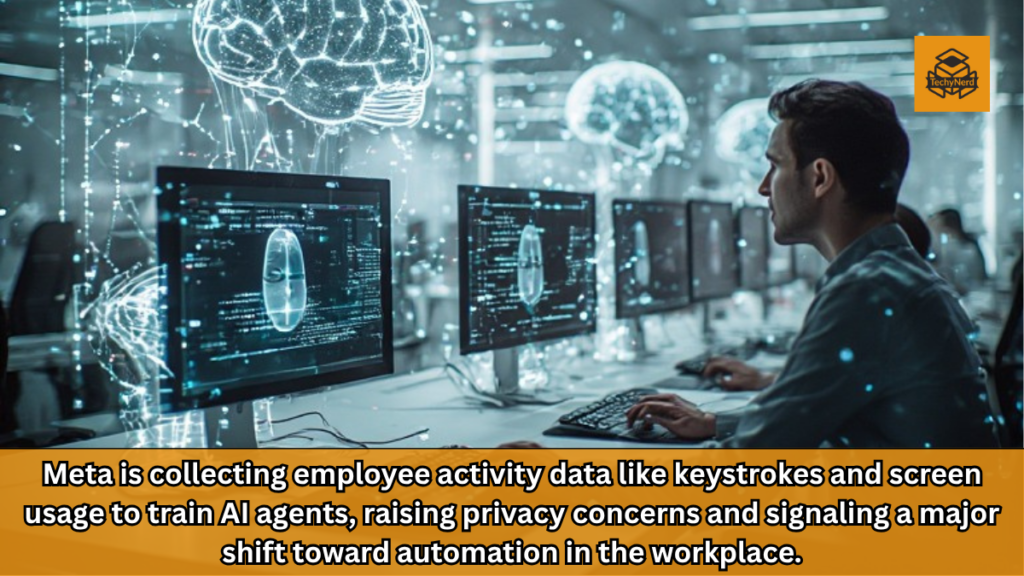
The accelerating integration of artificial intelligence into corporate ecosystems is fundamentally reshaping how organizations operate, and Meta is emerging as one of the most aggressive players in this transformation. In its latest strategic move, the company has begun deploying internal tools designed to capture employee interactions with computers, including mouse movements, keystrokes, and on-screen activity, to enhance the training of its AI systems.
This initiative represents a pivotal moment in the evolution of workplace technology, where the boundaries between productivity tools and data collection mechanisms are becoming increasingly blurred. While Meta positions this effort as essential for building more capable AI agents, it has simultaneously sparked a broader debate about privacy, ethics, and the future of white-collar work.
The Model Capability Initiative: Redefining Data Collection
At the core of this development is Meta’s Model Capability Initiative, a system designed to gather granular data on how employees interact with digital interfaces. Unlike traditional data collection methods that rely on curated datasets, this approach captures real-world behavior in real time.
The system operates across work-related applications and websites, recording detailed patterns such as how users navigate menus, execute commands, and interact with software interfaces. It also includes periodic screen snapshots, providing contextual information that can help AI models better understand complex workflows.
From a technical perspective, this represents a significant advancement in training methodologies. AI systems often struggle to replicate nuanced human behaviors, particularly in environments that require decision-making, adaptability, and contextual awareness. By leveraging live interaction data, Meta aims to bridge this gap and create models that can perform tasks with greater accuracy and autonomy.
The Vision of AI Agents in the Workplace
Meta’s broader strategy revolves around the development of AI agents capable of performing a wide range of tasks traditionally handled by human employees. These agents are envisioned as digital collaborators that can execute workflows, analyze data, and even make decisions with minimal human intervention.
The company’s leadership has articulated a future where employees transition from task execution to oversight roles, guiding and refining the performance of AI systems. This shift aligns with a growing trend across the technology industry, where automation is increasingly seen as a pathway to efficiency and scalability.
By capturing detailed interaction data, Meta is effectively building a training ground for these agents, enabling them to learn directly from human behavior. This approach mirrors the concept of apprenticeship, where systems improve by observing and replicating expert actions.
Integration with Broader AI Initiatives
The Model Capability Initiative is not an isolated effort but part of a larger framework that includes Meta’s Agent Transformation Accelerator. This program aims to integrate AI into every aspect of the company’s operations, from software development to content management.
Within this framework, employees are encouraged to incorporate AI tools into their daily workflows, even if it initially reduces efficiency. The long-term goal is to generate a comprehensive dataset that reflects a wide range of tasks and interactions, which can then be used to train more sophisticated models.
This strategy highlights a key principle in AI development: the quality and diversity of training data are critical determinants of system performance. By leveraging its own workforce as a data source, Meta is creating a feedback loop that continuously enhances its AI capabilities.
Workforce Implications and Organizational Restructuring
The introduction of AI-driven workflows is accompanied by significant changes in Meta’s organizational structure. The company is reportedly planning substantial workforce reductions, with layoffs affecting a notable portion of its global staff.
At the same time, Meta is redefining job roles, moving away from specialized positions toward more generalized roles such as “AI builder.” This shift reflects the increasing importance of interdisciplinary skills in an AI-driven environment, where employees are expected to work alongside intelligent systems.
The creation of dedicated teams focused on applied AI engineering further underscores the company’s commitment to this transformation. By concentrating resources and talent in this area, Meta aims to accelerate the development and deployment of AI solutions across its ecosystem.
Privacy Concerns and Ethical Considerations
The collection of detailed employee interaction data raises significant privacy concerns. While Meta has stated that the data will not be used for performance evaluations, the extent of monitoring involved has prompted questions about transparency and consent.
Experts in labor law and technology ethics have highlighted the potential implications of such practices. The continuous tracking of keystrokes and screen activity represents a level of surveillance that has traditionally been associated with lower-wage or gig-based roles. Extending this level of monitoring to white-collar employees marks a notable shift in workplace dynamics.
The ethical challenges are compounded by the lack of clear boundaries regarding what constitutes sensitive data. While Meta has indicated that safeguards are in place, the specifics of these protections remain अस्पष्ट, leaving room for uncertainty and चिंता.
Regulatory Landscape and Global Perspectives
The legality of workplace surveillance varies significantly across jurisdictions. In the United States, federal regulations provide limited restrictions on employer monitoring, allowing companies considerable latitude in implementing such systems.
However, the situation is markedly different in other regions. In Europe, data protection laws such as the General Data Protection Regulation impose strict requirements on data collection and processing. Practices like keystroke logging and screen monitoring may face significant legal challenges under these frameworks.
Countries such as Italy and Germany have already established stringent قوانین governing workplace surveillance, limiting the circumstances under which such measures can be employed. These differences highlight the complexity of implementing global strategies in a diverse regulatory environment.
Industry Trends and Competitive Pressures
Meta’s move is part of a broader trend in the technology sector, where companies are increasingly leveraging AI to optimize operations and reduce costs. Organizations across industries are exploring ways to automate workflows, improve efficiency, and gain a competitive edge.
This trend is driving significant निवेश in AI infrastructure and research, as well as a reevaluation of workforce strategies. Companies are balancing the potential benefits of automation with the सामाजिक and ethical implications of reducing human involvement.
The competitive landscape is also influencing these decisions. As AI capabilities advance, companies that fail to adopt these technologies risk falling behind. This creates a strong incentive to experiment with new approaches, even if they involve untested or controversial methods.
The Future of Work: Human-AI Collaboration
The integration of AI into the workplace is likely to redefine the nature of work itself. Rather than replacing human workers entirely, AI systems are expected to augment human capabilities, enabling more efficient and effective performance.
In this context, the role of employees may shift toward oversight, creativity, and strategic decision-making. Routine tasks could increasingly be handled by AI agents, freeing up human resources for more complex and value-added activities.
However, achieving this balance will require careful consideration of both technical and सामाजिक factors. Ensuring that employees are equipped with the skills needed to work alongside AI systems will be critical to the success of this transition.
Balancing Innovation and Responsibility
Meta’s initiative highlights the tension between innovation and responsibility in the technology industry. On one hand, the company is pushing the boundaries of what AI can achieve, exploring new methods for training and deployment. On the other hand, it must address the ethical and सामाजिक implications of its actions.
Building trust will be essential for the long-term success of such initiatives. This includes providing clear communication about data collection practices, ensuring robust safeguards, and engaging with stakeholders to address concerns.
Conclusion: A Transformational Yet Controversial Step
Meta’s decision to collect detailed employee interaction data for AI training represents a significant خطوة in the evolution of workplace technology. It underscores the growing महत्व of data in driving AI advancements and highlights the कंपनी’s commitment to leading this transformation.
At the same time, it raises important questions about privacy, ethics, and the भविष्य of work. As companies continue to explore the potential of AI, finding the right balance between innovation and responsibility will be crucial.
The outcome of this initiative will likely influence not only Meta’s trajectory but also broader industry practices, shaping how organizations approach AI integration in the years to come.
FAQs
1. What is Meta’s Model Capability Initiative?
It is a system designed to collect employee interaction data to improve AI model training.
2. What kind of data is being collected?
Mouse movements, keystrokes, clicks, and occasional screen snapshots.
3. Why is Meta collecting this data?
To train AI agents to better replicate human computer interactions.
4. Will the data be used for performance reviews?
Meta states it will not be used for performance evaluations.
5. What are AI agents in this context?
Software systems designed to perform tasks autonomously using AI.
6. Are there privacy concerns?
Yes, experts warn about increased workplace surveillance and data misuse risks.
7. Is this legal globally?
Legality varies; stricter regulations exist in Europe compared to the U.S.
8. How does this affect employees?
It may change job roles and increase monitoring in daily work activities.
9. What is Meta’s long-term goal?
To create AI systems that can perform most work tasks autonomously.
10. What does this mean for the future of work?
It signals a shift toward human-AI collaboration and increased automation.